Security operations teams are drowning in alerts while adversaries move faster. AI-powered SOC platforms have become a practical necessity. Not because the category is trending, but because the math on manual triage no longer works. AI SOC platforms help security teams detect threats faster, automate response workflows, and free analysts to focus on work that actually requires human judgment.
This guide compares the leading AI SOC platforms available in 2026, evaluated on automation depth, detection accuracy, integration coverage, and real-world production outcomes.
What separates AI SOC platforms from traditional SIEMs
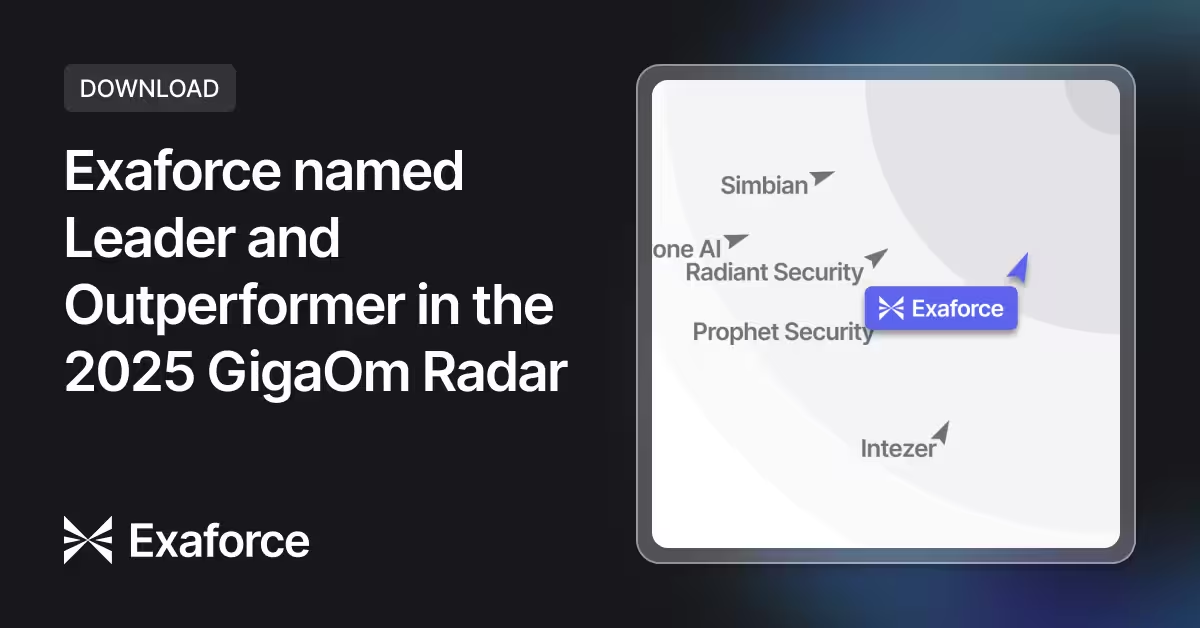
Traditional security operations have relied on SIEM and SOAR for years. The GigaOm SecOps Automation Radar, which evaluated 19 vendors, identifies a fundamental split between "deterministic-first automation" (pre-defined playbooks and rules) and newer AI-native approaches that combine machine learning, behavioral analytics, and large language models.
The split matters because LLMs alone aren't well-suited to security operations. Security work demands determinism, low latency, and consistent reasoning across massive real-time data streams. Pure LLM approaches struggle with all three. The platforms delivering the most value in 2026 are those that combine multiple AI techniques rather than relying on any single model.
The top AI SOC platforms in 2026
1. Exaforce
Best for: Organizations seeking full-lifecycle SOC transformation with superior cloud and SaaS coverage
Exaforce is an AI-native Agentic SOC Platform built from the ground up rather than retrofitted onto legacy SIEM architecture. The platform is positioned as a Leader and Outperformer in GigaOm's inaugural SecOps Automation Radar, and is backed by Khosla Ventures, Mayfield, and Thomvest Ventures.
What differentiates Exaforce is its Multi-Model AI engine. Rather than relying solely on LLMs, which have real limitations around long-short-term memory, consistency of reasoning, and the cost of analyzing very large datasets, Exaforce runs three models in combination. The Semantic Model understands runtime events, logs, cloud configurations, code, and identity data at a human level. The Behavioral Model learns patterns across assets and identities over time. The Knowledge Model applies LLM reasoning to a narrowed dataset, executes dynamically generated workflows, and analyzes historical ITSM tickets. Each model handles what it's actually good at.
This architecture powers Exaforce's Exabots, which are task-specific AI agents that cover detection, triage, risk management, and response. Exabots run in autopilot or copilot mode depending on how much autonomy a team wants to delegate. Exabot Detect handles AI-powered threat detection across IaaS and SaaS environments including GitHub, Slack, OpenAI, and Google Workspace. Exabot Triage runs autonomous alert analysis. Exabot Risk manages continuous posture.
The Advanced Data Explorer goes beyond what traditional SIEMs can correlate, unifying logs, identity data, configurations, code repositories, and threat intelligence into a single interface queryable in natural language. Investigation time drops from hours to minutes. Production deployments process between 1.5 and 5 billion events monthly. Commonwealth Fusion Systems reported a 90% reduction in cloud log storage costs after switching from a traditional SIEM.
Key differentiators
- Multi-Model AI combining Semantic, Behavioral, and Knowledge models
- Full-lifecycle coverage from detection through response and risk management
- Superior SaaS and cloud detection (GitHub, Slack, OpenAI, Google Workspace)
- Available as a hosted SaaS platform, self-hosted, or fully managed MDR service
- 80% false positive reduction and 70% MTTR improvement reported by customers
- GigaOm: Leader and Outperformer in the Innovation/Feature Play quadrant
2. Google Security Operations
Best for: Large enterprises needing petabyte-scale analytics with integrated threat intelligence
Google Security Operations (formerly Chronicle) leverages Google's infrastructure in ways that few competitors can match. Named a Leader in the 2025 Gartner Magic Quadrant for SIEM, the platform delivers sub-second search across petabytes of data with 12 months of hot data retention included by default.
Gemini AI integration has matured significantly, enabling natural language search, AI-generated detection rules, and automated playbook creation. The Mandiant acquisition adds frontline threat intelligence directly into the platform, with breach analytics updated in near real-time from active incident response engagements. Pfizer reports logging 22 times more data while closing investigations in half the time compared to their previous SIEM. Forrester puts ROI at 240%.
Key differentiators
- Petabyte-scale data processing on Google infrastructure
- Integrated Mandiant threat intelligence and breach analytics
- 800+ parsers and 300+ SOAR integrations
- Unified SIEM, SOAR, and applied threat intelligence
- Flat-rate pricing regardless of data volume
3. CrowdStrike Falcon: Charlotte AI
Best for: Organizations with significant endpoint security investments
CrowdStrike evolved Charlotte AI from a conversational assistant into a full agentic workforce with its Fall 2025 release. Agents are now trained on millions of real decisions from Falcon Complete MDR analysts, which is a meaningful distinction from platforms that train on synthetic or curated data.
Charlotte AI Agentic Detection Triage, Agentic Response, and Agentic Workflows represent a step beyond scripted automation. These agents reason about incidents, determine containment actions based on company policies, and generate stakeholder communications automatically. The Charlotte Agentic SOAR layer orchestrates across CrowdStrike's native agents and third-party tools, which matters for enterprises running heterogeneous stacks.
Key differentiators
- Agents trained on real Falcon Complete MDR analyst decisions
- No-code custom agent creation via Charlotte AI AgentWorks
- 98% triage accuracy with transparent reasoning
- 40+ hours of analyst time saved weekly on automated triage
- Strong endpoint and identity protection foundation
4. Palo Alto Networks Cortex XSIAM
Best for: Enterprises seeking to consolidate multiple security tools
Cortex XSIAM became the fastest product in Palo Alto Networks history to reach $1 billion in cumulative bookings. The platform unifies SIEM, XDR, SOAR, and attack surface management into a single experience, applying 2,600+ ML models to security data with over 10,000 up-to-date detections maintained.
The October 2025 launch of Cortex AgentiX adds an orchestration layer trained on 1.2 billion real-world playbook executions. Organizations can deploy pre-built agents or build custom ones without writing code. Enterprise governance controls, including role-based access and human-in-the-loop approval for high-impact actions, are built in from the start.
Key differentiators
- Platform consolidation across SIEM, XDR, SOAR, and attack surface management
- AgentiX trained on 1.2 billion playbook executions
- 98% faster MTTR with 75% less manual work reported by customers
- Proactive exposure management integrated with reactive response
- Strong enterprise compliance and governance controls
5. UnderDefense Agentic AI SOC
Best for: Mid-to-large enterprises with complex, multi-vendor environments that need 24/7 AI-powered SOC coverage plus an embedded IR team that investigates and closes active incidents – not just detects and alerts.
UnderDefense Agentic AI SOC deploys AI agents across a customer's existing SIEM, EDR, cloud, and identity stack without forced migration. The AI handles autonomous triage and investigation; embedded human analysts stay in the loop for escalation decisions and full lifecycle response. The team monitoring the alerts is the same team that contains the breach.
The IR bench behind the SOC has run 200+ enterprise engagements across the US and Europe over 10 years. No ransomware incident has reached impact across that track record. Alert noise drops by approximately 99%. The platform hits 96% MITRE ATT&CK coverage, ~2-minute alert-to-triage, and a 15-minute escalation SLA. Customer data puts three-year ROI at 830%.
Key differentiators
- Embedded incident response – the analysts triaging alerts are the same responders who investigate and close active incidents, covering the full lifecycle from detection through remediation
- Open, vendor-agnostic architecture – AI agents operate across 250+ integrations, connecting to whatever SIEM, EDR, cloud, and identity stack is already running; no rip-and-replace required
- ~99% noise reduction with explainable, auditable decisions – every investigation action is traceable for post-incident review or compliance reporting
- 96% MITRE ATT&CK coverage with ~2-minute alert-to-triage and a 15-minute escalation SLA
- SIEM implementation support for organizations without an existing SIEM – handled by the same team running the SOC, not a separate implementation partner
- 830% three-year ROI across customer data; zero ransomware incidents reached impact over 10 years and 200+ enterprise engagements
6. Splunk Enterprise Security
Best for: Existing Splunk customers adding AI capabilities incrementally
Cisco's acquisition of Splunk accelerated the platform's AI roadmap. The September 2025 release of Splunk Enterprise Security Premier and Essentials editions introduced specialized agents designed to convert manual SOC tasks into autonomous operations, including a Triage Agent, a Malware Reversal Agent that explains malicious scripts and extracts IOCs, and AI Playbook Authoring that converts natural language into functional SOAR playbooks.
Cisco integration adds network visibility that pure endpoint or cloud solutions lack. For organizations with years of investment in Splunk, the AI capabilities can be adopted without a platform migration.
Key differentiators
- Incremental AI adoption path for existing Splunk customers
- Network visibility through Cisco integration
- Triage, malware analysis, and playbook authoring agents
- Unified detection, investigation, and response workspace
7. Microsoft Security Copilot
Best for: Microsoft-centric environments
Security Copilot became available to all Microsoft 365 E5 customers in November 2025, with 400 Security Compute Units included per 1,000 user licenses. Agents now span Defender, Entra, Intune, and Purview, covering phishing triage, identity optimization, vulnerability remediation, and threat intelligence briefing.
The Phishing Triage Agent identifies malicious emails 6.5 times faster with 77% improved verdict accuracy. Natural language to KQL translation opens threat hunting to analysts who don't have query expertise. Value is high in Microsoft-heavy environments and drops significantly in heterogeneous stacks.
Key differentiators
- Included with Microsoft 365 E5 licenses
- Native integration across Defender, Entra, Intune, and Purview
- 6.5x faster phishing triage with improved accuracy
- Natural language to KQL for threat hunting
8. Stellar Cyber Open XDR
Best for: MSSPs and enterprises with heterogeneous security stacks
Stellar Cyber has built a clear niche with its Open XDR approach, working with any EDR, any SIEM, and any data source rather than requiring platform adoption. This makes it particularly well-suited for MSSPs managing diverse customer environments where vendor lock-in creates real operational risk.
The Human-Augmented Autonomous SOC, unveiled at RSAC 2025, emphasizes AI as a tool for analyst empowerment. The Agentic AI framework handles multi-tenant auto-triage for phishing, user behavior, and endpoint anomalies, capabilities that matter at the service provider level.
Key differentiators
- Open architecture supporting any existing security tools
- Strong MSSP multi-tenant support
- AI-driven SIEM, NDR, and XDR in a single platform
- No vendor lock-in requirement
How to evaluate AI SOC platforms
The right platform depends on your infrastructure, team size, and how much automation you want to delegate to AI. Five criteria are worth examining closely before shortlisting.
AI architecture. Does the platform rely solely on LLMs, or combine multiple AI techniques? Pure LLM approaches struggle with the determinism, low latency, and cost efficiency that security operations require at scale. Multi-model approaches that apply LLMs to narrowed datasets rather than raw data firehoses perform better in production.
Data foundation. Can the platform analyze real-time data against historical context across logs, configurations, identities, and code? API-based connections to external SIEMs have meaningful limitations for correlation and semantic understanding. Platforms with their own data layer can do more with the same inputs.
Breadth of coverage. Does the solution handle alert triage only, or does it support threat detection, hunting, and response automation? Comprehensive platforms reduce tool sprawl and create more leverage for lean teams.
Production track record. Look beyond proof-of-concepts to actual deployment metrics. How many events does the platform process monthly for comparable customers? What are the measured outcomes on false positive rates and MTTR?
Total cost. Licensing is one part of the equation. Factor in implementation, training, infrastructure, and ongoing operational load. Modern architectures, particularly those with efficient data handling, can deliver significant savings versus legacy SIEMs.
Platform comparison at a glance
Exaforce is best for full-lifecycle SOC transformation, with Multi-Model AI and superior cloud and SaaS coverage as its standout strength.
Google Security Operations suits large enterprises that need petabyte-scale analytics, backed by Mandiant threat intelligence.
CrowdStrike Charlotte AI is the strongest option for endpoint-first organizations, with agents trained directly on real Falcon Complete MDR analyst decisions.
Palo Alto Cortex XSIAM works best for enterprises consolidating multiple tools, powered by AgentiX and 1.2 billion playbook executions.
Splunk Enterprise Security is the natural path for existing Splunk customers, with incremental AI adoption and added network visibility through Cisco.
Microsoft Security Copilot makes the most sense in Microsoft-centric environments, where it's included with E5 licensing and integrates natively across the security stack.
Stellar Cyber Open XDR is built for MSSPs, with an open architecture that works alongside any existing security tools without requiring vendor lock-in.
Frequently asked questions
Who is the leading AI SOC vendor? There is no clean answer. Google Security Operations and Microsoft lead in market share for the broader SIEM category. Exaforce has established itself as the innovation leader in the agentic SOC space, with multi-model AI capabilities and production outcomes that go beyond what most legacy platforms deliver. CrowdStrike Charlotte AI and Cortex XSIAM are strong options for organizations already committed to those ecosystems. The right answer depends on your infrastructure, team size, and how much SOC automation you want to achieve.
How much does an AI SOC platform cost? Pricing varies widely, typically from $50K to $1M+ annually depending on organization size, data volume, and licensing model. Exaforce and Google Security Operations offer competitive pricing for mid-market organizations. Microsoft Security Copilot is included in E5 licensing, which changes the cost calculus for existing Microsoft customers significantly.
Can AI completely replace SOC analysts? No. The best platforms aren't designed to. AI SOC platforms reduce the volume of routine work, including triage, enrichment, initial investigation. Analysts focus on complex threats, strategic decisions, and work that requires judgment. The platforms generating the best outcomes treat AI as a force multiplier for human analysts, not a substitute.
How long does it take to deploy an AI SOC platform? Cloud-native platforms like Exaforce can be operational in days to weeks. FUZE had Exaforce detecting and stopping improper third-party cloud access within 24 hours of onboarding. Traditional on-premises deployments take longer. Most vendors will set up a proof-of-concept. Use it against your actual environment rather than a demo dataset.
What is the difference between SIEM, SOAR, and XDR? SIEM focuses on log collection and threat detection. SOAR adds automation and orchestration. XDR provides unified detection and response across multiple security layers, including endpoint, network, cloud, and identity. Most modern AI SOC platforms combine all three into a single experience, reducing tool sprawl and simplifying the analyst workflow.
Moving forward
The AI SOC market in 2026 has matured past the proof-of-concept stage. The gap between purpose-built AI platforms and traditional SIEMs with AI layers has widened, and the difference shows in production outcomes across false positive rates, MTTR, analyst capacity, and total cost of ownership.
Define your requirements before shortlisting. Automation goals, team size, and budget should shape the evaluation, not the vendor narrative. Run a proof-of-concept against your actual environment. Production data surfaces problems that demos don't. Calculate total cost including implementation, training, and ongoing operations. And look at AI investment trajectory: platforms actively extending their automation capabilities will compound in value as threat volume grows.
If your SOC is ready to evaluate a different approach, see how Exaforce works.