Log inRequest demo

Exabot Investigate

Your AI threat hunting partner, one question away

Traditional SIEMs require complex queries and manual correlation across siloed tools. Exabot Investigate turns investigations into a conversation. Ask in natural language and visually explore real-time logs and configs across cloud, SaaS, identity, endpoint, network, and code systems.

Request demo
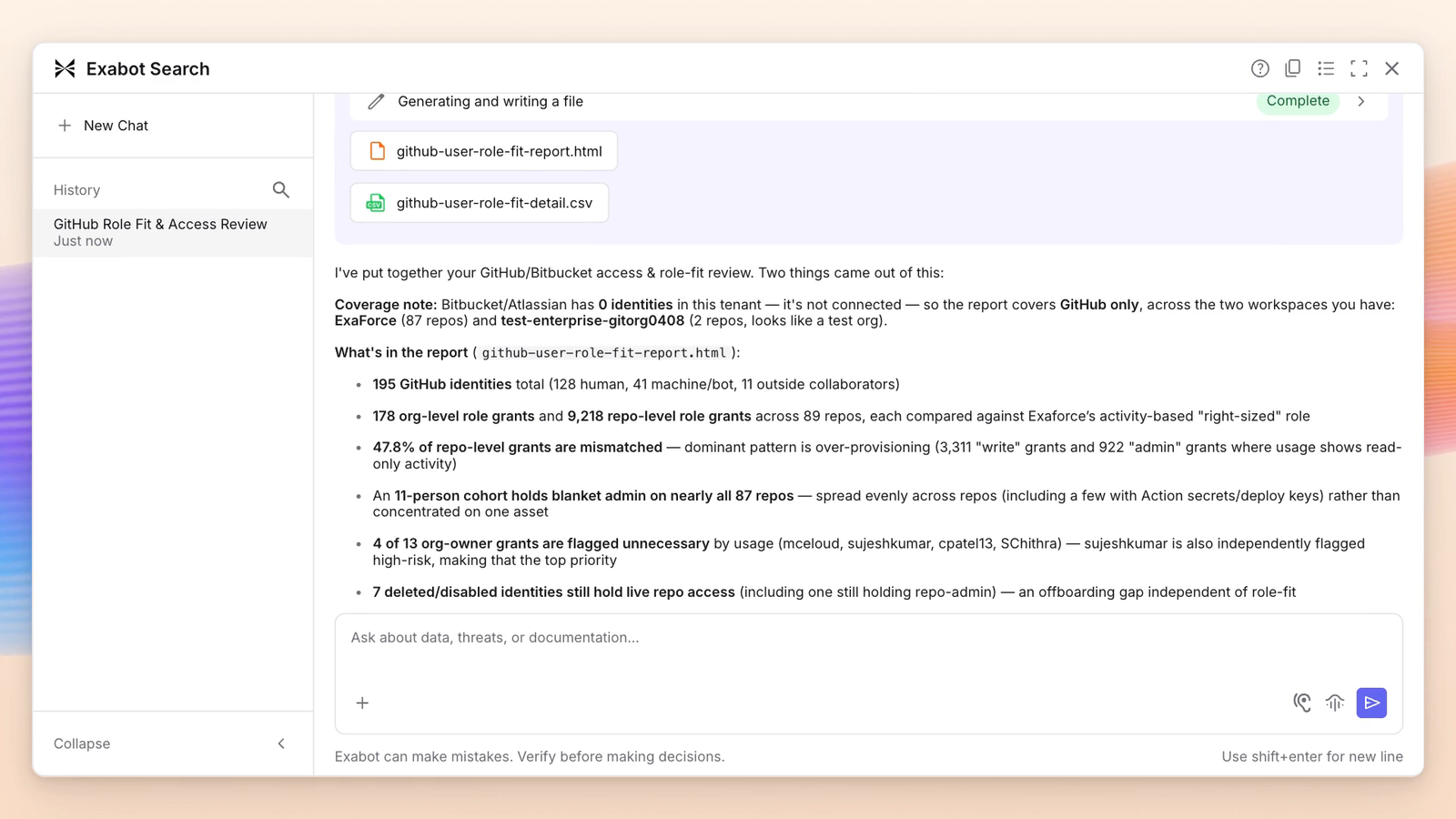
Exabot Search returning a completed GitHub role-fit and access review, with the generated report and CSV attached and the findings summarized beneath them.

Simplified, faster investigations and threat hunting

Exabot Investigate supports natural language search, visual exploration, and simplified queries across your data sources. Analysts of any skill level can hunt threats and investigate incidents without mastering complex SIEM query languages or source-specific schemas.

Deep understanding of your systems

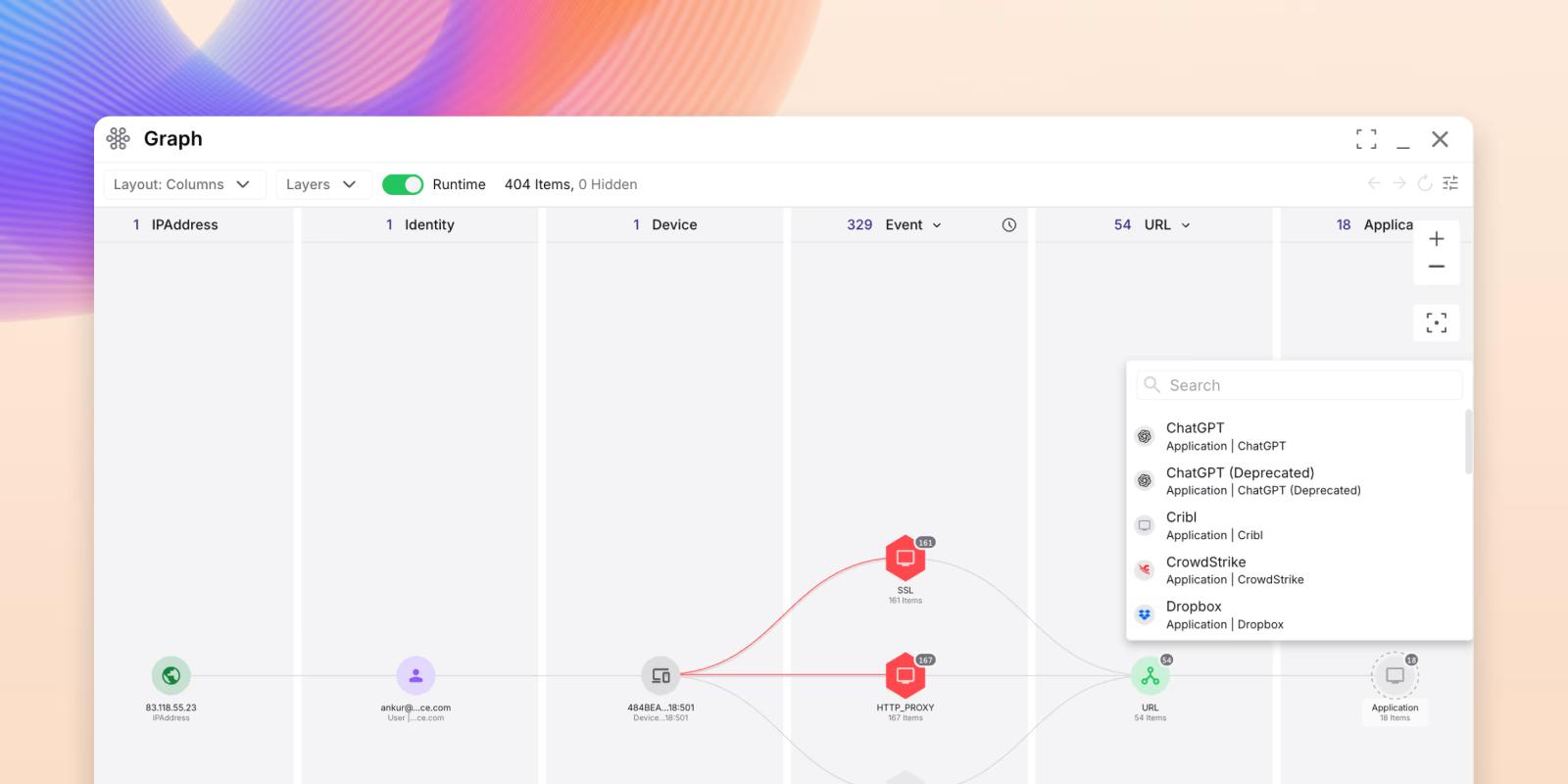
Exabot's Semantic Model resolves entities and relationships across all connected sources automatically mapping users to cloud identities, linking resources to sensitivity classifications, and correlating actions across systems. Analysts can investigate complex scenarios without domain expertise in AWS, GCP, Okta, GitHub, Office 365, OpenAI, or any platform, focusing on threat analysis.
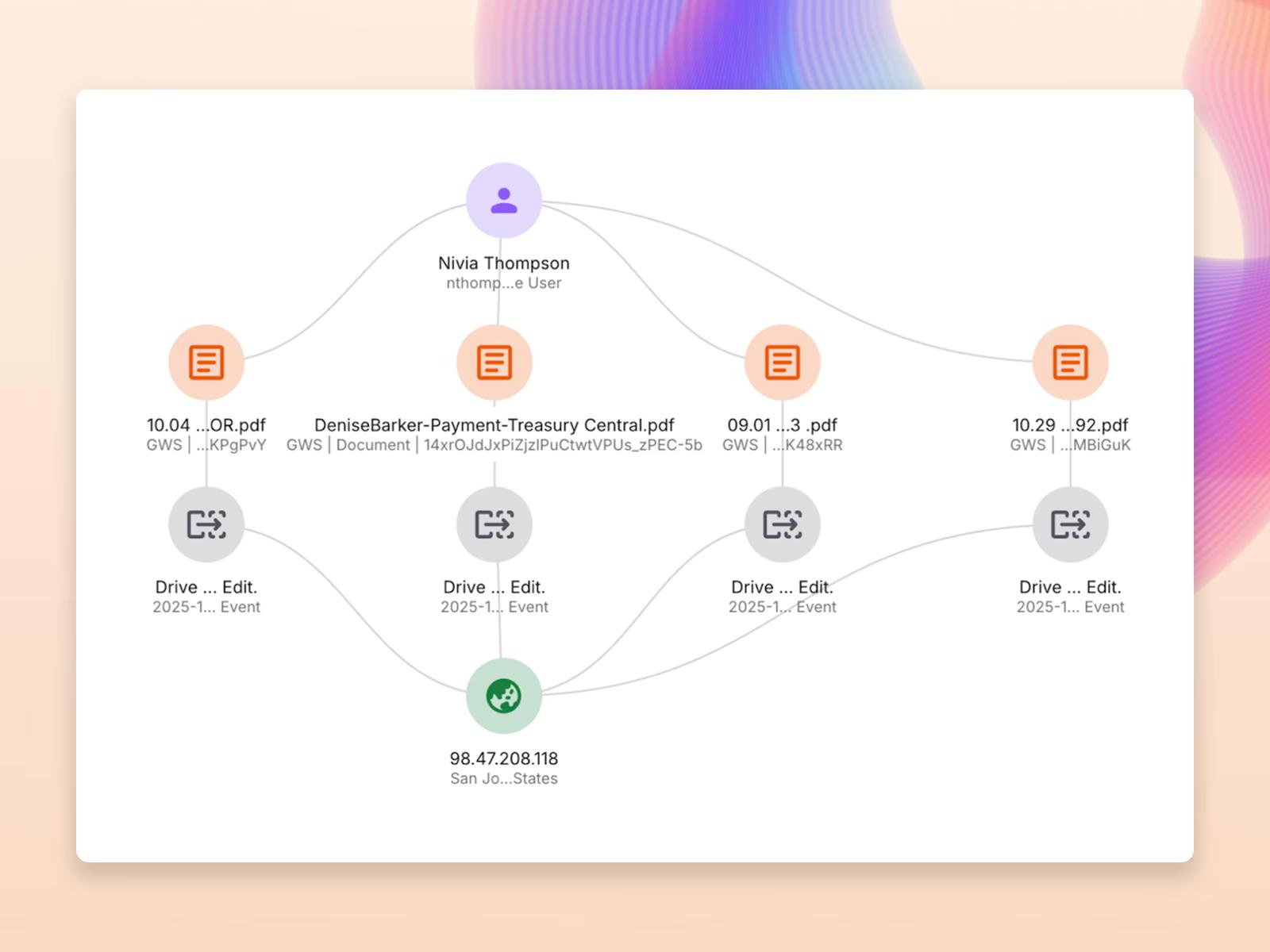
Graph close up

Turn simple questions into deep investigations

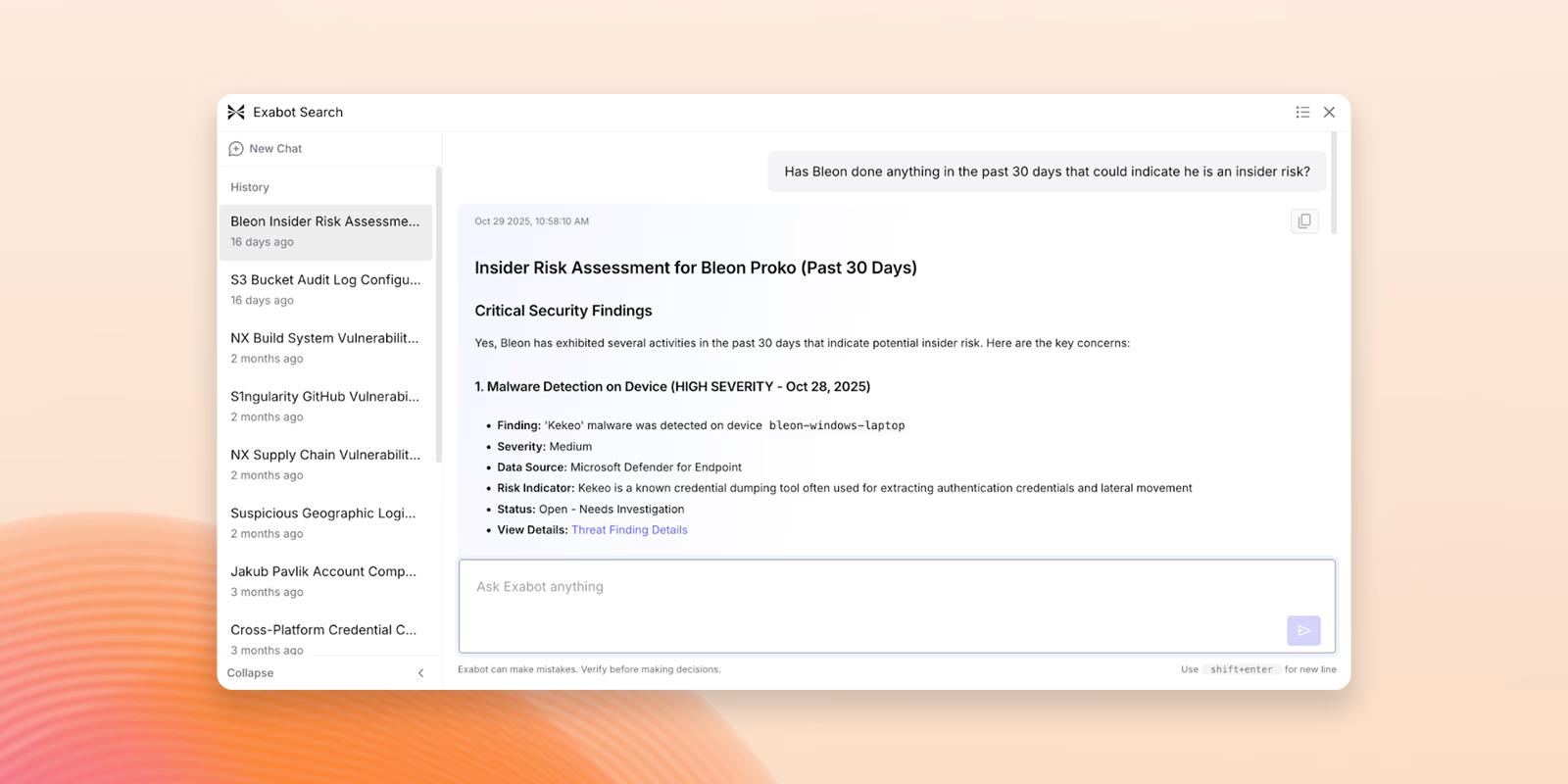
Search across any entity, such as users, endpoints, resources, and events, and ask complex, conversational questions that correlate runtime activity with configuration state. Investigate incidents and threat hunt faster with answers enriched by internet context, including IOC reputation checks, threat intelligence feeds, security research blogs, and vulnerability databases. Every response includes full source attribution for transparency and auditability.

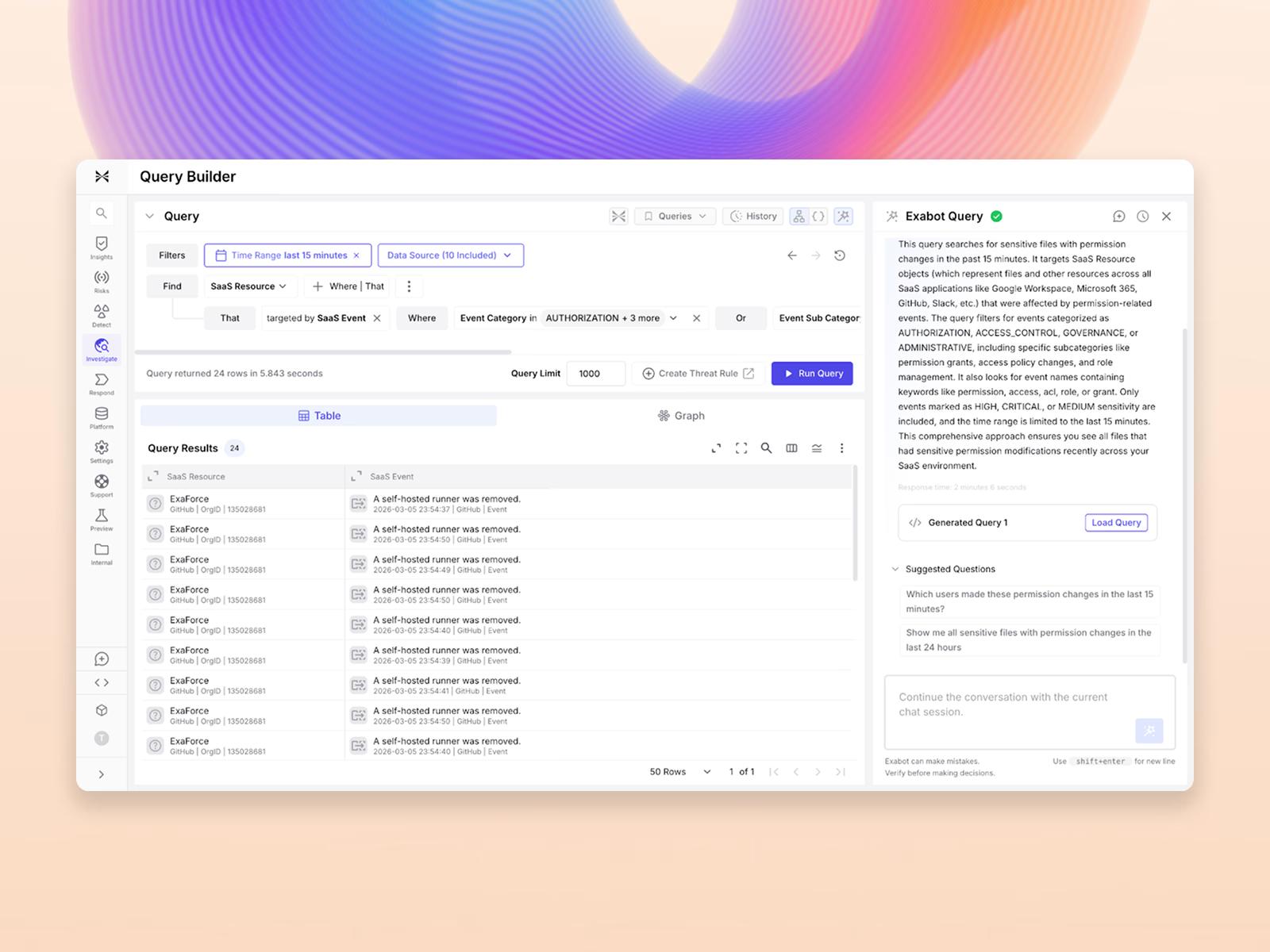
Query builder page

Easier investigations and threat hunts, even in complex scenarios

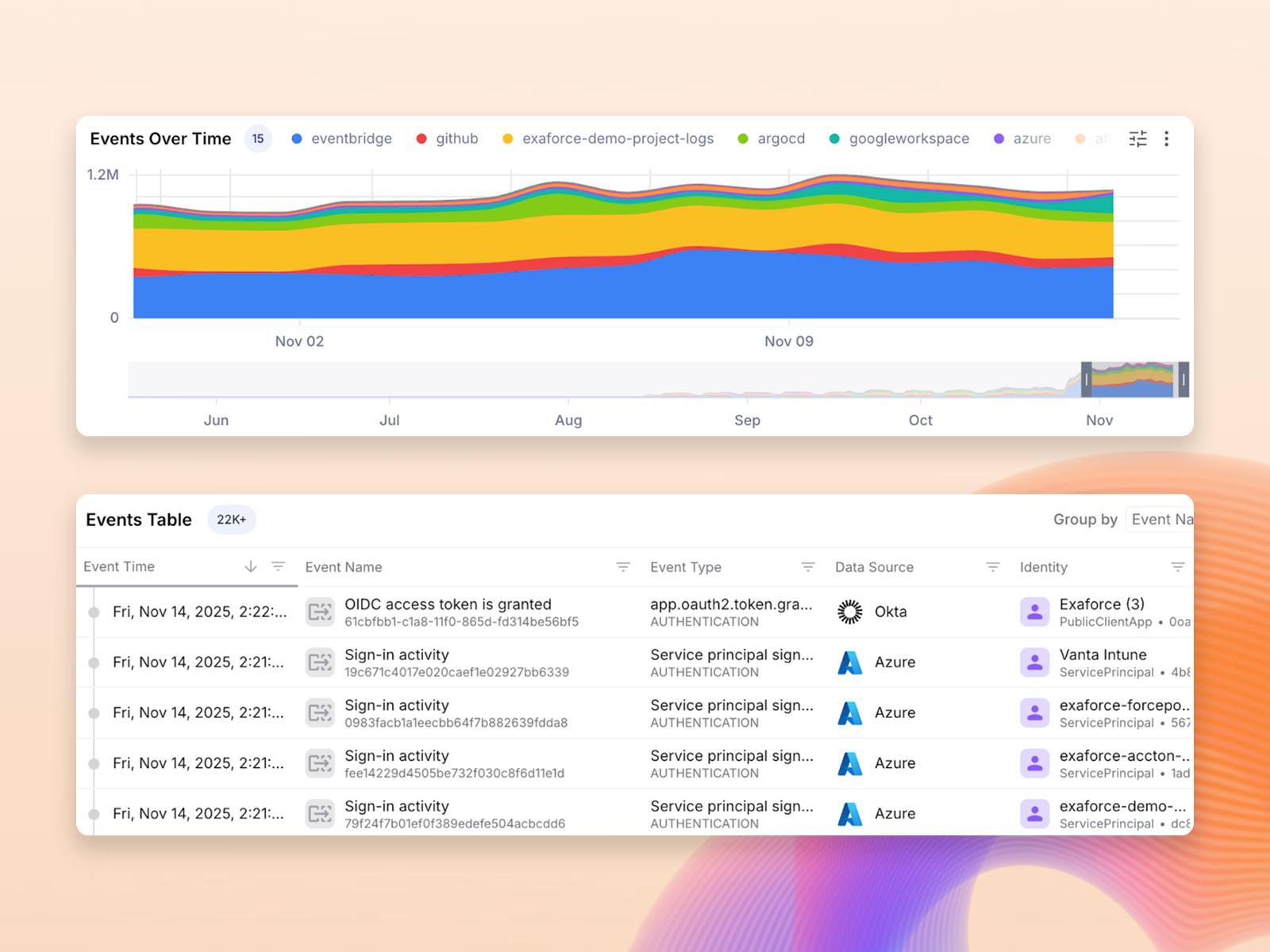
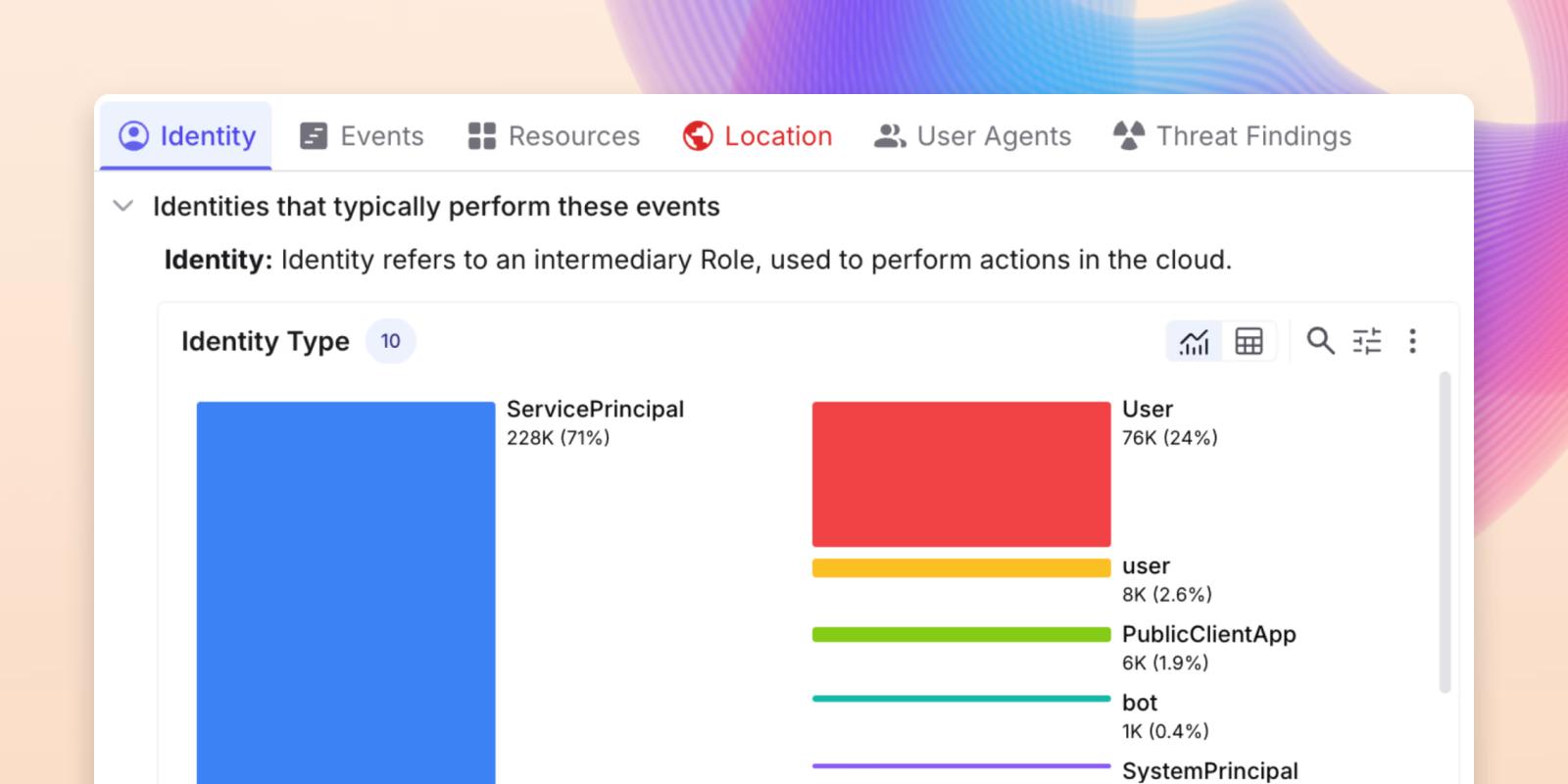
Pre-curated dashboards for every entity automatically surface correlated context. Explore visually with click-to-filter dimensions, drag-to-zoom time ranges, and pivots across related entities. Cross-filter by user, location, resource, and time, then drill from summaries to raw events in one click. Spot suspicious patterns faster and export complete investigations with supporting evidence.

Events over time chart and events table

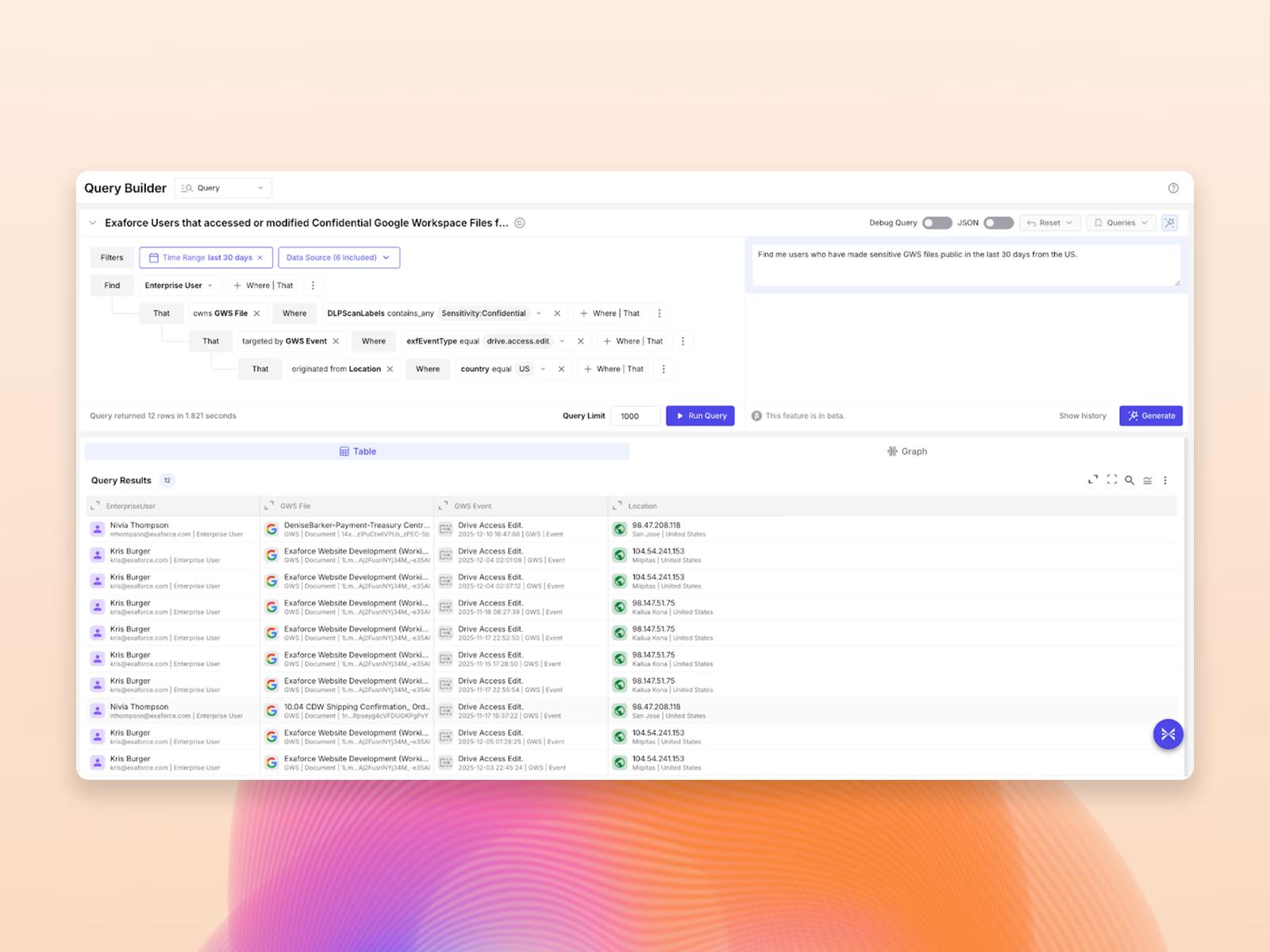
Unified query builder for events and configuration

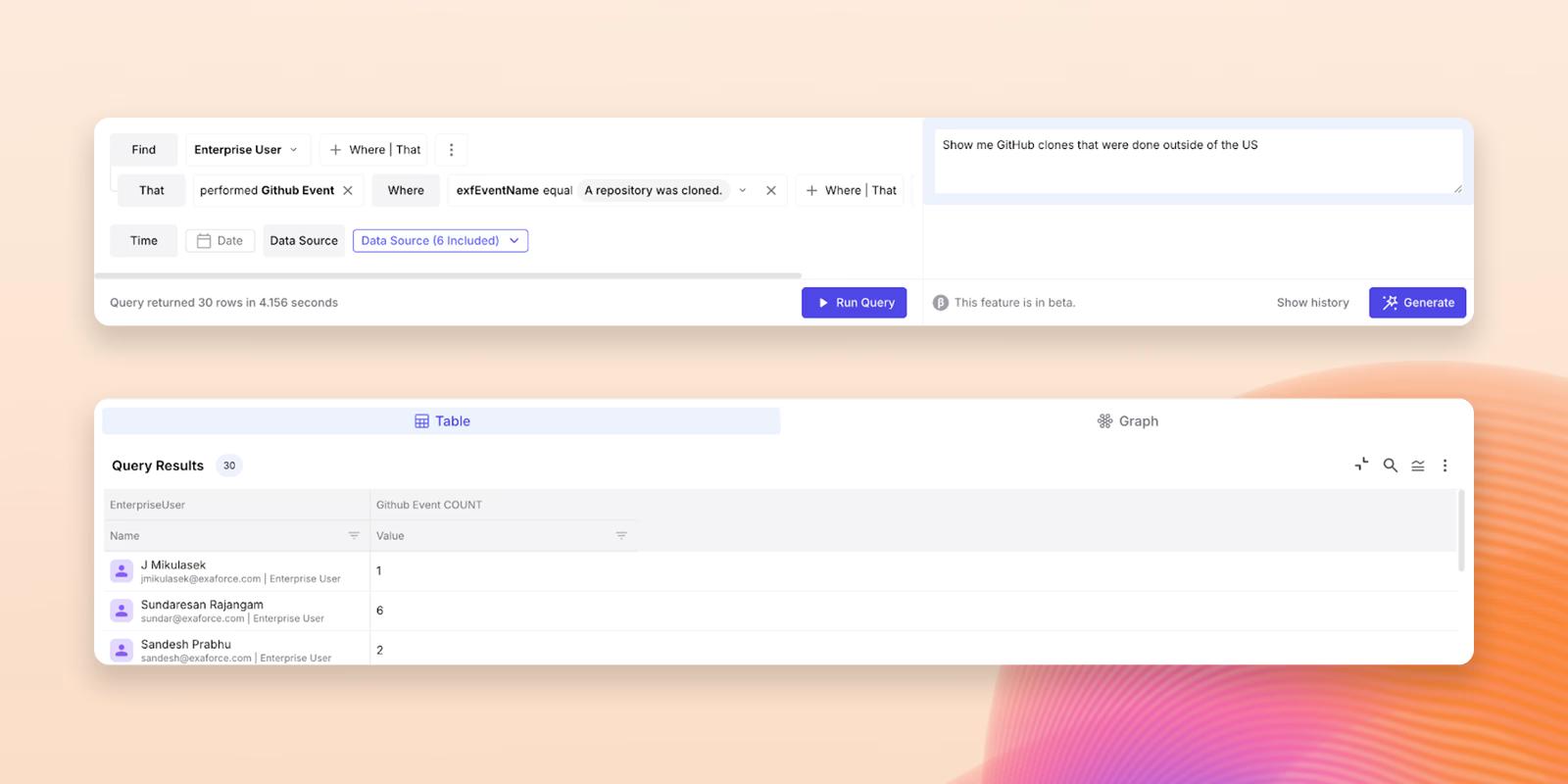
SIEM query languages take months to learn and produce brittle queries that break when schemas change. Build powerful queries using natural language and/or simple dropdowns. Query Builder lets you combine behavioral events and configuration context (identity, permissions, SaaS settings, cloud resources, etc.) into a single query so you can correlate “what changed” with “what happened”.

Query builder

Featured investigation capabilities

Purpose-built to answer the questions a senior analyst would automatically

Visual Exploration

Visually explore connected identities, configs, events, resources and more.

Exabot Search

Ask questions in plain English and get answers with linked evidence, no complex query language required.

Investigate

Deep dive into sessions, events, resources, and more with intuitive pivoting.

Query Builder

Dig into behavior and events combined with configuration context in a simplified way.

Effective Permissions

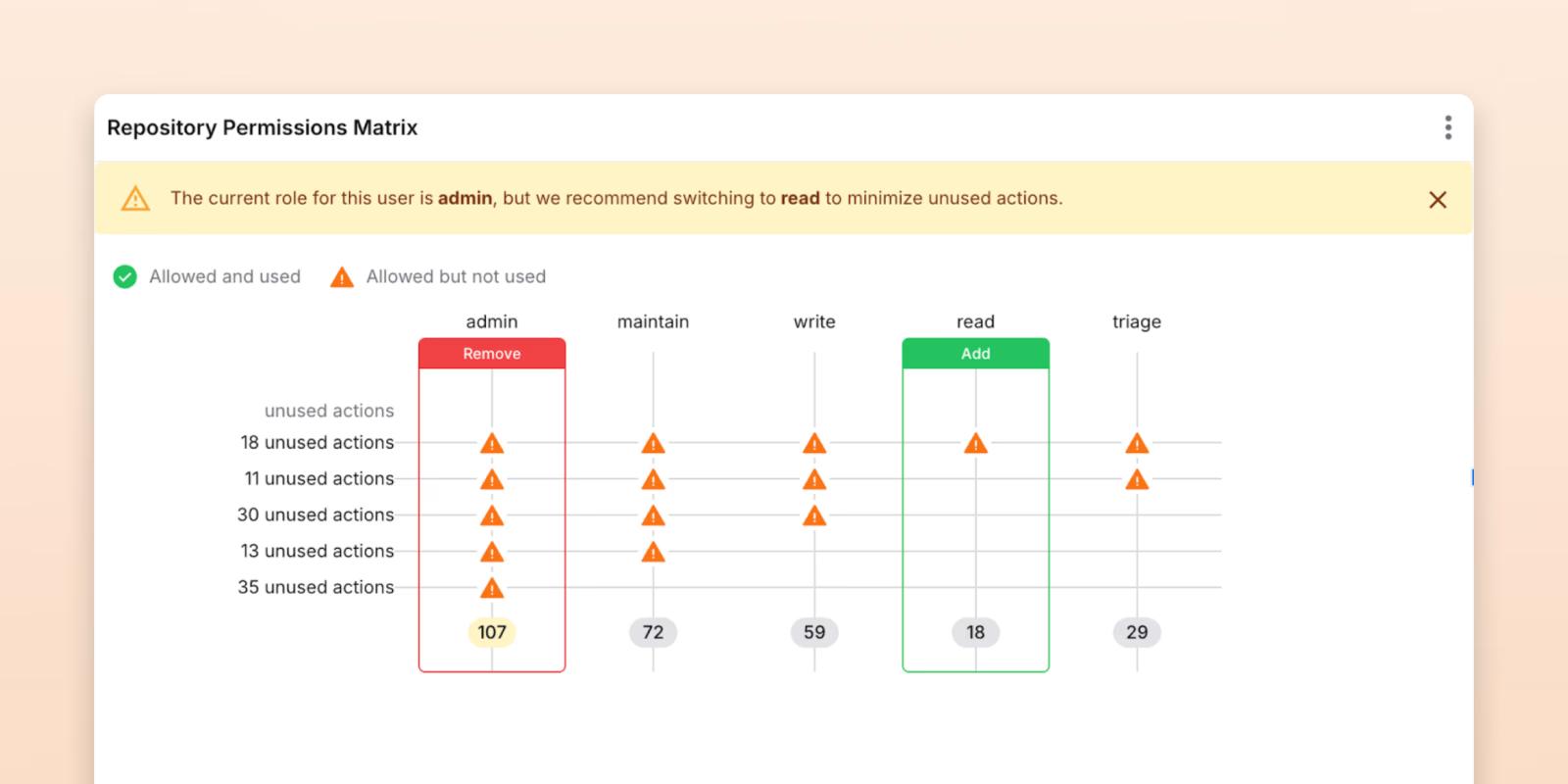
Visualize identity chains and effective permissions across cloud and SaaS to show how access was obtained and used.

Function Health

AI-driven analysis is essential for modern security operations, and Exaforce demonstrates how AI can act as a true investigation partner. The company's platform enables our team to operate with the depth and context that traditionally requires a full SOC and significant manual effort, helping us to scale our security efforts to meet our growing needs.

Dan Borkowski

SVP, Security & IT at Function Health

Frequently asked questions

Does it work without a SIEM?
Yes, Exabot Investigate operates independently of any SIEM. Exaforce ingests detections and raw signals directly from cloud, SaaS, identity, endpoint, and code sources into a real-time data warehouse, and can also enrich alerts from your existing SIEM. If you have already invested in a SIEM, Exaforce augments it with advanced investigation capabilities it lacks, especially for real-time analysis on the last 90 days of data in our in-memory database, while you can continue to use the SIEM for long-term historical storage.
How does this help analysts who aren’t cloud experts?
Exabot embeds domain expertise across major security platforms and identity systems, so analysts can ask plain-English questions instead of learning specialized query languages. For example, it can automatically interpret concepts like AWS IAM roles and policies, GCP service accounts, Okta authentication events, and GitHub or Google Workspace permissions. It also gathers and correlates context across systems to eliminate manual lookups, enabling junior analysts to investigate complex incidents immediately without years of platform-specific training.
How is Exabot Investigate different from searching in a SIEM or SOAR?
SIEMs require mastering complex query languages, such as SPL, KQL, SQL, and operate only on log data. You have to manually correlate identity, configuration, and behavioral context across multiple tools. Exabot Investigate provides natural language search and visual exploration across unified data, including logs, identity, config, and baselines. Investigations that take 30-60 minutes in traditional SIEMs take 3-5 minutes in Exaforce, with complete context automatically correlated.
What makes the conclusions “explainable”?
Every finding includes plain-English rationale, detailed evidence, and complete source attribution (event IDs, entities, resources), with links back to the underlying systems and logs. You can drill down into any entity and see exactly how the conclusion was reached, including the data examined and the underlying query.
Will this actually reduce investigation time?
Yes. Exabots handle the heavy lifting, grouping related alerts, building timelines, answering follow-ups in natural language, cutting investigation time from hours to minutes.