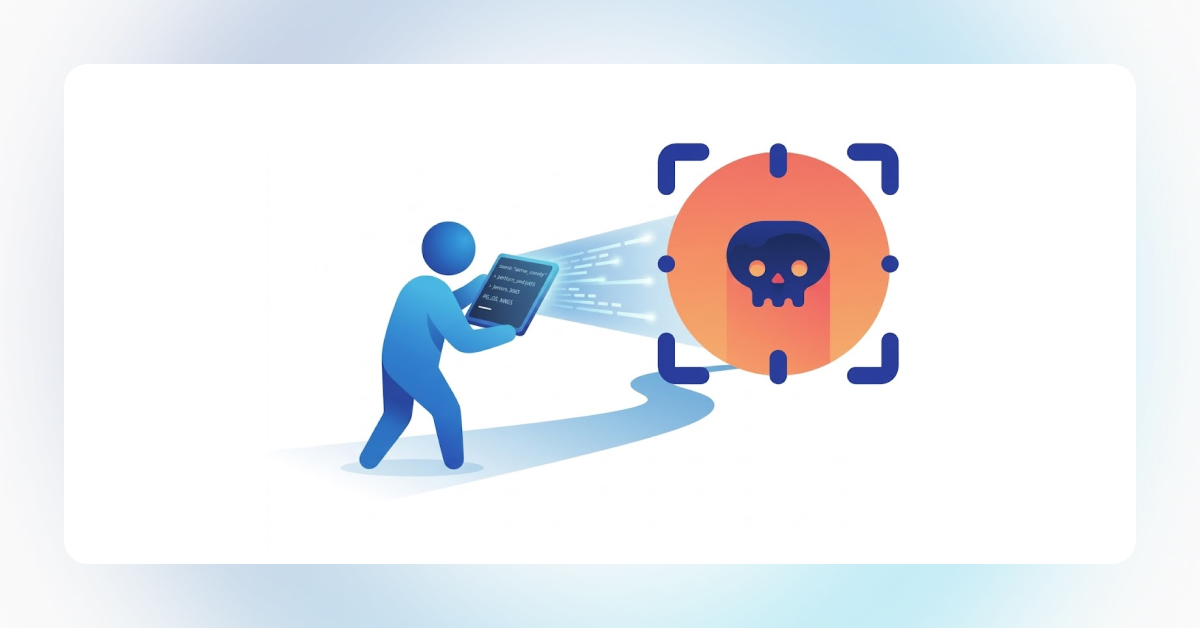




If you look at the cybersecurity strategies of most mature security organizations right now, they are built on a premise that assumes that if we can just verify who the user is, we can trust what they do. That premise is dead.
By 2026, the industry will be forced to reckon with a reality where the "front door" is the least interesting part of the attack surface. We are moving into an era of high-velocity, identity-centric compromise where attackers simply log in instead of breaking in. Instead of deploying malware, they abuse native workflows, and they do it faster than a weekly vulnerability scan can spin up.
Here is what we expect to see change in the security landscape in 2026.
1. Identity attacks surpass malware
For the first time, identity-based attacks will officially exceed 60% of all successful breaches. This includes credential theft, token replay, session abuse, and MFA bypass. We will reach a bifurcation point where malware will be viewed as either a noisy tactic reserved for unsophisticated actors or highly sophisticated, with a thorough design.
Economics drives this shift. Why should an attacker burn a million-dollar zero-day or risk triggering an EDR alert with a custom binary when they can simply buy a session cookie for $5 on the dark web? The ROI on identity abuse is simply higher. If the attacker looks like a user and uses the tools the user is assigned, endpoint protection is blind.
Security teams will need to treat identity as an active attack surface rather than an IT hygiene task. SOC teams need to understand the behavioral baseline for a developer versus a finance VP. They also need the capability to revoke access globally as soon as that behavior drifts.
2. MFA quietly becomes necessary but not sufficient
We will see a string of high-profile incidents where the post-mortem concludes that MFA was enforced, MFA worked as designed, and the breach happened anyway. The industry will be forced to retire the idea that authentication equals trust.
We spent the last decade optimizing the pre-login experience and woefully underinvested in post-login monitoring. Attackers have moved on. They are targeting session cookies, OAuth grants, and access tokens. They are utilizing SaaS-to-SaaS lateral movement where no human interaction is required.
Consider a scenario where a legitimate user authenticates, but their session token is hijacked. Or an OAuth app is granted excessive permissions. In these cases, the MFA prompt was valid, but the subsequent activity is malicious. The attacker is riding the rails of a trusted session.
Security teams must decouple authentication from authorization and trust. Just because a user passed the gate doesn't mean they get to roam the castle unobserved. Security teams need to implement continuous session assessment. They need visibility into privileged actions that are technically permitted but contextually abnormal. Examples include a marketing manager downloading the engineering repo or a sudden spike in Salesforce exports from a trusted API integration.
3. The death of the 90-day detection gap
The concept of dwell time is going to compress radically. AI-enabled attackers will shrink the window between initial access and data exfiltration from months to days or even hours. Organizations relying on weekly vulnerability scans or monthly threat hunts will suffer headline breaches because the attack will begin and end between their scan intervals.
Attackers are using AI agents to automate the boring parts of hacking, such as discovery, enumeration, and privilege escalation. What used to take a human operator three weeks of careful poking around will be executed by an automated script in thirty minutes.
Speed is the only metric that matters. Detection logic cannot rely on batch processing logs overnight. Security teams need streaming analytics that can detect behavior anomalies as close to when they happen as possible. If an identity behaves strangely, the response must be automated.
4. Deepfake social engineering becomes normal
We will see at least 5 publicly disclosed breaches where voice or video deepfakes were the primary vector for bypassing approvals. This will go beyond CEO impersonation wire transfer to include helpdesk technicians tricked into resetting MFA tokens by a frantic VP on a video call who looks and sounds exactly like the real person.
Generative AI for audio and video has hit the commodity phase. They are readily available and fairly cheap, with minimal training required. Bad actors only need a 30-second sample from a podcast and a $20 subscription. Verification workflows that rely on recognizing someone are now obsolete.
Security teams need out-of-band verification that relies on shared secrets or cryptographic proof rather than sensory recognition. "I know it’s him because I spoke to him" is no longer a valid defense in a security audit.
5. The next React2Shell will be traced to a vibe coded PR
A major supply-chain or open-source vulnerability will be traced back to a pull request that was largely written by an AI coding assistant and merged by a human who was too fatigued to spot the subtle flaw.
The code will look syntactically correct, follow the code base’s style guide, and generally look like a good approach to fixing a bug or adding a feature, but it contains a logic error. As developers rely more on AI generation, review fatigue sets in. The brain glosses over the diff because it looks fine.
Security teams will need to treat AI-generated code with the same suspicion they treat code from an external contractor. It requires rigorous, automated testing and security scanning before merging. Furthermore, dependency pinning and Software Bill of Materials (SBOM) management become critical. Teams need to know exactly which libraries entered their environment.
6. Third-party risk shifts from questionnaires to runtime behavior
Vendor risk assessments will become largely ceremonial. By 2026, mature security teams will care far less about SOC 2 PDFs, security questionnaires, or static attestations. Their focus will shift almost entirely to how third-party identities behave in production during real-time operations. Runtime evidence will matter more than promises.
We have realized that a static document cannot predict dynamic risk. A vendor might have a perfect security score on paper, but still suffer a credential compromise that exposes data. Relying on a questionnaire signed six months ago offers zero protection against a compromised API token used today. The lag between a compliance audit and a live threat is simply too big to ignore.
Security teams should treat third-party integrations with the same scrutiny applied to internal users. Stop trusting the contract and start monitoring the connection. If a marketing tool integration starts accessing engineering data, security systems in place should alert on that behavior automatically. The future of vendor risk is not just policies, but also watching their behavior.
7. Compliance borrows from incident response
While SOC 2, ISO 27001, and PCI aren't going away, the emphasis of audits will shift. Passing an audit will depend on static controls and on response maturity. Auditors will ask organizations to demonstrate their coordination speed during a complex incident, in addition to asking if they have endpoint agents installed.
The sheer number of compliant companies that got breached has eroded trust in the "checkbox" model. Stakeholders and insurers are demanding evidence of resilience. They will accept that breaches will happen, but they will want to know how well organizations handle the ambiguity and chaos of the response.
Compliance teams and IR teams need to start collaborating. Compliance controls need to start being mapped to incident response playbooks. Can you prove that you can isolate a compromised virtual machine in under an hour? That is becoming the new standard.
The operational truth
In 2026, security posture will be measured not only by what organizations say they have in place but also by what they can prove in real time. Attackers do not need loud malware if valid sessions, OAuth grants, and legitimate admin workflows let them move quickly and blend in. AI will amplify that advantage by speeding reconnaissance and exfiltration, enabling believable impersonation, and turning third party integrations into efficient paths for lateral movement.
Security readiness will be judged on whether MFA is enforced and whether organizations can answer within minutes what happened after the login, and accurately say if it is expected. If an attacker used a valid credential and never triggered an endpoint alert, security teams should still be able to detect the behavior, verify the blast radius, and contain the access. The teams that win in 2026 will treat identity and sessions as primary attack surfaces, instrument post authentication behavior across SaaS and cloud, and reduce detection to containment time with streaming signals and automated guardrails.