Most analyst coverage of the AI SOC market treats it as a procurement decision. Which tool automates triage fastest? Which has the most integrations? Latio approaches it differently. The 2026 Latio Security Operations Market Report, built on practitioner survey data and hands-on product evaluation, focuses on what a SOC actually needs to function and which tools are addressing those root causes versus layering AI on top of a broken foundation.
The SIEM problem is real, but it's not what vendors say it is
68% of practitioners are unhappy with their SIEM. Most of them are staying put anyway, because migration feels worse than the status quo. And 62% of security operations teams ranked improving standard metrics (mean time to investigate, mean time to respond) as their top priority.
These three data points are connected in a way that doesn't get discussed enough.
The reason SIEM migration feels so costly isn't the SIEM itself. It's everything built around it, including the detection logic tuned over years, the data pipelines routing to it, and the alert workflows that depend on its schema. When practitioners say that migration isn't worth it, they're describing an integration dependency problem more than a storage problem.
The report calls out that the answer here is actually fixing the layer before the storage layer, including the data cleaning, enriching data flowing into a queryable architecture, with extensible detection logic. That's why the report explicitly warns against buying an AI SOC tool, hoping it will fix underlying data problems. It won't. It will generate expensive, confident-sounding wrong answers against incomplete logs.
What separates "AI SOC" from AI-enhanced SOAR
One of the most useful frameworks in the report is its market map, distinguishing platforms by whether they're primarily a data platform or a pipeline tool, and whether they focus on detection engineering or incident response.
This framing exposes something easy to miss when evaluating vendors. Most tools positioned as "AI SOC" are, as the report puts it, evolved versions of SOAR. They use LLMs to automate investigation steps that previously required a playbook. That's useful, but it's constrained by the same fundamental limitation as traditional SOAR: garbage in, garbage out. If the data feeding the agent is incomplete, improperly structured, or siloed across five sources with no consistent identity graph, the automation produces noise.
The vendors that are comprehensive service providers with both data platform depth and incident response automation are the ones that recognized this early. The distinguishing architectural choice is whether agents have direct, structured access to enriched underlying data, or whether they're translating queries against whatever the SIEM happens to return. This determines whether AI-driven triage and investigation actually works at scale or just in controlled demos.
Why we earned three Latio awards and what they represent
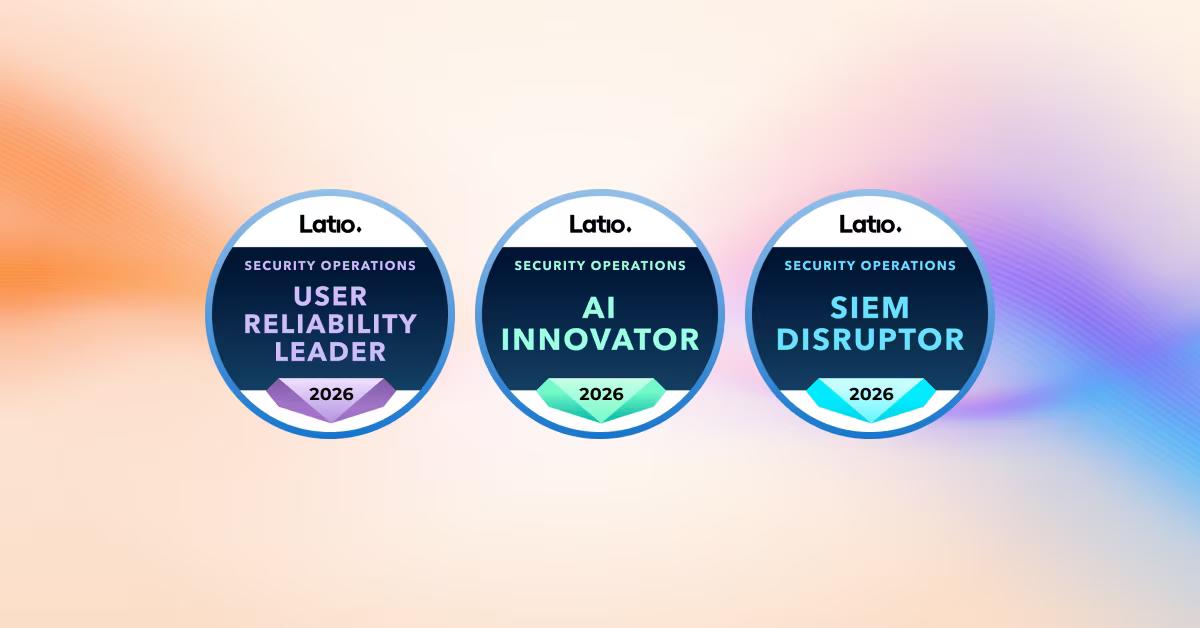
Latio named Exaforce an AI Innovator, a SIEM Disruptor, and a User Reliability Leader for 2026. We're proud of that recognition, but the more meaningful thing is what each category actually measures.
The AI Innovator designation is specifically about teams that have built an AI SOC as more than investigation automation. Tools that give agents direct access to underlying data, with a proper knowledge graph built at ingestion time rather than reconstructed on every alert, behave categorically differently from tools that bolt LLM reasoning onto a SOAR framework. Our Exabots (Detect, Triage, Investigate, Respond) run against a real-time knowledge graph that links events, identities, configurations, and cloud activity as data lands. That architecture is what allows high-quality AI reasoning at scale, and it's what Latio recognized.
The SIEM Disruptor category reflects something unique about how Exaforce approaches the market. For teams ready to move, Exaforce is a full SIEM replacement, with native log ingestion, out of the box and custom rules, and deep investigations that are intuitive to run. For teams that aren't ready, Exaforce ingests alerts from existing SIEMs, runs queries natively against tools like CrowdStrike, and layers agentic detection and response on top of what's already there. Most vendors force a binary choice between staying put and burning everything down. The disruption is making that choice disappear.
The User Reliability Leader designation is the one we take very seriously, because it's the hardest to maintain. The report is direct about a pattern observed across the AI SOC category. Tools that perform well in demo conditions often fail in complex production environments where the data isn't clean, the integrations aren't consistent, and the edge cases are genuinely weird. Our engineering team takes pride in keeping the product available and our customers secure.
What practitioners should do with this report
The report's conclusion is useful regardless of where you are in your SOC modernization journey: treat your SOC as a data architecture and detection engineering problem first, and a response automation problem second.
The report provides a practical framework for that sequencing. Start by gaining complete visibility into where your security telemetry flows, then consolidate your detection logic into a single authoritative location, and finally migrate data to a modern architecture. This isn’t glamorous work, but it’s the work that makes everything else function.
You can read the full market analysis and Exaforce vendor spotlight, including how the report positions the 50+ vendors across the modern SOC landscape, in the complete report.