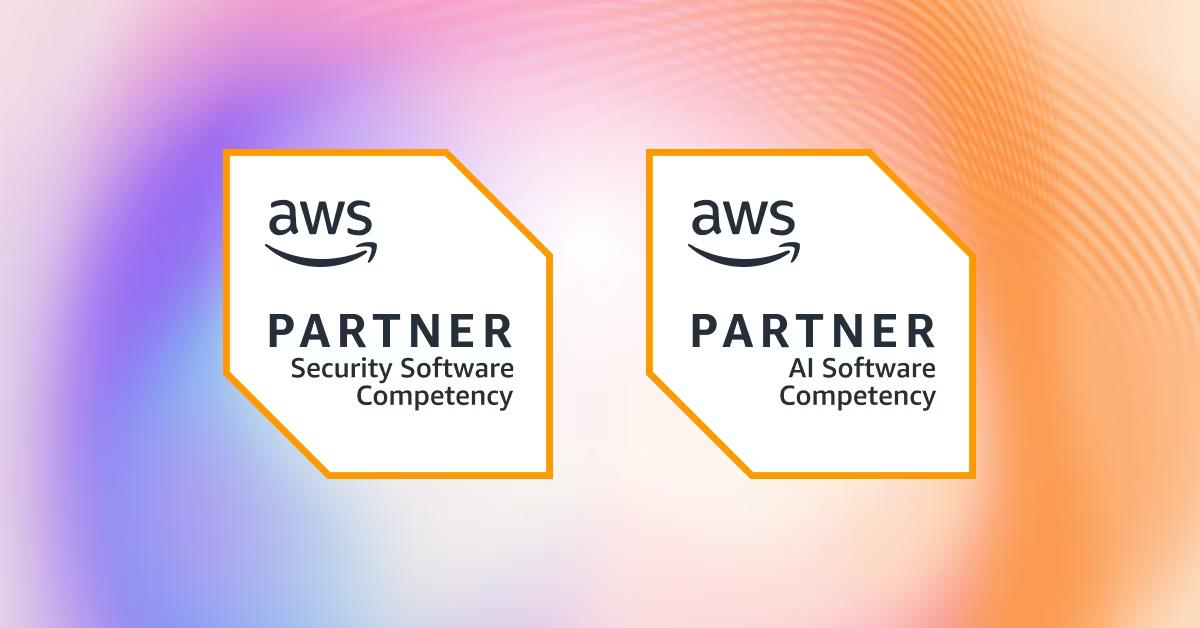
Most customers will never ask how many AWS competencies a vendor has, but the process behind earning them says more than the badge itself. We set out to build a platform that defenders could actually rely on, and we let the validation follow from the work. So when AWS awarded Exaforce both the AWS Security Competency and the AWS AI Competency simultaneously, across four distinct validated categories, it landed differently than a typical announcement.
The four categories are Identity and Access Management and Threat Detection and Response under the AWS Security Competency, and Generative AI Applications and Agentic AI Applications under the AWS AI Competency. Read together, those four categories are a precise description of what Exaforce is. That is the result of AWS putting our platform through two separate evaluation tracks, each with its own technical requirements and its own security experts, and coming to the conclusion that the security problem and the AI problem are the same, and you cannot solve one without the other.
Why these categories
The Security Competency requires annual evaluation by AWS security experts, with customers interviewed on real deployments and operational outcomes. The AI Competency, which AWS launched in November 2025 to include three new Agentic AI categories covering autonomous AI systems, required demonstrating production-grade deployments on AWS services, including Amazon Bedrock and Amazon SageMaker AI. The bar for both is that customers can rely on what you have built.
That makes the category selection meaningful. The Identity and Access Management category goes to partners that have demonstrated cloud identity coverage at the depth required for real cloud environments, where identities are distributed across IAM roles, service accounts, OAuth tokens, federated SSO sessions, and third-party SaaS connections, and where the effective permissions on any given identity at any given moment are almost never what the policy document says they are. Exaforce qualified because identities and permissions are first-class objects in the knowledge graph.
The Threat Detection and Response category validates the core SOC platform. AWS evaluates whether partners ingest from the AWS telemetry stack without requiring a separate data pipeline, whether detection coverage is actually meaningful, and whether response is operationally viable. For Exaforce, that means ingesting directly from Amazon GuardDuty, AWS CloudTrail, AWS Config, and the broader AWS ecosystem at ingest, normalizing and chaining that telemetry into the knowledge graph in real time, without a separate ETL layer or a staging environment that introduces latency between event and alert.
The two AI categories reflect something different. Generative AI Applications covers the Multi-Model AI reasoning layer that drives the platform. The Agentic AI Applications category is where the requirements diverge sharply from what most AI security vendors can demonstrate. AWS defines Agentic AI Applications as production-grade autonomous systems that take real actions, not copilots that surface suggestions for a human to execute. Earning that designation means AWS reviewed our Exabots as autonomous agents that actually run the SOC lifecycle end to end, with the tool integrations, governance controls, and operational monitoring to back that claim up.
What AWS validation means
These designations are evidence that what we have already built meets an independent technical standard. AWS Security Competency partners are evaluated by AWS security experts on real customer deployments, not on documentation. The AI Competency requires demonstrating that agents are production-grade autonomous systems with responsible AI development practices, governance controls, and operational monitoring in place. Both of those evaluation processes are designed to find gaps, not to confirm the narrative you want to tell. Finding none is the actual result here.
We are continuing to deepen the integrations across the AWS telemetry stack and invest in the Multi-Model AI architecture that drives both detection quality and agent reasoning. For security teams running on AWS, that means coverage that extends from the control plane through the data plane, from IAM through GuardDuty through CloudTrail through your endpoints, unified in a single knowledge graph that Exabots reason against in real time.