Ask a SOC leader what has changed most in the last two years, and the answer is speed. Attackers automate reconnaissance, steal credentials, and live off the land, moving laterally and finishing campaigns in minutes. The old idea of dwell time, the days or weeks defenders once had to catch an intruder, has quietly disappeared. And the tools underneath most SOCs were built for human investigators clicking between consoles, where every pivot from one screen to an API to a data silo costs time and context that defenders no longer have to spare.
The industry’s answer is the agentic SOC: AI that reasons and acts on its own, at machine speed. It is a genuinely exciting shift, but there’s a catch that doesn’t get said often enough… An AI agent is only as good as the data it reasons over. Point it at fragmented logs, and it inherits every gap and silo those logs already carry. For agents to act with confidence, they need one thing above all else: a trusted, high-fidelity source of truth. That source is the network, and it’s why Exaforce and ExtraHop have partnered.
The Network Doesn’t Lie
Endpoints get disabled. Logs get tampered with. Identities get stolen. The one thing an attacker cannot avoid is the network, because to do anything useful they have to move across it (for instance, to reach a domain controller and carry data out). The network is also the only place that connects the dots, tying a user to a device, a device to an application, and an action to the data it touched. That’s exactly the context an AI agent needs, and exactly what disconnected logs cannot provide. It’s also the thesis behind Project AgentStream, the ExtraHop-led coalition, of which Exaforce is a member, built to make the network the context layer for autonomous security operations.
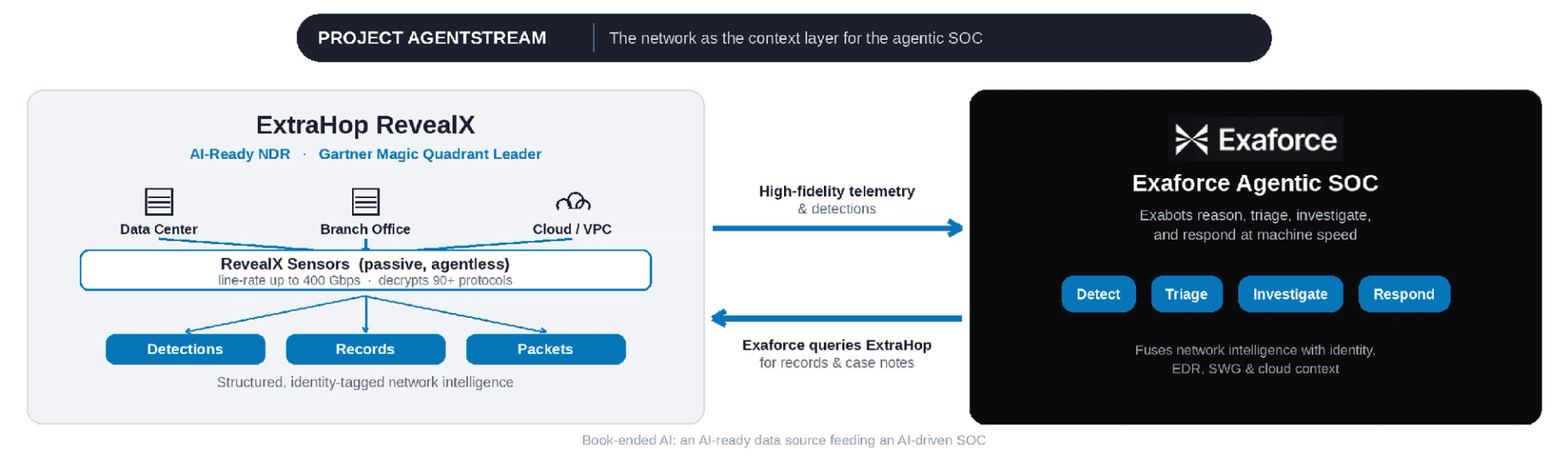
ExtraHop RevealX 360 is where that context comes from. It’s a cloud-delivered NDR platform and a Leader in the Gartner Magic Quadrant for network detection and response. Passive sensors sit across data centers, branch offices and cloud, watching traffic through a SPAN, a network TAP, a packet broker, or a cloud vTAP without ever touching it (and, crucially, decrypting and decoding the enterprise protocols where lateral movement likes to hide). The high-end sensors do this at line-rate speeds of up to 400 Gbps. What makes RevealX 360 built for the AI era, though, is not raw capture. It’s that the platform turns traffic into structured, identity-tagged records and behavioral detections mapped to hundreds of MITRE ATT&CK techniques. With its Premium Investigation option, it can keep packet-level evidence for forensics, retaining searchable records for up to 365 days. In short, it hands an AI agent clean, machine-readable context to reason over instead of a firehose of packets.
Two Kinds of AI, Working End-to-End
If ExtraHop is the AI-ready source, Exaforce is the AI-driven SOC on the other end. Exaforce runs the full SOC lifecycle with four task-specific Exabots: Detect, Triage, Investigate and Threat Hunt, and Respond. Each Exabot shares one reasoning core grounded in a live, unified view of your environment. It can run as SaaS or as a fully managed 24/7 MDR service. Furthermore, it never looks at the network in isolation: it fuses ExtraHop with identity, endpoint, SWG, and cloud signals to build a single picture of the risk.
We like to think of it as book-ended AI. On one end, RevealX 360 has already done the hard work of decoding and structuring what happened on the wire. On the other end, Exaforce reasons over it and acts – combining rich telemetry from a wealth of other data connectors. The true value of high-fidelity network intelligence shows up when there is an intelligent consumer waiting and ready to combine it with additional context.
Passive RevealX sensors across your sites feed the RevealX 360 console, which streams high-fidelity, identity-tagged detections and records to Exaforce, where Exabots fuse them with identity, EDR, SWG, and cloud context.
What it Looks Like in Practice
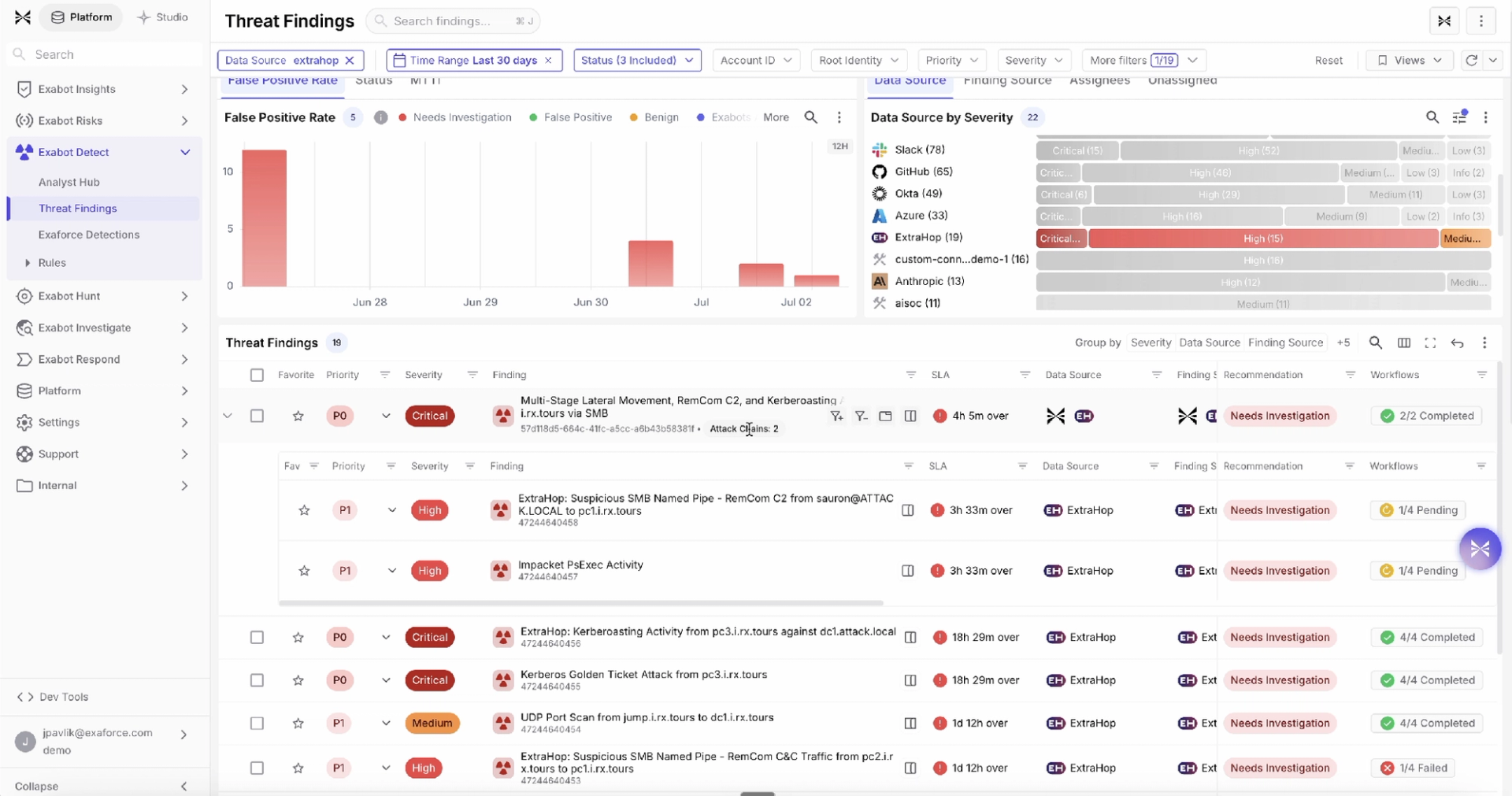
Day to day, ExtraHop detections stream into Exaforce alongside everything else, and the network quickly becomes one of the richest sources in the mix. High-severity findings arrive continuously and get triaged around the clock, with no analyst waiting on the queue. See the Exaforce + Extrahop solution brief for the full integration architecture and use cases.
ExtraHop is a first-class data source in Exaforce. Findings stream in and are triaged automatically, prioritized alongside identity, endpoint, and cloud telemetry.
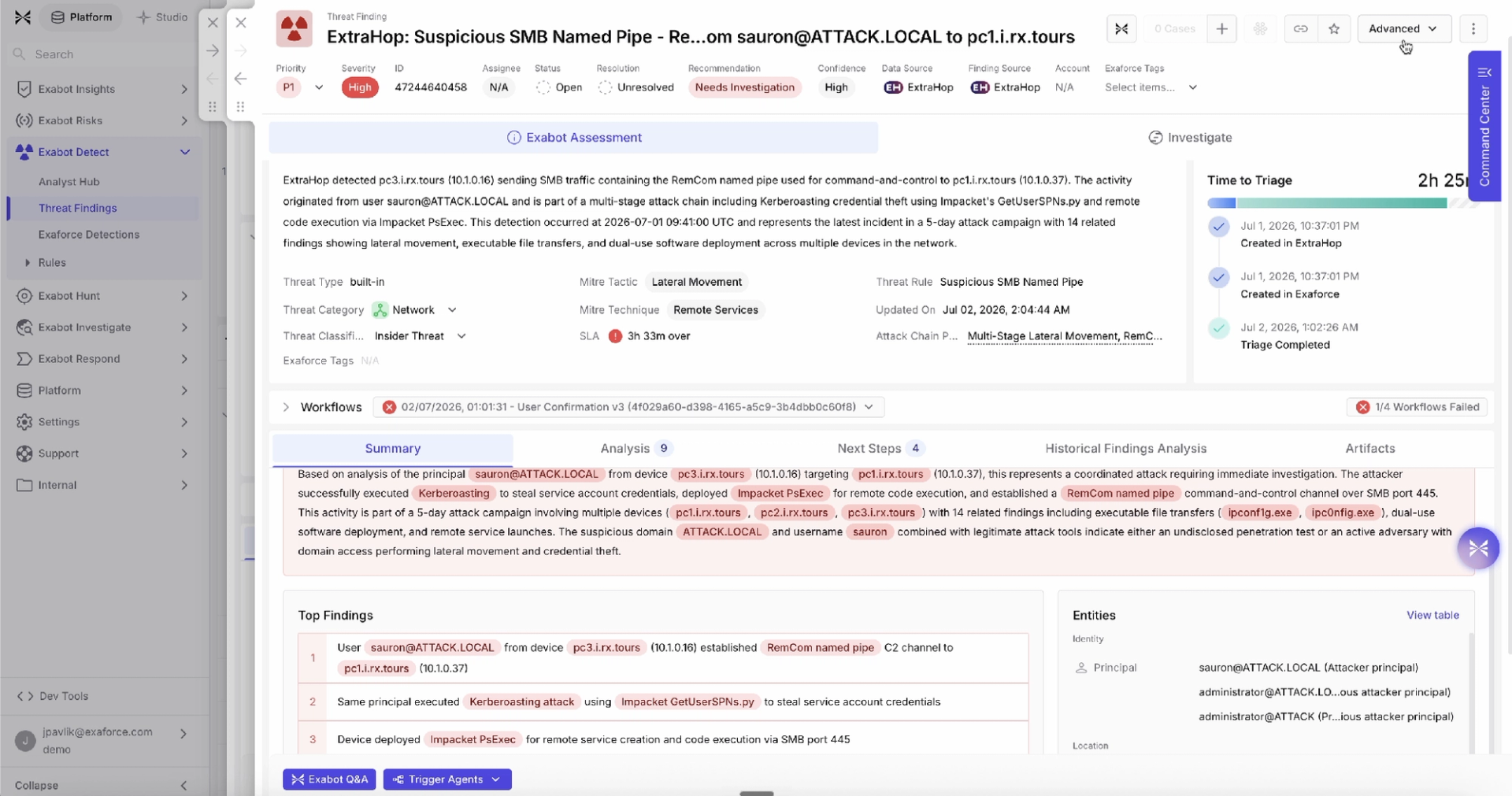
From there, every detection gets the treatment an analyst would give it with unlimited time: enriched with who acted, what they touched, from where, and why it matters, then triaged against a real-time knowledge map. The output is a plain-English assessment with a transparent verdict, and a small timeline that says it all: created in Exaforce and triaged, on its own, in minutes.
An ExtraHop-sourced finding, fully assessed by an Exabot. The Time to Triage timeline runs from created in ExtraHop to created in Exaforce to triaged, with no human effort in between.
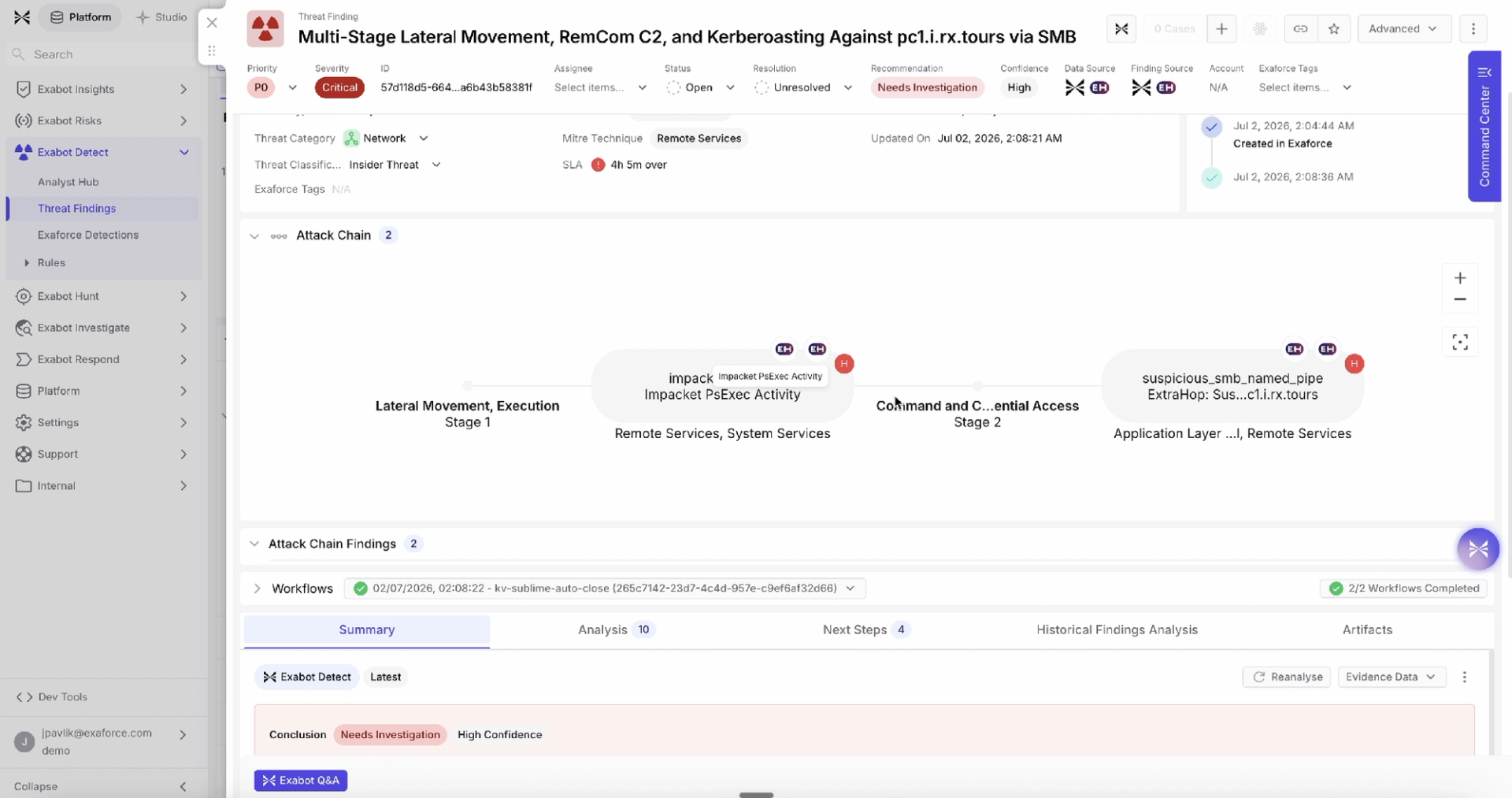
Real attacks don’t announce themselves with a single alert, so Exaforce stitches related ExtraHop detections into one multi-stage attack chain instead of a scatter of disconnected events. In the case below, an Impacket PsExec lateral-movement detection and a RemCom command-and-control detection over SMB were pulled into a single investigation spanning lateral movement, execution, and credential access.
One story instead of scattered alerts: Exaforce links related detections into an attack chain, from Impacket PsExec lateral movement to RemCom command-and-control over SMB.
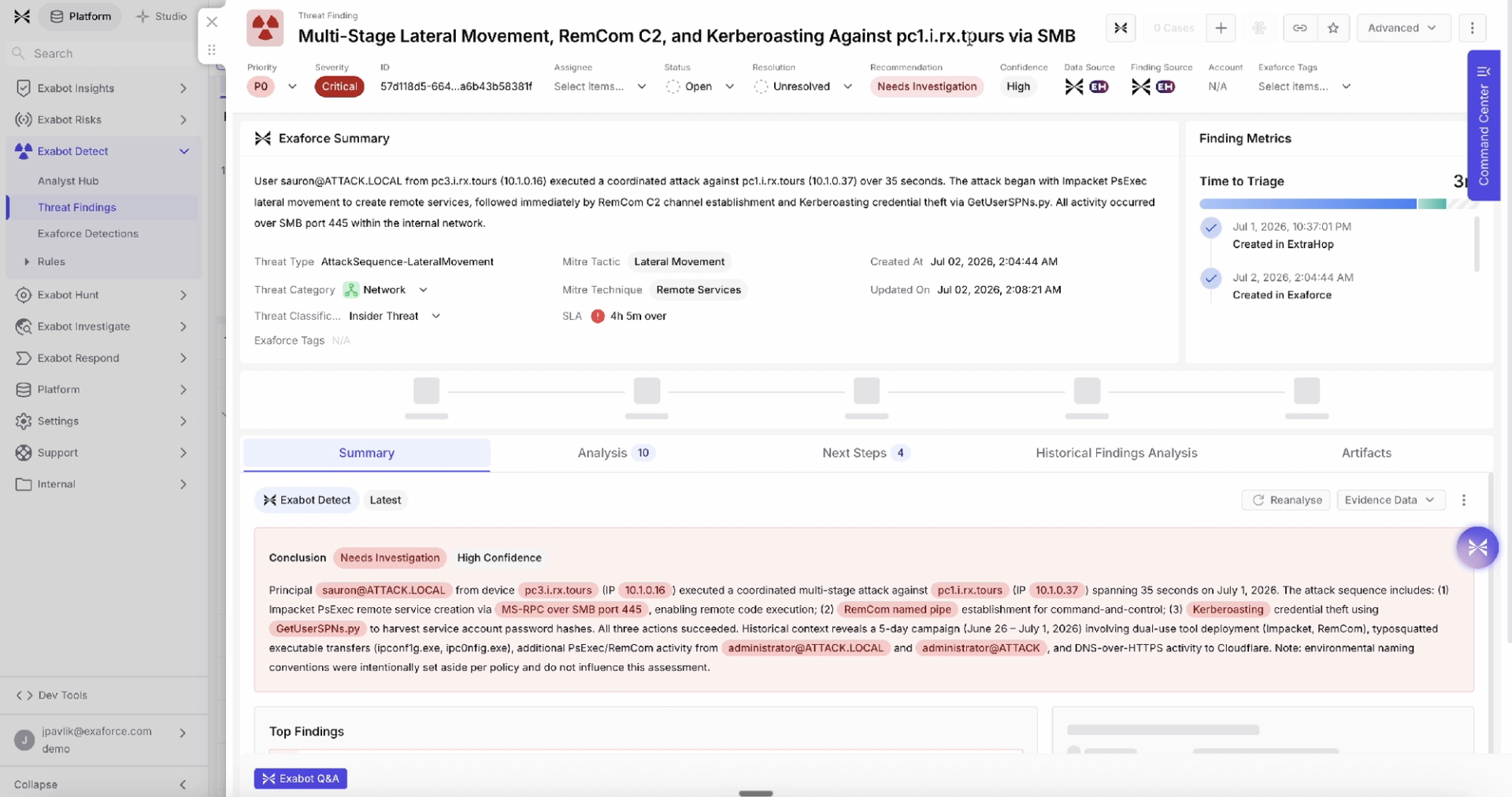
And it all lands on a clear, evidence-linked conclusion with a few sentences summarizing the coordinated attack and a confidence level. Whenever an analyst wants to dig further, Exaforce queries RevealX 360 directly and pulls the supporting records into analyst-ready case notes.
A coordinated, multi-stage attack distilled into one high-confidence verdict, with the full sequence and underlying evidence a click away.
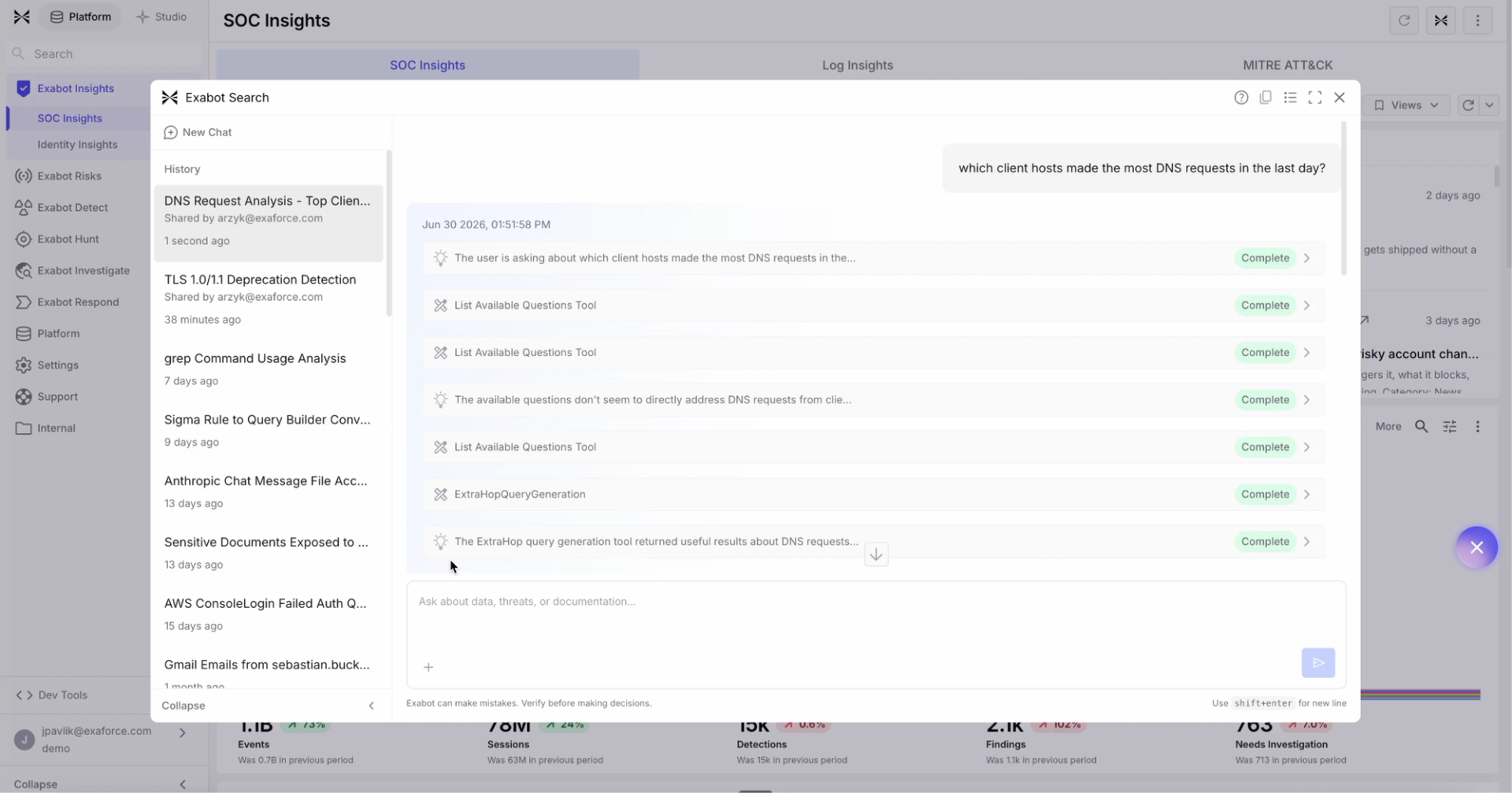
Finally, a standout capability of the ExtraHop connector is its integration with Exaforce's Exabot Search, allowing network data queries in plain language without needing to memorize complex syntax. Analysts can use Exabot Search to quickly identify which devices interacted with a compromised account, retrieve records for a specific port or named pipe, or review a host's activity over the previous week. Extracted directly from RevealX 360, the results are delivered in seconds. For threat hunting and deep investigations, that turns the richest data source in the environment into something the whole team can interrogate conversationally… a level of network-native, natural-language access that sets this integration apart from other agentic SOCs.
Natural-language threat hunting in action: an analyst asks Exabot Search, in plain English, which client hosts made the most DNS requests in the last day, and Exaforce generates the ExtraHop query and returns the answer, no query syntax required.
The Payoff
The benefit shows up in the day-to-day math. Lateral movement and pre-ransomware activity get caught while an attacker is still moving, hours or days before encryption, because RevealX 360 can see the encrypted east-west traffic and Exaforce can reason across it with identity and endpoint context. Alert fatigue drops, because detections arrive pre-structured and Exabots quietly close the noise and surface only what is real. Threat hunting stops being a special project: with a year of records a query away, Exaforce assembles forensic-grade case notes on demand or proactively, without anyone pivoting between tools.
In production, teams running this pattern report every network detection triaged around the clock: about 95 percent of findings auto-triaged and closed, up to 80 percent fewer false positives reaching analysts, and suspected compromises ruled out in roughly 15 seconds (those reflect publicly reported Exaforce results, but your individual results vary).
Attackers don’t keep business hours, and they’re already using AI. The only way to meet a machine-speed adversary is with machine-speed defense. And the only way to trust machine-speed defense is to ground it in something an attacker cannot fake. Pair the Exaforce agentic SOC with ExtraHop RevealX 360, and that something is the network.
Read the solution brief or request an Exaforce + ExtraHop demo.