Dropzone AI sells an AI SOC Analyst that investigates alerts end to end on the SIEM, EDR and ticketing tools you already run, alongside an AI Threat Hunter and an AI Threat Intel Analyst. Its own line is "customer guided, software executed": the agent does the investigation and "your analysts own every verdict." Teams look for a Dropzone AI alternative when they need the platform to go past investigation into containment, when their alert volume is uneven and a fixed annual allowance is awkward to budget, or when they want detection and a data layer of their own rather than an analyst on top of the stack. This guide covers what Dropzone does, why teams compare, how to judge a replacement, and five options to test. Exaforce publishes this page and is one of the five.
What Dropzone AI does
Dropzone's site describes an agentic SOC platform with three agents: the AI SOC Analyst, which "works every alert as it lands" and investigates "every alert end to end"; the AI Threat Hunter, which looks for threats outside current coverage; and the AI Threat Intel Analyst, which prioritizes the threats relevant to your environment. It connects through 100+ integrations with "no data migration and no normalization," is "not a SIEM or a staffed service," and deploys "in hours, not weeks." Contracts are quote-based. (From dropzone.ai, Nov 2026.)
For a team whose only problem is a Tier 1 queue on a stack it intends to keep, that is a clean answer: a fixed amount of investigation capacity, bought by the analyst.
Why security teams shop around
- Lifecycle coverage. Dropzone centers on investigation. Containment stays with your analysts or a separate SOAR product, so every confirmed threat is still a handoff from software to a person or another tool.
- Fixed capacity meets uneven volume. An annual investigation allowance is easy to budget when volume is steady. A noisy integration, a new data source or an incident can spend a quarter's allowance in a week.
- Detection stays someone else's. The analyst investigates what your SIEM and EDR raise. If the detections are the weak link, or the SIEM bill is the problem, the analyst does not change either.
- Hunting and detection engineering. Teams that want hunting, detection tuning and response in the same product as triage look at broader platforms.
How to judge a Dropzone AI replacement
- Map the alert lifecycle. Write down every handoff from tool to person between an alert firing and a threat contained, then ask each vendor which of those handoffs disappears.
- Price the billing unit at real volume. Investigations, endpoints, data volume or a flat fee: take last month's alert count, including the busy week, and price each option against it.
- Read the investigation reports. Ask for full reports during a trial and have your analysts judge the reasoning, not the summary.
- Decide who operates it. Software you run, a service, or a platform offered both ways.
Five Dropzone AI alternatives at a glance
Exaforce
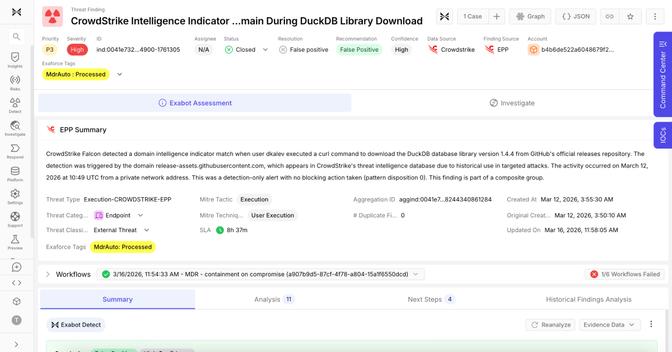
Exaforce takes the alert from detection to containment on one platform. Its data platform ingests logs, identity data, configuration and code from 130+ sources and resolves them at ingest against a model of identities, resources and their relationships, with a behavioral model of what is normal for each; its own detections run on that model. The Exabots, its AI agents, detect, triage, investigate and respond from the same context, so containment can follow a confirmed verdict with an analyst approving the action, and every verdict shows its reasoning. With ExaU, teams build their own Exabots for the work specific to them. Customers report 90% fewer false positives and a 95% reduction in mean time to investigate, with an average of under 30 minutes from alert to response. Teams run it themselves or have Exaforce MDR run it.
Prophet Security
Prophet Security is the closest like-for-like: an AI SOC Analyst on your existing tools, plus an AI Threat Hunter, an AI Detection Engineer that tunes those tools' detections, and Watchtower, a 24x7 human review. Single-tenant deployment with a bring-your-own-key option. See Dropzone AI vs Prophet Security for the head-to-head.
Torq
Torq brings an AI SOC platform built on its hyperautomation engine: Auto Triage, the Socrates remediation agent, case management and a context model of the environment. It closes the containment gap Dropzone leaves, at the cost of designing and maintaining the workflows. See Torq alternatives.
7AI
7AI's agent teams investigate every alert end to end with the reasoning shown and carry out responses, with high-impact actions held for approval, delivered as "Service as Software" with a 24x7 PLAID ELITE team. The fit is a large enterprise that wants outcomes over a product. See 7AI alternatives.
Intezer
Intezer applies memory analysis, reverse engineering and sandboxing to the artifacts behind an alert, returns a verdict with the evidence attached, and prices per endpoint, which is a different unit to budget against. Strongest on endpoint and phishing queues, weakest on identity and cloud. See Intezer alternatives.
Making the call
- Steady Tier 1 volume is the only problem: an analyst with fixed capacity suits you; compare Dropzone, Prophet and Intezer on price per month.
- Response, hunting or detection engineering is also on the list: a broader platform. Exaforce, Prophet and 7AI cover more of the lifecycle in different ways.
- Playbooks drive most of your work: Torq.
In the trial, track two numbers: how many alerts still reach a person, and how long each takes to close.
Frequently asked questions
What does Dropzone AI do?
Dropzone AI's AI SOC Analyst investigates alerts from your existing security tools end to end and presents the findings for your analysts to decide on. It also sells an AI Threat Hunter and an AI Threat Intel Analyst.
Is Dropzone AI a SIEM?
No. Its site says it is "not a SIEM or a staffed service." It investigates alerts your SIEM, EDR and other tools raise.
How is Dropzone AI priced?
Quote-based; ask how any investigation allowance behaves in a busy month.
What is the best Dropzone AI alternative for containment as well as investigation?
A platform whose agents can act on a confirmed verdict, with approval rules you set. Exaforce does that on its own data platform; Torq does it through workflows you build.
Dropzone AI vs Prophet Security: what is the difference?
Both investigate alerts from your existing tools. Prophet adds a detection engineer, a threat hunter and a human review service; Dropzone adds a threat hunter and a threat intel agent and prices by the analyst. Price a month of your alerts on each.