Torq began as a no-code alternative to traditional SOAR and now sells an AI SOC platform: Auto Triage that filters noise and issues verdicts analysts can audit and override, Socrates, a natural-language agent that remediates threats, HyperAgents for repetitive investigation tasks, case management and a context model of the environment. Teams look for a Torq alternative when they want investigation that is good out of the box rather than built, when they do not have automation engineers to design and maintain workflows, or when they want the platform to bring its own data layer and detections rather than orchestrate across the SIEM they already pay for. This guide covers what Torq does, why teams compare, how to compare, and five platforms to test. Exaforce publishes this page and is one of the five.
What Torq does
Torq's site describes "agentic AI that acts across triage, investigation, and response." Auto Triage removes duplicate events, filters false positives and issues AI verdicts; Socrates is "a natural-language agentic AI that autonomously remediates critical threats"; HyperAgents handle repetitive investigation tasks and record evidence and timelines; case management, threat hunting and reporting round it out, with autonomous or human-supervised remediation. Torq holds FedRAMP Moderate certification. Pricing is not published. (From torq.io, Nov 2026.)
For an enterprise with strong automation skills and many custom processes, especially one retiring an older SOAR, the workflow depth is the point.
Why teams look for Torq alternatives
- Value depends on workflows you build. An automation engine delivers what someone designs into it. Teams without automation engineers, or with turnover in that role, find the platform's value tied to a backlog they cannot staff.
- Orchestration is not detection. Torq coordinates the tools you have. If the SIEM bill or the detection layer is part of the problem, orchestrating across it does not change either.
- Investigation quality out of the box. Some teams want an agent that investigates well on day one from a model of the environment, rather than from playbooks that encode how the last person thought an investigation should go.
- Pricing visibility. With no published unit, comparing against per-endpoint or per-investigation vendors waits until the quote.
How to compare the alternatives
- Minimal-configuration test. Give each platform the same week of real alerts with no custom workflows and compare how many cases still reach an analyst.
- Where the context comes from. Playbooks you wrote, raw logs read at investigation time, or a model of identities, resources and relationships built at ingest.
- Where detections come from. Orchestrating your tools' alerts, or shipping and tuning its own detections.
- Response authority and audit. What the platform may do on its own, what needs approval, and whether every action is logged.
- Operate it, have it run, or both.
Five Torq alternatives at a glance
Exaforce
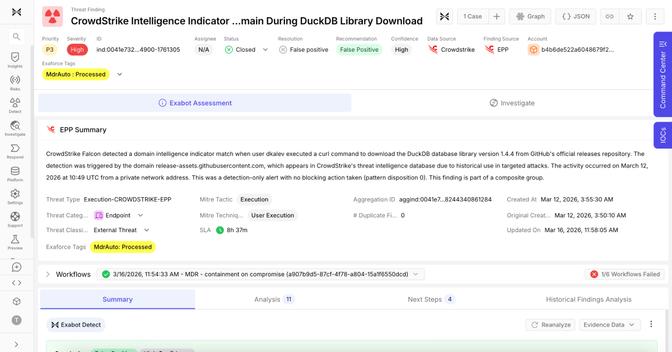
Exaforce is an agentic SOC platform rather than an automation engine. Its data platform ingests logs, identity data, configuration and code from 130+ sources, resolves them at ingest against a model of identities, resources and their relationships, with a behavioral model of normal activity, and runs its own detections on that model. The Exabots, its AI agents, detect, triage, investigate and respond from that context, so they depend less on hand-built playbooks, and every verdict shows its reasoning. With ExaU, teams build their own Exabots for the work specific to them, which is where a Torq user's custom workflows would go. Customers report 90% fewer false positives and a 95% reduction in mean time to investigate, with an average of under 30 minutes from alert to response. Teams run it themselves or have Exaforce MDR run it.
Intezer
Intezer applies memory analysis, reverse engineering and sandboxing to the files and endpoint artifacts behind an alert, returns a verdict with the evidence attached, and prices per endpoint. No workflows to build; the limit is attacks that never produce a file. See Intezer alternatives.
Dropzone AI
Dropzone AI's AI SOC Analyst investigates "every alert end to end" on your existing tools with no data migration, while "your analysts own every verdict." It replaces the investigation half of what a Torq workflow does, not the response half. See Dropzone AI alternatives.
ReliaQuest GreyMatter
ReliaQuest describes GreyMatter as "the agentic AI security operations platform": agentic personas it calls Teammates, a model-agnostic layer that picks a model per task, field-level normalization across data sources, detection on data in motion, SOAR and automation, and human-in-the-loop governance with ReliaQuest engineers providing feedback. It is positioned as "enterprise AI without the AI pricing meter" at "one predictable price," without published figures. The fit is a large enterprise that wants the platform and a service team together. See Torq vs ReliaQuest.
7AI
7AI's agent teams investigate every alert end to end with the reasoning shown and carry out responses, with high-impact actions held for approval, delivered as "Service as Software" with a 24x7 PLAID ELITE team. No workflows to build because you are buying the outcome. See 7AI alternatives.
Choosing the right Torq alternative
- Strong automation skills and many custom processes: Torq's workflow depth may still be the right answer; compare it with ReliaQuest on who maintains the automations.
- Short on engineering time: compare how much each platform delivers with minimal configuration. Exaforce, Intezer and Dropzone are the candidates here.
- The SIEM or the detections are the real problem: only a platform with its own data layer and detections changes that. See SIEM replacement.
- You want it run for you: 7AI, ReliaQuest and Exaforce MDR.
A pilot on a few weeks of real alerts shows the differences quickly, especially in how many cases still reach an analyst.
Frequently asked questions
What does Torq do?
Torq is an AI SOC platform built on a hyperautomation engine. Auto Triage filters alerts and issues verdicts, Socrates remediates threats from natural-language instructions, HyperAgents handle repetitive investigation tasks, and workflows automate response across your existing tools.
Is Torq a SOAR?
Torq started as a no-code alternative to SOAR and still runs on an automation engine. It now positions itself as an AI SOC platform, with agents on top of the workflows.
Can Torq integrate with existing SOC tools?
Yes; integrating and orchestrating existing tools is what the platform is built for. The question for a buyer is how much of the investigation and response logic you have to build yourself.
How is Torq priced?
Torq does not publish pricing. Ask for the unit and price a real month of your alert volume against it.
What is the best Torq alternative if we do not have automation engineers?
A platform that investigates from a model of your environment rather than from workflows you write. Exaforce is built that way; Dropzone AI and Intezer are focused analysts that need no workflow design.