Torq and ReliaQuest both sell agentic AI for security operations and sell it in opposite ways. Torq is software your team builds on: an automation engine with AI agents for triage, investigation and remediation, whose value depends on the workflows you design. ReliaQuest's GreyMatter is a platform most customers buy with ReliaQuest's managed services and engineers in the loop. The first question is therefore not which has the better agents but how much of your SOC you want to run yourselves. This page compares the two on that question and says where Exaforce, which publishes it, fits between them.
Torq in brief
Torq began as a no-code security hyperautomation company and now positions an AI SOC platform whose tagline is to "expand SOC capacity and velocity with agentic AI that acts across triage, investigation, and response." Auto Triage removes duplicate events and false positives and issues verdicts that analysts can audit and override; Socrates is a natural-language agent that remediates critical threats autonomously or under supervision; HyperAgents, case management, a context graph and the hyperautomation engine sit underneath, and workflows can be built from natural-language requests. It holds FedRAMP Moderate certification. No pricing model is stated. (From torq.io, Nov 2026.)
ReliaQuest in brief
ReliaQuest's GreyMatter is described on its site as the agentic AI security operations platform. It connects to existing tools across cloud, multi-cloud and on-premises environments, normalizes their data, and runs role-based Agentic Teammates that investigate and resolve alerts, with a model-agnostic layer choosing the AI model per task and ReliaQuest engineers providing human-in-the-loop governance. Modules cover detection on data in motion, SOAR and automation, phishing defense, a SIEM-less option and exposure management. It is positioned as "one predictable price." (From reliaquest.com, Nov 2026.)
Torq vs ReliaQuest side by side
The differences that matter
- Who does the engineering. Torq's value comes from automations built around your business, which means engineering time to build and maintain them as tools and processes change. ReliaQuest's value comes with engineers attached.
- Where the context lives. Torq orchestrates your tools and keeps a context graph of what it has seen; ReliaQuest normalizes your tools' data into its own layer. Neither replaces the detections your tools produce with a model of the environment built at ingest.
- How you leave. Leaving Torq means losing workflows your team wrote; leaving ReliaQuest means losing the service and the normalization layer. Ask each what is portable.
- How you pay. Platform pricing without a usage meter is simple to budget; an unstated model needs a quote. Neither is per alert, as far as either site says.
Where Exaforce fits alongside Torq and ReliaQuest
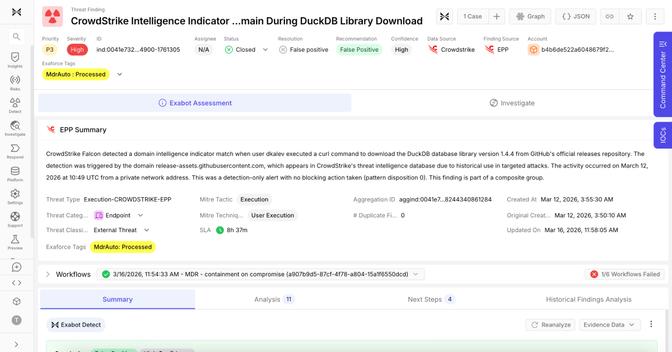
Exaforce is an agentic SOC platform rather than an investigation layer on someone else's detections. Its data platform ingests logs, identity data, configuration and code from 130+ sources and resolves each event at ingest against a model of identities, resources and their relationships; its own detections run on that model. Its Multi-Model AI splits the reasoning across semantic, behavioral and knowledge models rather than asking one language model to read raw logs. The Exabots, its AI agents, detect, triage, investigate and respond on that shared context, with the reasoning shown on every verdict, and analysts review outcomes and approve the actions they choose to gate. With ExaU, teams build their own Exabots for the work specific to them. Customers report 90% fewer false positives and a 95% reduction in mean time to investigate, with an average of under 30 minutes from alert to response. Teams run it themselves or have Exaforce MDR run it. Between the two models, Exaforce is run by the customer or by Exaforce MDR on one foundation, and because the Exabots reason over a model of identities, resources and behavior built at ingest, investigations depend less on hand-built playbooks and less on a vendor engineer. See Torq alternatives and ReliaQuest alternatives for the wider lists, and SOAR vs AI SOC for why playbook maintenance is the cost that decides this comparison.
How to choose
- Decide first whether you want software or a service, and whether that answer changes in two years.
- Count the engineering hours you can give to building and maintaining automations. If the honest number is small, Torq's model will underdeliver.
- Trial the shortlist on live alerts and count how many cases each closes without an analyst or a vendor engineer touching them.
- Ask what you keep if you leave.
Frequently asked questions
Is Torq a SOAR?
Torq started as a hyperautomation platform and now sells an AI SOC platform with agents for triage, investigation and remediation on top of that engine. It is commonly bought to replace an older SOAR.
Is ReliaQuest an MDR?
ReliaQuest sells the GreyMatter platform, usually with managed services and governance engineers in the loop, so most customers experience it as a platform plus a service.
Which is better for a small team?
A small team without automation engineers will get more from a platform that comes with people, or from an agentic platform whose agents do not need playbooks written for them. Torq's model rewards teams that can build.
Does either replace the SIEM?
Torq orchestrates your tools and keeps your SIEM. ReliaQuest works across your SIEMs and offers a SIEM-less option through its own data layer. A platform with its own data platform and detections, such as Exaforce, is the option if retiring the SIEM is the goal.