
We've walked into mature SOAR programs with hundreds of playbooks and an incident queue still growing faster than the code meant to tame it. That gap is the main reason security teams are evaluating the agentic SOC in 2026.
The term gets used loosely, so precision helps. What does an agentic SOC actually do differently from the automation teams already run? And where does the human analyst fit once agents take on the investigation work? For a look at day-to-day operations, this guide also covers what running one looks like from the inside.
What is an agentic SOC?
An agentic SOC is a security operations center where AI agents handle investigation, triage, and response tasks through dynamic reasoning rather than static, pre-written rules. The word "agentic" comes from AI research, where it describes systems that can set goals, plan sequences of actions, and adapt their approach based on what they find.
In practical terms, this means the AI reads the alert, decides what to look up, pulls relevant context from your EDR, SIEM, cloud resources, identities, code, threat intelligence feeds, and more, forms a hypothesis about what happened, presents its conclusions to a human with supporting evidence, and either takes action automatically or with a human in the loop.
Agentic vs. scripted automation in the SOC
When a SOAR playbook fires, it follows a path defined by a human engineer at the time the playbook was written. The playbook simply checks if condition A matches, then it runs action B.
An AI agent does something structurally different. It receives a task, such as investigating a phishing alert, and then decides what steps to take. It might query Active Directory for the targeted user's role, check if the sending domain was registered recently, pull VirusTotal results for the attached file, and look for lateral movement from the same endpoint in the past 48 hours. If any of those lookups change the picture, the agent adjusts its approach.
This capacity for goal-directed, adaptive behavior is what separates AI security agents from the automation that came before them.
Four traits that define agentic AI in the SOC
Security platforms marketing agentic capabilities vary widely in what they actually deliver. The term is meaningful when it describes these four properties working together:
- Autonomy means the agent can complete multi-step tasks without a human approving each action, within guardrails the team defines. It decides which data source to query or tools to use and in what order.
- Planning means the agent can decompose a complex goal into sub-tasks. Investigating an alert becomes a sequence of lookups, correlations, and checks that the agent manages independently.
- Reasoning means the agent weighs evidence. It retrieves data and interprets it. "This is a true positive. The IP address matches a known bad actor, the user has no history of downloading that type of file, and the user bulk downloaded multiple of those files within 30 seconds" is a conclusion drawn from reasoning across multiple data points.
- Adaptability means the agent changes its plan based on the alert and environment. If the initial lookup reveals the alert fired about an AWS event, the agent adjusts its data gathering and assessment accordingly rather than continuing down an irrelevant path.
Agentic SOC vs. SOAR and where playbooks fall short
Teams have invested years building playbook libraries, and for well-defined, high-frequency tasks, deterministic automation still makes sense. But the coverage problem is real.
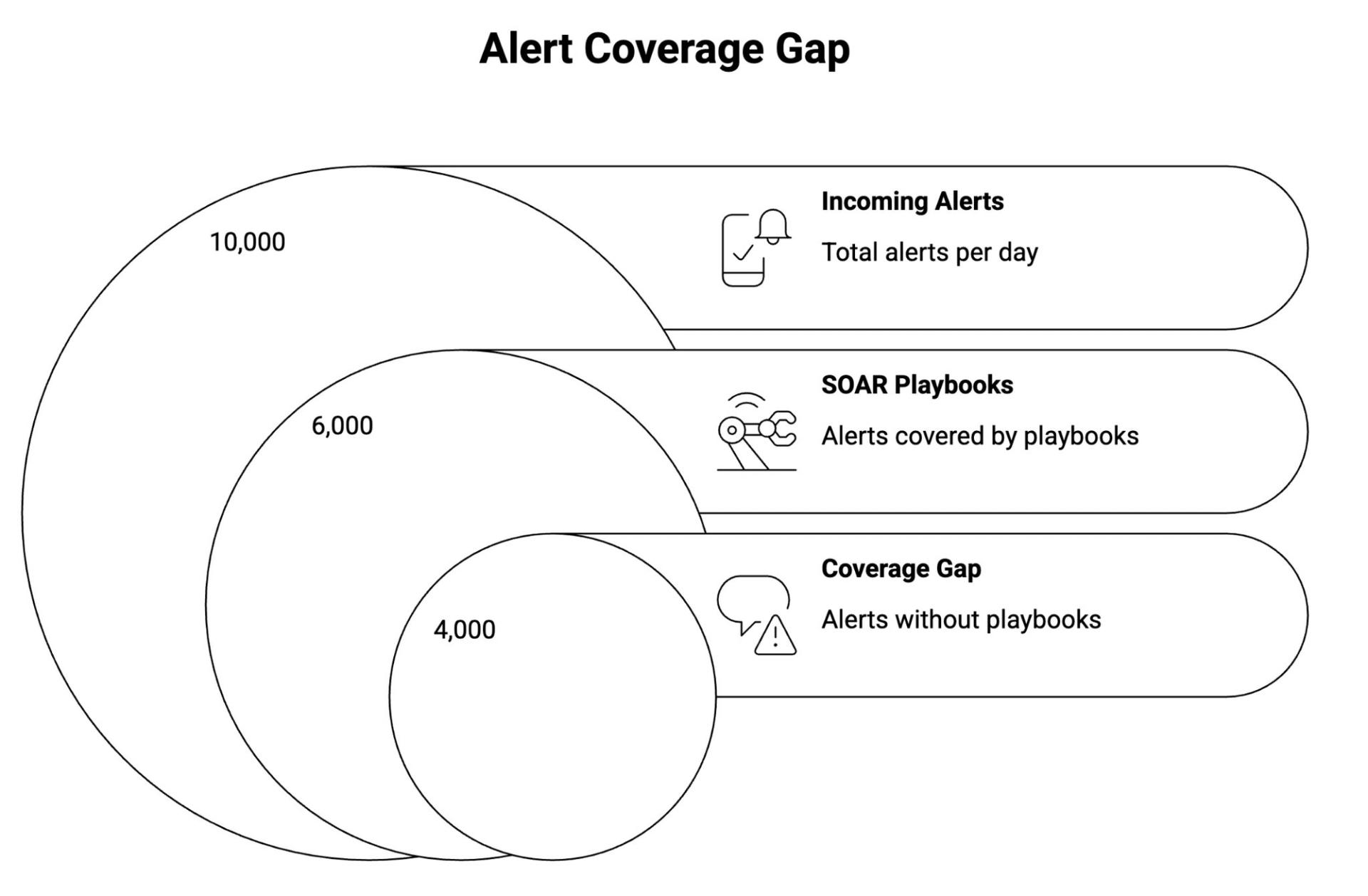
The core issue is that playbooks only work for alert types that are common enough and well-understood enough to have a playbook written for them. Everything else falls to human analysts, which means it often doesn't get investigated at all.
The proportion varies by organization, but the pattern is consistent. SOAR captures the frequent and the predictable. Agentic systems can handle a majority, including the tail and unique situations. An AI agent doesn't need a pre-written procedure for a specific alert combination it's never seen before. It can reason about unfamiliar situations the same way a good analyst would, by pulling relevant context and working through what it means.
Accton, for example, cut mean time to investigate (MTTI) from 3 hours to 10 minutes after deploying Exaforce's Agentic SOC Platform.
The other limitation of playbook-based SOAR is brittleness. When your environment changes (new SaaS tools, a cloud migration, an acquisition), playbooks break or stop being accurate. Maintaining them is a full-time job. AI agents are less sensitive to environmental drift because they're reasoning from current data rather than executing a procedure written against a prior state of your environment.
Agentic SOC vs. AI SOC
The two terms overlap, and vendors often use them interchangeably. AI SOC is the broader category. It covers any security operations model that applies AI, including copilots that summarize alerts or translate natural language into queries while an analyst drives every step.
An agentic SOC sits at the far end of that spectrum. Agents own multi-step work, such as a full phishing investigation, and hand the analyst a conclusion with the evidence attached.
A useful test when evaluating any AI SOC tool is to ask who decides the next step of an investigation. If the answer is always the analyst, the tool is assistive. If the agent decides and the analyst reviews, the model is agentic.
How an agentic SOC works
When an alert fires, it enters an orchestration layer that routes it to an appropriate AI agent. The agent reads the alert metadata and the associated raw log data, then begins executing an investigation plan.
The agent determines what information it needs based on the alert type and the data already visible. For a suspicious login alert, it might start with geolocation and device history. For a malware detection, it might start with the process tree and network connections made in the same window, then map what it finds to MITRE ATT&CK techniques.
The agent uses a set of tools and data (identity provider, cloud data, resource configuration, threat intelligence feeds, ticketing system, etc.) to execute its investigation steps. Each tool call returns data that may inform the next step. When the agent reaches a conclusion, it can be supported with evidence. It then generates a human-readable summary and optionally takes a defined response action (containment, block, notification).
The quality of this loop depends heavily on data access. Agentic systems need unified telemetry. Siloed data environments, where your endpoint data and network data can't be correlated against a shared timeline, create blind spots that limit what an agent can reason about. This is driving the adoption of a unified security data platform as the infrastructure for agentic SOC deployments.
The role of the human analyst in an agentic model
Will AI replace SOC analysts? In an agentic SOC, analyst time shifts away from repetitive Tier 1 and Tier 2 triage and enrichment, which agents absorb, and toward the judgment calls that remain. That remaining work is more demanding.
The volume of manual triage and investigation work drops substantially in agentic deployments. That's the point. Agents handle the investigation steps that currently consume most of an analyst's day. What remains for humans is the judgment that agents aren't equipped to make and the creative tasks like threat hunting and detection engineering.
From operator to orchestrator
The analyst's role shifts from executing investigations to supervising agents, handling escalations, and running ad-hoc investigations. This requires different skills than traditional SOC work. Analysts need to understand how to interpret agent outputs, when to trust a conclusion, and when to dig deeper, how to write business context for agents, and how to think like a bad actor to find new and novel attacks.
Some security teams are finding that the agentic model exposes skills gaps. Analysts who were productive at high-volume triage aren't necessarily good at the investigation and judgment work that agentic systems escalate to them. This is a people and training problem as much as a technology one, and it compounds the broader workforce gap documented in ISC2's cybersecurity workforce research.
The concept of human-in-the-loop (HITL) in agentic SOC refers to where humans participate in the automated workflow. For high-confidence, low-risk actions (blocking a known-malicious IP, isolating a confirmed-infected endpoint), many teams now allow autonomous response under predefined guardrails. For higher-risk actions (disabling a user account, quarantining a server), human approval stays in the loop. The boundary is a policy question that each organization sets based on its environment and risk tolerance.
Transparency, governance, and the AI trust problem
The biggest barrier to agentic SOC adoption in 2026 is the question of whether security teams can trust what agents decide, and whether they can explain those decisions when something goes wrong.
A SOC that can't audit its agents has a different kind of problem than a SOC without automation. If an agent incorrectly isolates a production server and you can't reconstruct why the agent made that call, you've lost the ability to prevent the same error in the future.
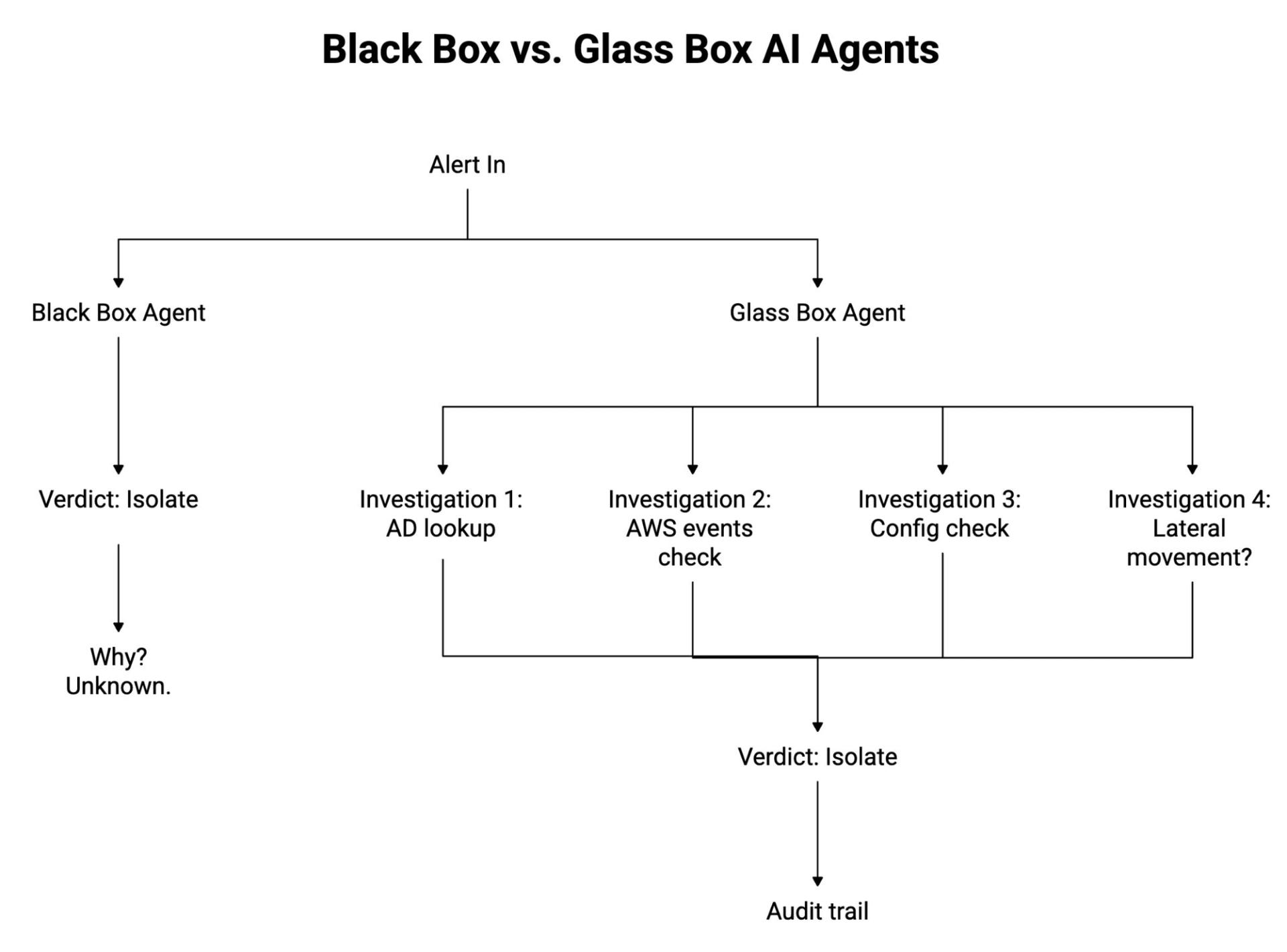
The questions to ask before adopting an agentic platform: Can you view a step-by-step record of every action an agent took during an investigation? Can you see which questions it asked and the resulting answers, and what it concluded from each? Can you define guardrails that prevent agents from taking specific categories of action without human approval? And when an agent makes an error, can you trace the failure point in its reasoning?
Glass box versus black box AI is a useful shorthand for evaluating these capabilities. A black-box agent gives you a conclusion but not the reasoning. A glass-box agent exposes its decision chain in a format that a human analyst can review and audit. For regulated industries where investigation procedures need to be defensible, glass-box is a requirement.
The governance infrastructure around AI agents is immature relative to the agent capabilities themselves. Organizations moving quickly toward autonomous response are often ahead of their ability to audit what their agents are doing. Close that gap before an incident exposes it. The NIST AI Risk Management Framework offers a starting point for teams building governance policies around agentic systems. MITRE ATLAS is also useful here, since it catalogs adversary techniques that target AI systems, including the agents running in your SOC.
The architectural shift happening in SOCs
Agentic SOCs are a new architectural center of gravity. Instead of treating alerts as the primary unit of work, an agentic SOC treats the investigation as the unit of work, where agents pull context across identity, endpoint, cloud, network, and SaaS, form hypotheses, test them, and produce an evidentiary narrative that a human can review. That shift only works when the environment supports reasoning from unified, queryable telemetry and an orchestration layer that decides which tasks can run autonomously versus which require human approval.
Good agentic SOC platforms are built for governed autonomy. If you can't reconstruct why an agent escalated, contained, or closed an incident, you can't tune it or defend it to an auditor. If you can, cycle times drop and analyst load lightens as a natural consequence; if you can't, you'll mostly end up with a smarter interface on top of the same backlog.
If you are ready to see governed autonomy in practice, request a demo of Exaforce's Agentic SOC Platform.