A stolen AWS access key that could only write to one S3 bucket was tested for Amazon Bedrock access 210 seconds after its first use. This is LLMjacking: the use of stolen cloud credentials to run large language models on the victim's bill. In four hours, two separate tool sets made 163 API calls with the key from five addresses on three networks. AWS denied 146 of them. The 17 calls that succeeded were all sts:GetCallerIdentity, which no policy can block. The key did not leak from its owner. The key owner issued it to a customer, the digital experience hosting provider Acquia, and Acquia stored it in its own environment. The key owner disabled the key 15 hours before Acquia's first status post about its incident. Acquia published a list of malicious addresses 28 hours after the key was disabled, and all five addresses are on that list. We track this activity as Claimant Braniac. This post shows the attack in the raw AWS CloudTrail logs, with four hunting queries and the indicators.
Executive summary
- Access. A long-term IAM user access key, issued by a SaaS vendor to one customer for S3 data exchange. In the 30 days before the attack the key made 16,295 calls: 16,209 to Amazon S3 and 86 to sts:GetCallerIdentity.
- Infrastructure. Five source addresses. One is in a hosting range in Pakistan (AS26548). Four are in United States ranges that residential providers announce (AS7015, AS6079) and that smaller operators hold. Two tool sets: Boto3 on Windows 10 with python-requests, and Boto3 in a Linux container with a liveness-check/1.0 client.
- Actions. Key validation, 23 Amazon Bedrock calls, and list and describe calls on 21 AWS services. Also four cross-account sts:AssumeRole attempts and 72 S3 calls on buckets that the key owner does not own.
- Source. All five addresses are on the list of malicious addresses that the hosting provider Acquia published for its own security incident. A sixth address from that list probed the customer's bucket 18 minutes after the start time that Acquia gives for the attack.
- Name. We track this activity as Claimant Braniac: a threat actor that works with stolen credentials and goes after AI services.
- Outcome. 17 of 163 calls succeeded, all GetCallerIdentity. No model ran. No call named the customer's bucket. The key owner set the key to Inactive 44 seconds after the last successful call. That was 15 hours before the provider's first status post and 28 hours before it published the addresses.
The attack at a glance
How LLMjacking with a stolen AWS key works
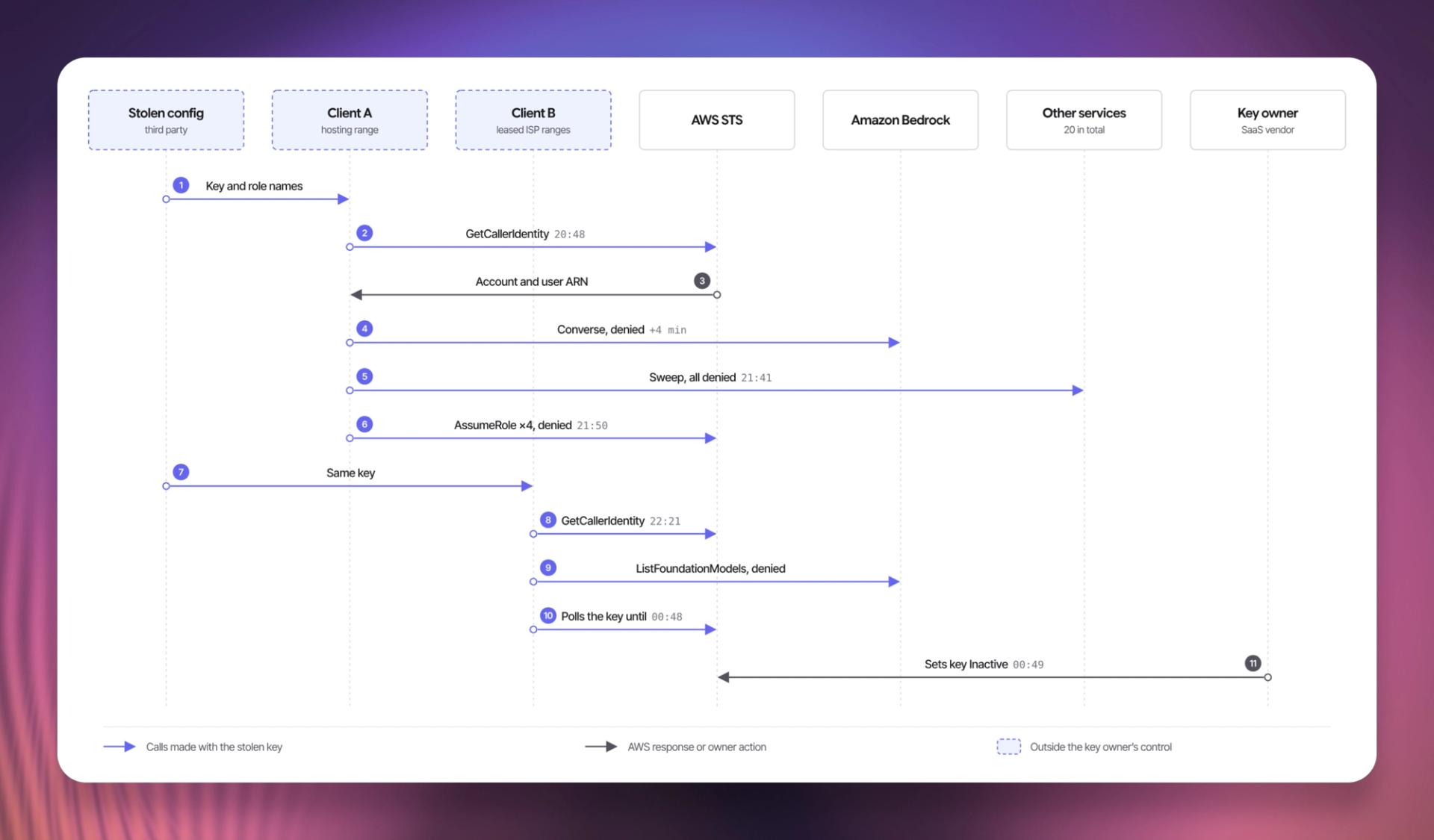
Figure 1. Two clients use one stolen key. Client A, on a hosting range, validates the key with GetCallerIdentity at 20:48 UTC and tries a Bedrock model 210 seconds later. It then sweeps other services, tries to assume four roles in outside accounts, and probes six outside buckets. Client B, on ranges that two residential providers announce, starts 93 minutes after Client A. It validates the key, lists Bedrock models, and polls the key until the owner sets it to Inactive at 00:49 UTC. AWS denied every call except GetCallerIdentity.
Timeline (UTC)
Calendar dates are removed. All times are on one day unless a row says -2 days or +1 day.
Stage 1: The key leaves a third party's environment
The key owner is a SaaS vendor. It issues each customer one IAM user and one long-term access key for S3 data exchange. The customer stores that key in its own systems. So the vendor cannot see where the key lives, and it cannot rotate the key without breaking the customer's jobs.
The logs point to a leak on the customer's side, not at the vendor. Four facts in the key owner's logs support this:
- The attacker held more than the key. In one second, Client A tried to assume four named roles in four AWS accounts. Then it probed six named buckets. None of these accounts, roles or buckets belongs to the key owner.
- One configuration bundle holds exactly that set of names. Examples are an AWS config file with role_arn lines, or a list of environment variables.
- The addresses match. Acquia published a list of malicious addresses on its status page. All five addresses that used the key are on it.
- The first probe matches the start time. Acquia dates the start of the malicious activity to 09:59:09 UTC. At 10:17:14 UTC on the same day, a client in one of the listed ranges sent a ListObjects call to the customer's bucket. The bucket name is a random string that nobody can guess. The call was denied.
The customer is Acquia, a digital experience hosting provider. Acquia later told its own customers that unauthorized parties may have copied configuration data, "including environment variables, which may include credentials" (Acquia customer actions notice). The key owner disabled the key before the provider said anything in public. The provider's first status post came 15 hours later, and the address list came 28 hours later. We did not see evidence from inside the provider. The link rests on the facts above and on the provider's own published indicators.
The first probe of the customer's bucket came two days before the first call with the key:
eventTime:        10:17:14Z (-2 days)
eventSource:      s3.amazonaws.com
eventName:        ListObjects
sourceIPAddress:  192.42.116.16
userAgent:        [curl/8.13.0]
errorCode:        AccessDenied
userIdentity.type:         AWSAccount
userIdentity.principalId:  AIDA[redacted]
userIdentity.accountId:    [outside account]
requestParameters.bucketName:  [customer bucket]
requestParameters.max-keys: 25- The value AWSAccount in userIdentity.type means that the caller signed the request with an identity of another AWS account.
- That probe did not use the stolen key. The first call with the key came about 58 hours later. We do not know why the attacker waited.
A key that a partner stores is part of your IaaS attack surface, although you do not control where it is kept.
Stage 2: Key validation with GetCallerIdentity
Each client started with sts:GetCallerIdentity. The call tells the caller that a key is live, and it returns the account ID, the user ID and the user ARN. AWS states that "no permissions are required to perform this operation". An explicit deny does not stop it.
eventTime:        20:48:33Z
eventSource:      sts.amazonaws.com
eventName:        GetCallerIdentity
awsRegion:        us-east-1
sourceIPAddress:  103.175.79.213
userAgent:        Boto3/1.43.123 md/Botocore#1.43.123 ua/2.1 os/windows#10 md/arch#amd64 lang/python#3.14.3 md/pyimpl#CPython m/e,N,D,b,Z cfg/retry-mode#legacy Botocore/1.43.123
userIdentity.type:         IAMUser
userIdentity.accessKeyId:  AKIA[redacted]
readOnly: true- The call has no errorCode. It is the only call type that succeeded: 17 times in four hours, from all five addresses.
- In the 30 days before, this key called GetCallerIdentity 86 times, always from AWS address space (AS14618). A validation call from a new network is the earliest signal that the logs give.
- Client A repeated the call before each new phase: at 20:48, 21:40, 22:31 and 22:54.
Stage 3: The LLMjacking attempt on Amazon Bedrock
The first action after validation was a model call, not a data call. Client A sent bedrock:Converse to an Anthropic Claude inference profile 210 seconds after the first validation. The client was python-requests, not Boto3, so a second script signed this request.
eventTime:        20:52:03Z
eventSource:      bedrock.amazonaws.com
eventName:        Converse
awsRegion:        us-east-1
sourceIPAddress:  103.175.79.213
userAgent:        python-requests/2.33.1
errorCode:        AccessDenied
errorMessage: User: arn:aws:iam::[redacted]:user/[redacted] is not authorized to perform: bedrock:InvokeModel on resource: arn:aws:bedrock:us-east-1:[redacted]:inference-profile/us.anthropic.claude-fable-5-2 because no identity-based policy allows the bedrock:InvokeModel action- Client A sent 7 Converse calls. Two were on the Claude inference profile. Five were on Amazon Nova Micro, Nova Lite and Meta Llama 3 8B in us-east-1 and us-west-2. It moved from the most expensive model to the cheapest ones.
- Client B never called a model. It sent 16 ListFoundationModels calls in the same two regions, each one directly after a successful GetCallerIdentity.
- CloudTrail records Converse as a management event, so a default trail shows the attempt. See Amazon Bedrock in CloudTrail.
Sysdig named this pattern LLMjacking when it reported a script that checked stolen cloud credentials against ten AI services (Sysdig, 2024). Here the same check ran against a key whose policy allows S3 only.
Stage 4: Cloud discovery across 21 AWS services
After the first model call failed, Client A looked for anything else the key could reach. It sent 20 calls to 19 services in two bursts. The first burst was 8 calls in 7 seconds. Every call was denied.
eventTime:        21:48:03Z
eventSource:      ec2.amazonaws.com
eventName:        DescribeInstances
sourceIPAddress:  103.175.79.213
errorCode:        Client.UnauthorizedOperation
errorMessage: You are not authorized to perform this operation. User: arn:aws:iam::[redacted]:user/[redacted] is not authorized to perform: ec2:DescribeInstances because no identity-based policy allows the ec2:DescribeInstances action. [trimmed]- The targets are where secrets and compute are: IAM, Secrets Manager, SSM Parameter Store, Lambda, CloudFormation, ECS, ECR, SageMaker, EC2, RDS.
- Client B ran a shorter list from two addresses. It added calls that inspect the key's own user: iam:GetUser, iam:ListAccessKeys, iam:ListGroupsForUser and iam:GetAccountAuthorizationDetails.
- EC2 returns Client.UnauthorizedOperation, not AccessDenied. A query for denied calls must match both codes.
- In the 30 days before, the key touched two services. In one hour of the attack it touched 17 services that were new for it.
Stage 5: Cross-account AssumeRole and outside buckets
At 21:50:14 Client A tried sts:AssumeRole on four role ARNs in four accounts, in about one second. None of the accounts belongs to the key owner. The attacker used the key as a possible way into the environment that the key was stolen from.
eventTime:        21:50:14Z
eventSource:      sts.amazonaws.com
eventName:        AssumeRole
sourceIPAddress:  103.175.79.213
errorCode:        AccessDenied
errorMessage:     User: arn:aws:iam::[redacted]:user/[redacted] is not authorized to perform: sts:AssumeRole on resource: arn:aws:iam::[outside account]:role/[redacted]
Client A then turned to six buckets with names that are not in the key owner's accounts. It sent two ListObjects calls with max-keys: 8. One hour later it read 11 configuration properties of each bucket: policy, ACL, encryption, logging, replication and six more.
eventTime:        21:51:12Z
eventSource:      s3.amazonaws.com
eventName:        ListObjects
awsRegion:        eu-central-1
sourceIPAddress:  103.175.79.213
errorCode:        AccessDenied
requestParameters.bucketName:  [outside bucket]
requestParameters.max-keys:    8
resources[0].accountId:        HIDDEN_DUE_TO_SECURITY_REASONS
additionalEventData.httpStatusCode: 403- The value HIDDEN_DUE_TO_SECURITY_REASONS in resources.accountId shows that another account owns the bucket.
- These denied calls are in the key owner's trail because the caller's account also receives the event. A denied call on someone else's bucket is evidence that your key is in someone else's hands.
- The attacker knew the region of each bucket. It called GetBucketLocation once per bucket, then sent the other reads to four regional endpoints.
Stage 6: A second tool set polls the key
Ninety-three minutes after Client A, a second tool set began to use the same key. It has another Boto3 build (1.44.9), another Python version (3.12.15) and a Linux kernel string that ends in linuxkit. That string is typical of a container on a desktop container runtime (inference). It came from four addresses on two networks, and all four sent the same user agent.
eventTime:        00:33:18Z (+1 day)
eventSource:      sts.amazonaws.com
eventName:        GetCallerIdentity
sourceIPAddress:  63.246.137.113
userAgent: Mozilla/5.0 (X11; Linux x86_64) liveness-check/1.0- Client B worked on a schedule. One address validated the key and listed Bedrock models at 22:21, 23:51, 00:02, 00:15, 00:29 and 00:39.
- The liveness-check/1.0 client sent 10 calls in the last 16 minutes. We found no public report of this user agent.
- Client A and Client B share no address, network, SDK build or timing. But the addresses of both are on the provider's list for one incident. So both tool sets belong to one campaign, which we track as Claimant Braniac. The logs do not show if one operator or several ran them.
- During the four hours, the customer's normal jobs made 88 successful calls with the same key from private addresses. The stolen key and the real workload ran side by side.
How far it got
All counts come from the CloudTrail events of the key between the first attacker call and the deactivation.
The least-privilege policy held. The key could write to and read from one bucket, and no call with the key named that bucket. The one call that did name it came two days before, from another AWS identity, and S3 denied it. The only data that left was the identity of the IAM user.
The logs cannot see what happened to the other credentials in the same configuration set. The four roles and six buckets belong to other accounts, and their owners hold those trails.
MITRE ATT&CK mapping
The four AssumeRole attempts are an attempt to use T1078.004 in other accounts. All were denied.
Hunting for this pattern
The queries are DuckDB SQL over CloudTrail log files in the JSON format that AWS delivers to S3. We ran each one on 30 days of events for the stolen key.
Setup:
CREATE OR REPLACE VIEW trail AS
SELECT CAST(r.eventTime AS TIMESTAMP) AS ts,
       r.eventSource, r.eventName, r.awsRegion, r.sourceIPAddress, r.userAgent,
       r.errorCode, r.errorMessage, r.recipientAccountId,
       r.userIdentity.type AS id_type, r.userIdentity.arn AS arn,
       r.userIdentity.accessKeyId AS access_key
FROM (SELECT unnest(Records) AS r
      FROM read_json('cloudtrail/*.json', maximum_object_size = 1073741824));
1. A long-term key is validated, then calls Amazon Bedrock within 15 minutes. On this incident it returned three rows, one for each address that did both. The shortest gap was under one second.
SELECT v.access_key, v.sourceIPAddress,
       min(v.ts) AS validated_at, min(b.ts) AS first_bedrock_call,
       count(DISTINCT b.eventName) AS bedrock_actions,
       count(*) FILTER (WHERE b.errorCode IS NULL) AS bedrock_ok
FROM trail v
JOIN trail b
  ON b.access_key = v.access_key
 AND b.sourceIPAddress = v.sourceIPAddress
 AND b.eventSource = 'bedrock.amazonaws.com'
 AND b.ts BETWEEN v.ts AND v.ts + INTERVAL 15 MINUTE
WHERE v.eventName = 'GetCallerIdentity'
  AND v.access_key LIKE 'AKIA%'
GROUP BY ALL
ORDER BY validated_at;
2. A long-term key calls three or more services in one hour that it did not call in the 30 days before. It returned one row: 17 new services in the hour of the first sweep. It returned nothing for the 30 days of normal use.
WITH hourly AS (
  SELECT access_key, date_trunc('hour', ts) AS hour, eventSource
  FROM trail
  WHERE access_key LIKE 'AKIA%'
  GROUP BY ALL
)
SELECT h.access_key, h.hour,
       count(*) AS new_services,
       list(replace(h.eventSource, '.amazonaws.com', '') ORDER BY h.eventSource) AS services
FROM hourly h
WHERE NOT EXISTS (
  SELECT 1 FROM trail p
  WHERE p.access_key = h.access_key
    AND p.eventSource = h.eventSource
    AND p.ts >= h.hour - INTERVAL 30 DAY
    AND p.ts <  h.hour
)
GROUP BY ALL
HAVING count(*) >= 3
ORDER BY h.hour;
3. One key and one address get 10 or more denials across 5 or more services in 10 minutes. It returned two rows: the sweep of Client A (20 denied calls, 19 services) and the sweep of Client B (18 denied calls, 10 services).
SELECT access_key, sourceIPAddress,
       time_bucket(INTERVAL 10 MINUTE, ts) AS window_start,
       count(*) AS denied_calls,
       count(DISTINCT eventSource) AS services
FROM trail
WHERE errorCode IN ('AccessDenied', 'Client.UnauthorizedOperation')
GROUP BY ALL
HAVING count(*) >= 10 AND count(DISTINCT eventSource) >= 5
ORDER BY window_start;
4. An IAM user is denied AssumeRole on a role in another account. It returned the four attempts. Add the account IDs of your own organization to the exclusion list.
SELECT ts, access_key, sourceIPAddress,
       regexp_extract(errorMessage, 'arn:aws:iam::(\d{12}):role/', 1) AS target_account,
       recipientAccountId AS own_account
FROM trail
WHERE eventName = 'AssumeRole'
  AND errorCode = 'AccessDenied'
  AND id_type = 'IAMUser'
  AND regexp_extract(errorMessage, 'arn:aws:iam::(\d{12}):role/', 1)
      NOT IN ('', recipientAccountId)
ORDER BY ts;
Indicators
Use these to search your own CloudTrail logs for Claimant Braniac's tool sets. Ownership of hosting and proxy ranges changes over time, so check each address before you act on it. The provider's full list of 17 addresses and ranges is on the Acquia status page (https://status.acquia.com/incidents/289tg0v47fx0).
Takeaways
Treat a key that a partner stores as a key that will leak. You cannot inspect the partner's laptops, pipelines or hosting provider. Give the key the smallest policy that the job needs. Here that policy turned 163 calls into 17 harmless ones.
Alert on what a key has never done. This key used two services for 30 days and 17 new ones in one hour. A baseline per access key finds that change without a rule for each service.
Read the denied calls. Every useful signal in this incident was a denial. Denied AssumeRole calls and denied bucket reads also told the owner which other accounts were at risk.
Add a network condition to partner keys. An aws:SourceIp or aws:SourceVpc condition would have denied the model calls and the sweep. It cannot stop GetCallerIdentity, so keep the alert on validation from a new network.
Search your own logs when a supplier publishes indicators. Go back further than the alert. Here the first trace was one denied call from an outside account, two days before the stolen key was used.
Tell the partner what the attacker asked for. The role names and bucket names in your denied calls are an inventory of what the attacker stole from the partner. Send them that list.
Frequently asked questions
What is LLMjacking?
LLMjacking is the use of stolen cloud credentials to run large language models at the victim's cost. On AWS the attacker calls Amazon Bedrock actions such as Converse or InvokeModel. The victim pays for each token.
How do I find LLMjacking attempts in CloudTrail?
Search for eventSource = bedrock.amazonaws.com from principals that never used Bedrock before. Include the denied calls. A GetCallerIdentity call from a new network shortly before the Bedrock call makes the case stronger.
Can I block sts:GetCallerIdentity?
No. AWS requires no permissions for this call, and an explicit deny does not stop it. Monitor it: a validation call from a network that the key never used is an early sign of a stolen key.
Why did the attacker call services that an S3 key cannot use?
The attacker does not know the policy of a stolen key. A script tries the valuable services first and reads the errors. The denials cost the attacker nothing, so a small policy limits the damage but does not stop the attempt.
What should I do when a partner's access key is used from a new network?
Set the key to Inactive, then tell the partner. Check the trail for successful calls other than GetCallerIdentity. Send the partner the role and bucket names from the denied calls, because those names come from the partner's own configuration.
Does AWS quarantine a stolen access key by itself?
AWS can attach the AWSCompromisedKeyQuarantine policy when it finds a key in a public place. A key stolen from a private environment is not public, so do not wait for that policy.
How Exaforce customers are protected
A stolen key looks valid to AWS. The attack becomes visible only in what the key does after the first call. Exaforce MDR watches that activity for every identity in your cloud accounts, people and machines, and responds around the clock.
- Coverage. Exaforce covers each stage in this post. It sees the use of a key from a new place and calls to services that the key never used, AI services included. It sees the sweep across services and the attempts to move into other accounts. It reads the AWS activity that you already log. See the IaaS attack surface page for the full scope.
- Correlation. The Exabots, the Exaforce AI agents, joined this activity and the alerts from the customer's other cloud security tools into one incident. Analysts worked one case with one timeline, not a queue of separate alerts.
- Response. Exaforce MDR analysts opened the incident with the customer's security team while the attack was in progress. The customer disabled the key. No model ran, and the attackers read no customer data.
- Log analysis. The analysis after the incident showed that the leak was outside the customer's own systems. It gave the customer the list of outside roles and buckets to send to the affected partner. The hosting provider later published its own indicators, and all five addresses from this incident are on that list.
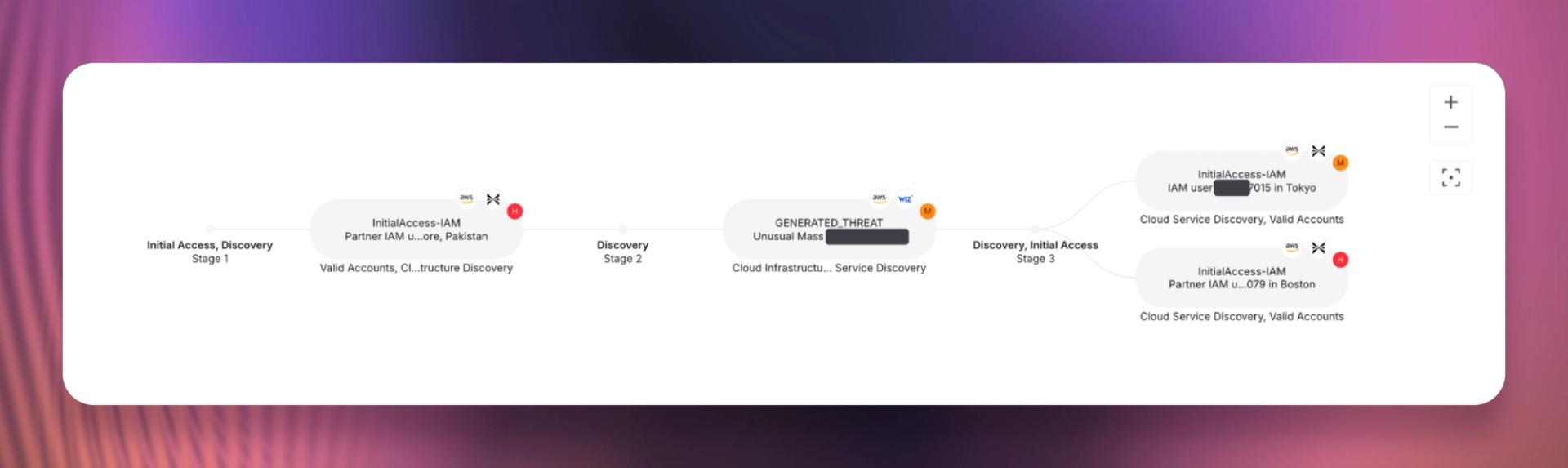
Figure 2. The Exaforce console shows the incident as one attack chain. It joins four related findings in three stages, from the first use of the key to its use from two more networks. The stage numbers are from the console and differ from the stages in this post. The name of the IAM user is redacted.
Seeing this in your environment? Call the Exaforce incident response hotline at +1 (844) 660-1663, or go to https://www.exaforce.com/incident-response. A responder answers within 15 minutes, and you do not need a retainer.
References
- AWS, CloudTrail record contents
- AWS, STS GetCallerIdentity
- AWS, Monitor Amazon Bedrock API calls with CloudTrail
- AWS, IAM global condition context keys (aws:SourceIp, aws:SourceVpc)
- Acquia, Customer actions: November 2026 security incident
- CMSWire, Acquia Says Attackers May Have Copied Configuration Data, Customer Credentials
- Sysdig, LLMjacking: Stolen Cloud Credentials Used in New AI Attack
- Elastic, AWS Bedrock Foundation Model Enumeration Followed by Invocation via Long-Term Key
- MITRE ATT&CK: T1199, T1552.001, T1078.004, T1496.004, T1526, T1580, T1087.004, T1619, T1090