What has changed since early 2025, mostly since Claude Code has emerged, is that AI is more prominent on the organization's endpoints. More applications, agents, code, connections, domains, MCP servers, browser extensions and developer plugins are now running on the organization's endpoints. With this scaling AI agentic landscape, we see that security teams struggle to cover this. Previous visibility capabilities are not enough, and catching crucial rogue agents and shadow AI applications in time became harder than ever.
For example, at one of our customers, we discovered more than 5,200 AI skills, 290 MCP servers and 879 browser extensions on their endpoints, next to 1,100 hosted agents. In the last 30 days alone, 5,845 AI chats contained secrets or PII, and 94 endpoints ran packages that execute their own code at install time. And we discovered this with no additional agent deployed.
Nowadays, when a SOC analyst wakes up in the morning, they usually wonder what agents are running on their organization's endpoints, what access those agents have and if any of them are misused. And if so, how should they respond?
The old ways to get this data
Let's first consider the old ways to get this data:
- We have the EDR data (over API to Exaforce), which gives us an installed-app inventory. But it does not show which AI processes were running, or what is actually live inside a skill or an MCP config. For the processes, we usually need the raw telemetry export (CrowdStrike FDR, SentinelOne Cloud Funnel, Defender XDR streaming).
- AI provider admin APIs can show chats, tokens and users. But they show nothing about the endpoint: local MCP servers, skills, hooks or plugins.
The “go-to” vendor answer is a new endpoint agent or a proxy. Both come with a price: one more thing to deploy on every endpoint, one more thing to maintain, one more console outside the SIEM, and one more vendor to manage. When talking with our customers and prospects, many of them declined a new endpoint agent outright and asked if there is another approach.
One needs to understand that the risk sits in files at rest: skills, MCP configs, rules files, editor extensions. Traffic inspection doesn’t read them.
What “Agentless” means
The idea behind agentless is to minimize the friction with the customer's organization. It removes the burden of mass deploying an additional agent on the organization's endpoints (with all that this entails), and uses the data and the connections the customer already has, both for visibility and response.
In practice, agentless means three things. Exaforce does not install an agent of its own on any of the customer’s devices. It does not sit in the path of your traffic, so there is no proxy to route through and no browser extension to roll out. And it reads from the tools you already run, with the permissions you already granted.
Basically, each data source connection adds a layer. The LLM providers show chats and tokens, EDR telemetry shows what ran, the collector shows what is configured, and the code sources show what is in the repo. Together, they create a complete picture of the AI agent surface of the organization. The customer's coverage is in its own hands: what you connect is what you see.
Three layers of visibility
And that's where Exaforce, as the most intelligent and broad AI SOC, comes in. We already hold the data and we already have a semantic model in place, so no new agent is needed.
Three layers of AI visibility
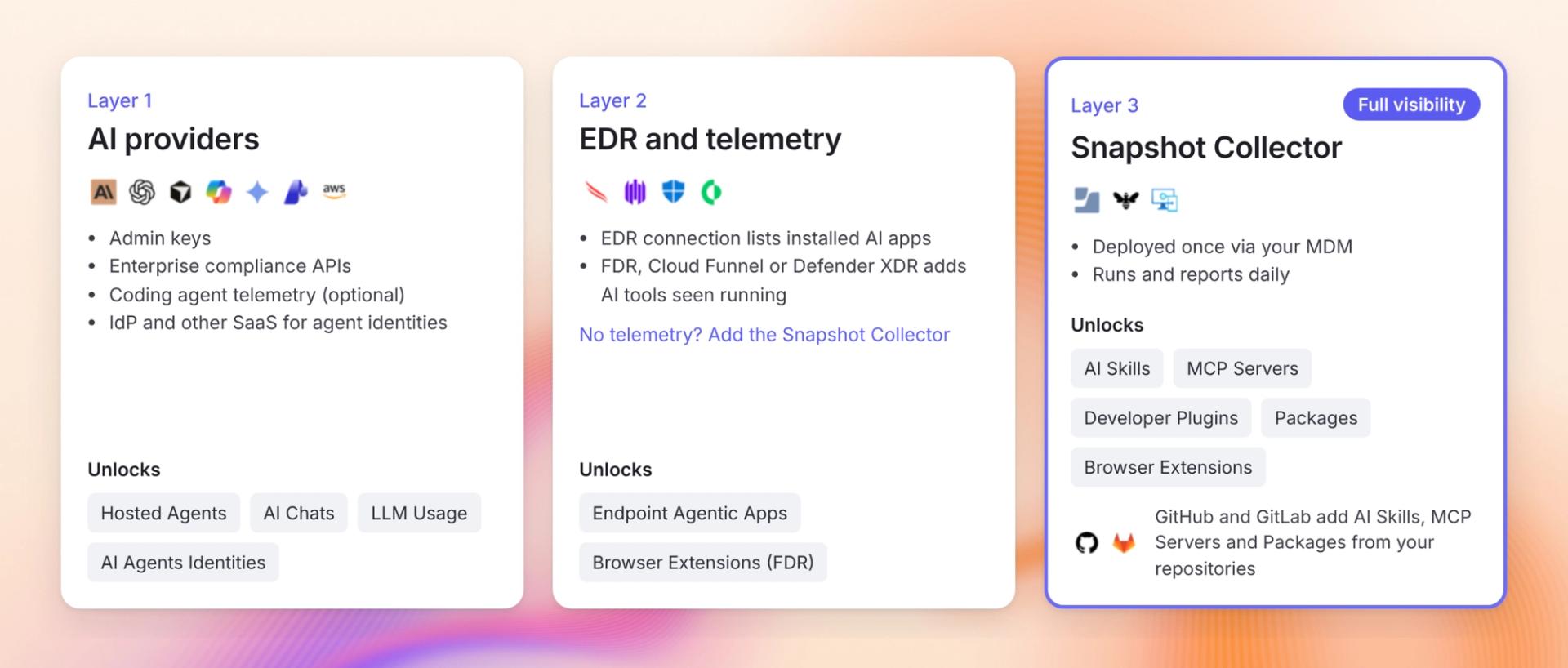
For AI agent security, we have three layers of visibility, depending on the connections the customer is able to provide:
- Layer one is based on the AI provider connections: an Admin key for usage and identities, a Compliance key (with Enterprise license) for chat content, and a workspace API key for hosted agents. OTEL from the client apps, or agent hooks in Cursor, adds the AI Chats on endpoints, even without an Enterprise license. This layer will provide visibility into Hosted Agents, AI Chats, LLM Usage and AI Agent identities for the customer.
- Layer two is based on the EDR connections. A traditional EDR API integration with Exaforce will provide data on the installed AI apps on the customer's endpoints. With CrowdStrike, the full list needs FDR. If the customer can also provide the EDR telemetry (FDR, Cloud Funnel or Defender XDR), it will add AI tools and running AI applications. Together, this will provide full visibility into the customer's endpoint agentic applications, and also browser extensions.
- The third layer is Exaforce's in-house Snapshot Collector, an MDM script that needs to be deployed once (through Iru (Kandji), Intune or another MDM). The snapshot will run once a day on the customer's endpoints and will provide visibility into its AI Skills, MCP Servers, developer plugins, npm packages, and additional browser extensions. The script isn't an agent. There is no daemon and no service that needs to be managed, maintained or controlled. It already runs with the rest of the MDM commands and scripts, and doesn't create any additional friction for the customer or its endpoints.
Our customers can also complement this data with code repo integrations with GitHub/GitLab. The IdP and other SaaS connections the customer already has tie each AI agent identity to a real identity and show the OAuth grants and API keys that agents act with.
When a finding fires on an AI agent, the customer will see a full event that ties the agent to all the other data points existing for the customer that are related to it, based on the semantic model. Whether this agent is on the endpoint or hosted, used a skill, an MCP server or a dev plugin, the incident will be able to tell us. It will also tell us whether this agent inherits its permissions from a specific user, and what it did within the organization (actions, access, how it was used). Exaforce will connect all the data points to a full picture revolving around this agent.
Isn’t an MDM script just an agent?
As detailed above, the third layer of visibility is provided with the customer deploying a script into its MDM, which provides full endpoint visibility for AI agents. The difference between this script and a full agent is that it runs once a day under MDM as root or SYSTEM, then exits. No additional daemon or services are required for this, and it is read-only.
The Snapshot Collector is also designed to be careful with what it sends outside. It removes secrets seen on the device before anything is uploaded. If a file cannot be cleaned of secrets, it is not sent. The upload is a single outbound HTTPS call to the customer’s Exaforce tenant, and each device has its own token that the customer can revoke at any given time. Nothing listens on the device for incoming connections.
We made one more decision by design. The script only reads. A script that also blocks is an agent in everything but name, and we concluded that response and prevention can be enabled using other connections our customers use, that work seamlessly with Exaforce automation agents.
Does agentless mean weak endpoint coverage?
All of our response and future prevention capabilities (a hint on our next release) will be made through the already established connections (EDR, LLM provider APIs). This covers deactivating keys, removing members and spend limits, and inline blocking per policy with inference hooks where available, starting with Anthropic and Cursor.
With host agents, inline gateways or a proxy, there is a hidden cost that only shows after the rollout. They add a stop on the way to the model, so every prompt goes to the vendor's cloud and only then to the AI provider. One security team shared with us that this adds at least 0.8 seconds to every prompt, and up to 30 seconds initially. Imagine an AI agent that sends many prompts to finish one task. These small delays will stack up. This results in agents that work longer, developers that wait while coding, and a frustrated organization.
Native connections do not sit between the user and the model, so visibility doesn't add any delay to a prompt. For prompt blocking, our design relies on the providers' official inference hooks, which are built specifically for this purpose, and not on a generic hook or a proxy that adds another stop in the path.
We already heard that agentless sounds like weak endpoint coverage. But together with the MDM script and the other integrations, we enable our customers to control what they want visibility into, with the least friction possible.
The SOC POV
How would the SOC benefit from this? For example, take the Nx supply chain attack from August 2025 (see our blog about it). Malicious versions of a popular npm package ran a script at install time. The script then used the AI coding tools already deployed on the developer's machine, Claude and Gemini, with their permission prompts switched off, to search for tokens and keys. For the SOC, the hunt comes down to three distinct questions:
- Which endpoints have the bad package versions?
- Which of them also run AI coding agents?
- What can these agents reach through their MCP servers and settings?
With an inventory of packages, developer plugins and coding tools, agents, MCP servers, browser extensions and their configuration on every developer endpoint, the analyst answers all three from one place, in a fraction of the time.
At the customer described above, the same view shows 94 endpoints that ran install scripts, and one with a confirmed malicious package. Exaforce enabled the customer with visibility into that landscape.
Deploy the Snapshot Collector
Exaforce's vision is to provide our customers with the toolbox to gain AI agent visibility, response and prevention with the connections and the tools they already have, with the addition of a script pushed through the MDM. Exaforce customers will gain visibility into every AI skill, MCP server, developer plugin, code package and browser extension running on every endpoint, with the addition of how all these and other agentic apps are configured.
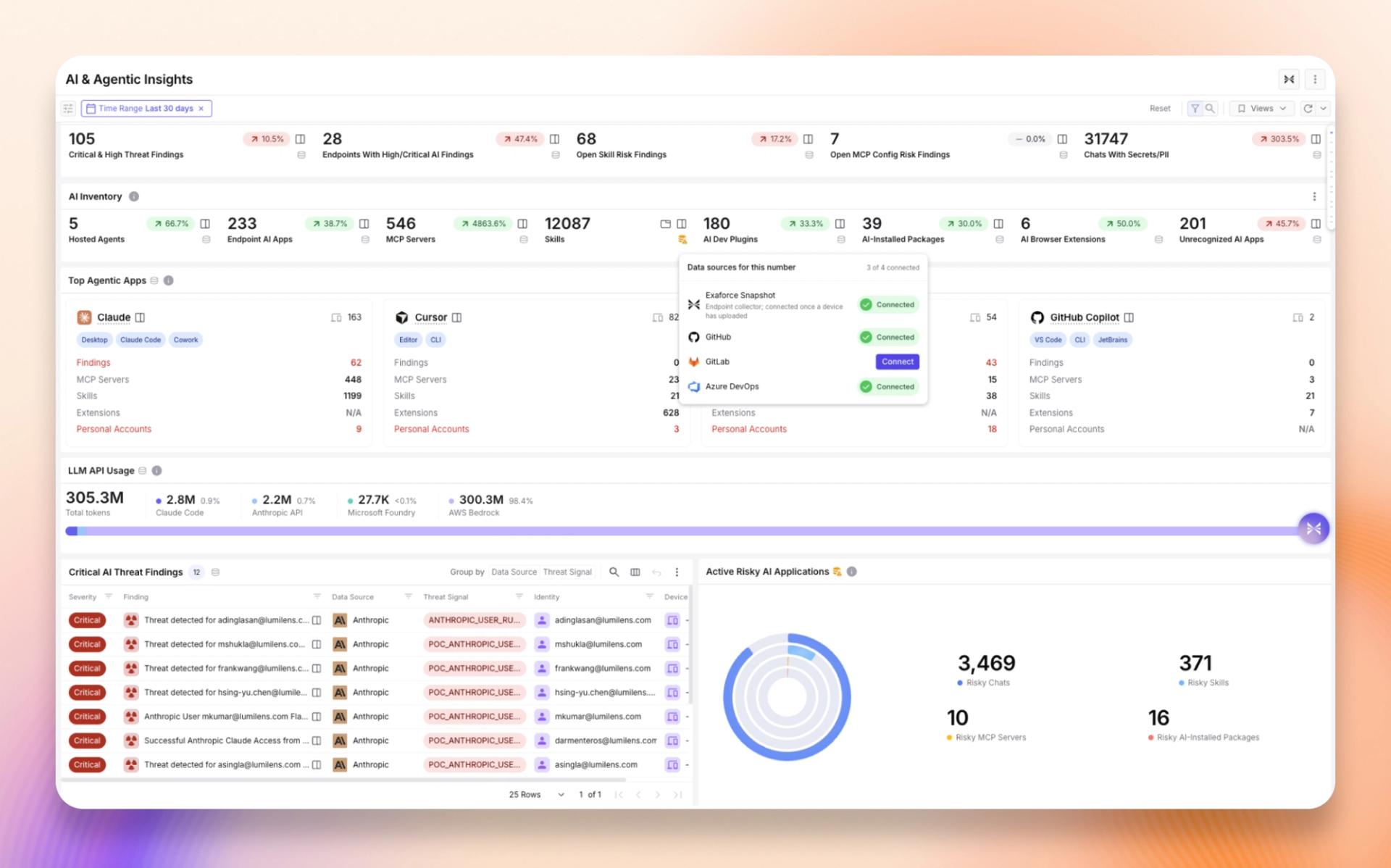
To simplify the visibility into all of these integrations, we also provide our customers with a unified dashboard. It includes every integration's status, AI agentic metrics, and proactive data to help them detect, investigate and respond to any AI agentic risk or threat. Together with the future EDR policy allowlist and AI inference hooks, our customers will be able to cover AI agentic security end to end, without deploying any agent on their organization's endpoints.
AI & Agentic Insights dashboard
We encourage our customers, current and future prospects to take this step and deploy the Exaforce Snapshot Collector as soon as possible. Not a customer? Ask us for a demo to see this in action.