As a security leader, your job goes beyond managing alerts and investigations. You need to review access, investigate suspicious activity, stay ahead of emerging threats, enforce policies, and keep leadership informed. You also have ongoing tasks, recurring checks, and reports that need your attention throughout the day.
The first generation of AI agents in SOC brought automation to specific security tasks, such as alert triage, threat detection, and investigation. But these agents operate within narrow boundaries. Each one handles a defined function, often working independently of other agents and workflows. They also lack persistent memory. Once a session ends, the context and instructions shared during that interaction are lost. The next session starts from scratch, requiring you to explain their expectations all over again. This makes it difficult to build workflows around agents that can learn how a team works, retain context, and take on responsibilities over time.
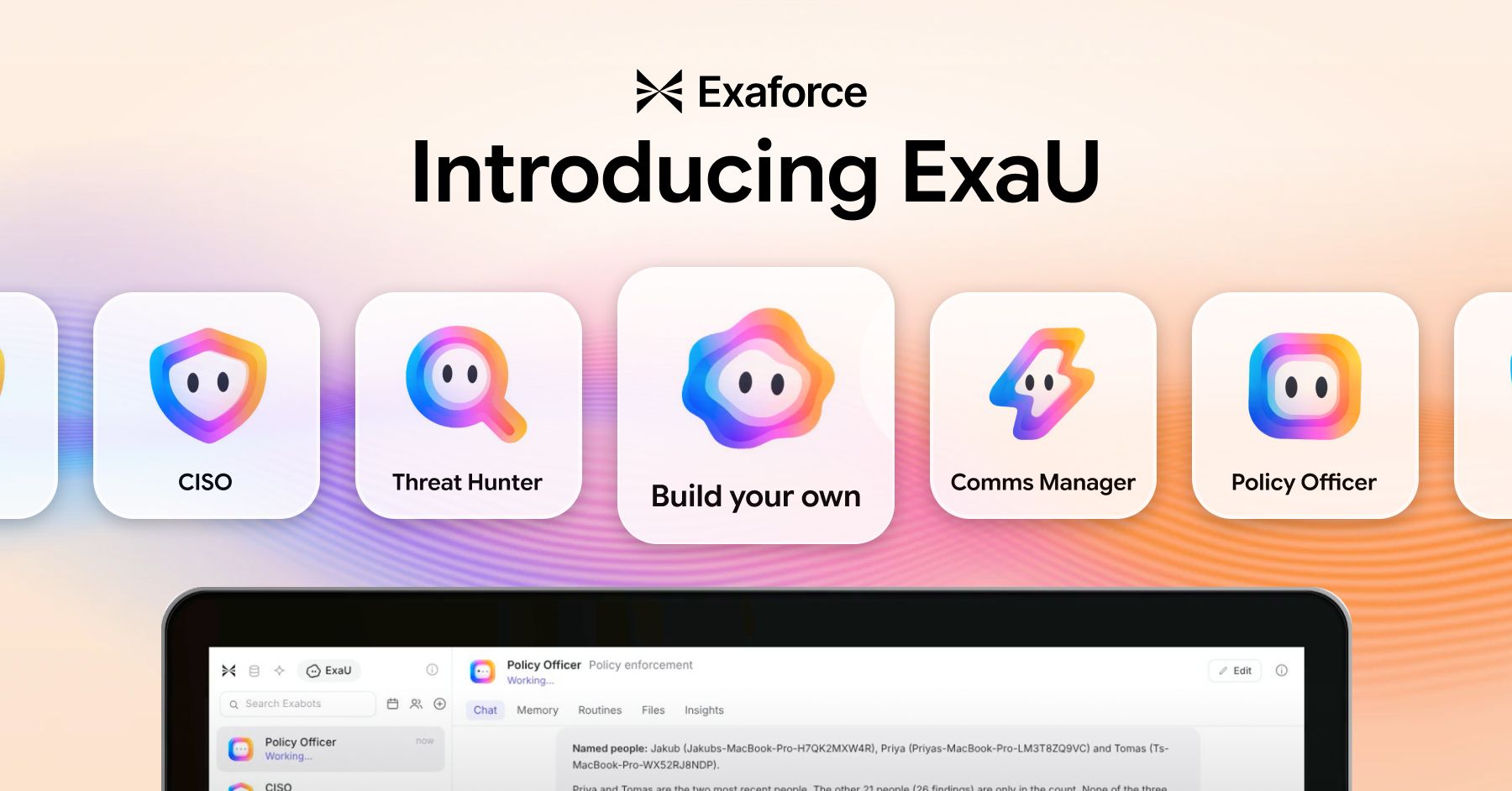
Introducing ExaU: A New Generation of Security Agents
Today, we're introducing ExaU, a new generation of AI workforce built around a simple idea: give every security team its own team of intelligent agents, each with a custom role, persistent memory, and the ability to work independently and together as a team. ExaU doesn’t wait for instructions. Once deployed, ExaU agents work silently in the background and proactively come to you when something needs your attention.
ExaU is an evolution of the next generation of security agents that can act proactively. With ExaU, your customized Exabots work on an ongoing basis. They follow schedules, monitor their areas of responsibility, investigate changes, and keep track of work over time. They can pass findings and tasks to other Exabots, allowing work to move across your team without requiring you to coordinate every step.
You don't have to keep prompting them. Once you set an agent up, it works in the background on a schedule, looks into changes in its area, and comes to you when something needs your attention. You give it a responsibility once, with the context it needs. It remembers your instructions, its past findings, and your decisions. When priorities shift, you update the instructions and it carries that forward. The longer an agent does the job, the better it gets at it.
You can start from a template or describe the job in plain language, the way you do it today or the way you want it done. A few examples:
- A security chief of staff that tracks open risks, owners, and deadlines across your team, and delegates tasks to other Exabots.
- An access reviewer that checks every privileged change against policy
- A policy officer that enforces corporate and AI usage rules
- A briefing agent that drafts the Monday status for the CISO
Agents also build their own to-do list. Tell one what it owns, and it watches what is actually happening across identities, devices, cloud infrastructure, SaaS apps, and AI tools to work out what needs doing next. It also decides when something matters, so you hear about real issues and a lot less noise.
Built on the same Exaforce foundation
ExaU works natively inside Exaforce. They use the same real-time security knowledge graph that powers the rest of the platform, which continuously connects identities, cloud activity, devices, SaaS applications, and security telemetry. They understand how those pieces relate from their first task.
ExaU also uses the identities, integrations, and data sources you've already connected to Exaforce. You don't need to provision anything new. Every agent works with your own security data and records what it does in the Exaforce audit log.
ExaU Exabots sit alongside native Exabots, the Exaforce-managed agents that handle core security functions like threat detection, alert triage, and investigation around the clock. ExaU lets each person on your team build agents for the extra work that's specific to them, and then share those agents. An analyst can share a threat hunting agent with the CISO. The CISO's briefing agent can pull status from every team's agents. The agents work together the way your team already does.
What you can do with ExaU
You can build an agent for whatever your team needs. Start from a template or describe the job in plain language, the way you do it today or the way you want it done. Then give each agent its own job, and add another when the work grows. They work in parallel, hand off to each other, and keep going around the clock. Here's what that looks like day to day.
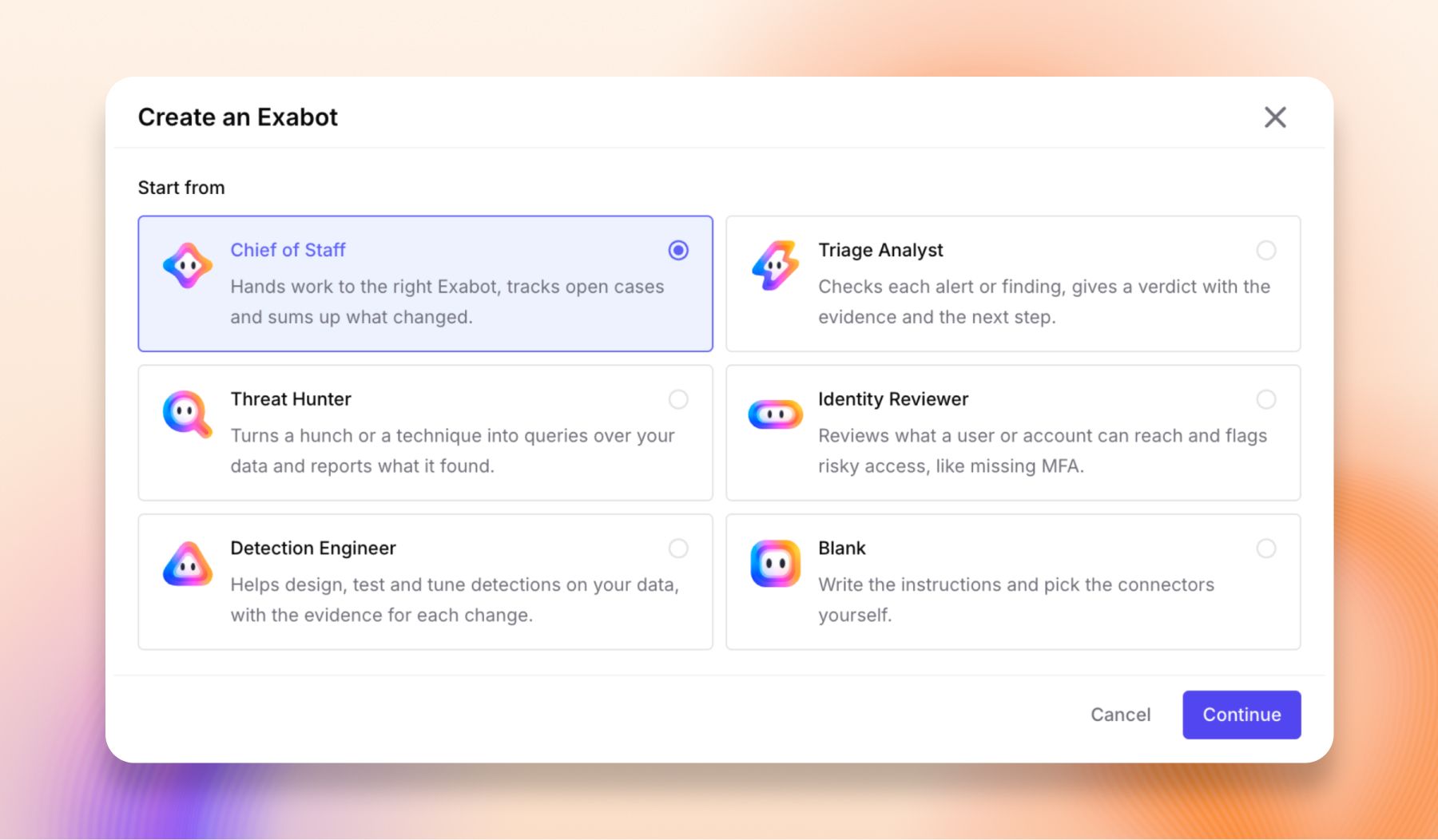
Build agents for the roles you need
A threat hunter that looks for hidden compromises. An access reviewer that checks every privileged change against policy. A policy officer that enforces corporate and AI usage rules. A security chief of staff that tracks open risks and owners. The role is whatever you need it to be.
Let them build the list
Tell an agent what it's responsible for. It watches what's actually happening across identities, devices, cloud infrastructure, SaaS apps, and AI tools, and works out what needs doing next. It comes back with findings, questions, and recommendations, and it also decides when something matters, so you hear about real issues instead of more noise. Agents can set their own follow-ups and run routines that end on a date or after a set number of runs.
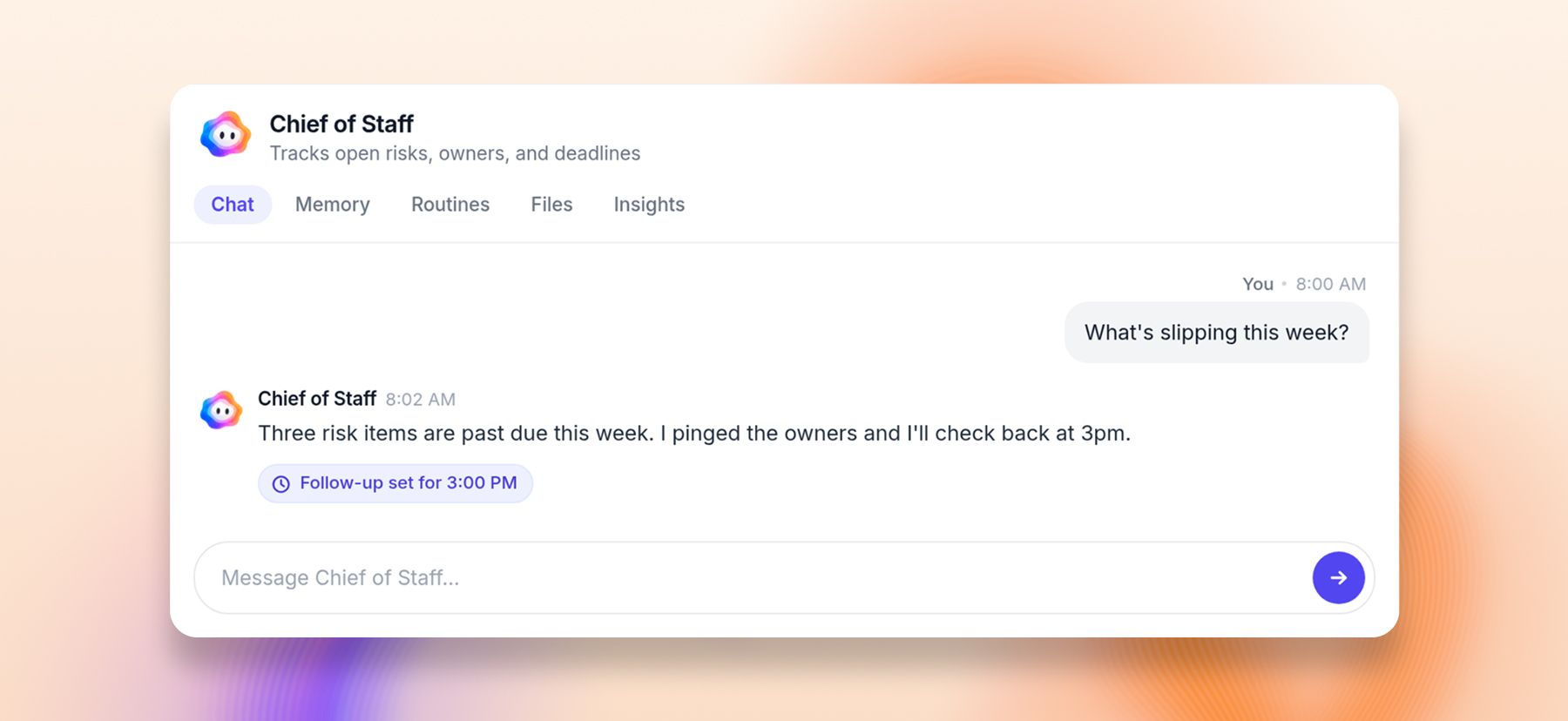
Agents that remember
Agents remember your decisions, exceptions, preferences, and past instructions, so nobody explains the same thing twice. See what your agent remembers. Every agent has a Memory tab, so you can see what it knows. Memory comes in three parts. Lessons are things the agent picked up on the job, like how to work in a specific test tenant. Team notes are shared with everyone who uses the agent. Only you notes are your personal preferences, like how you want a daily PR watch written up.
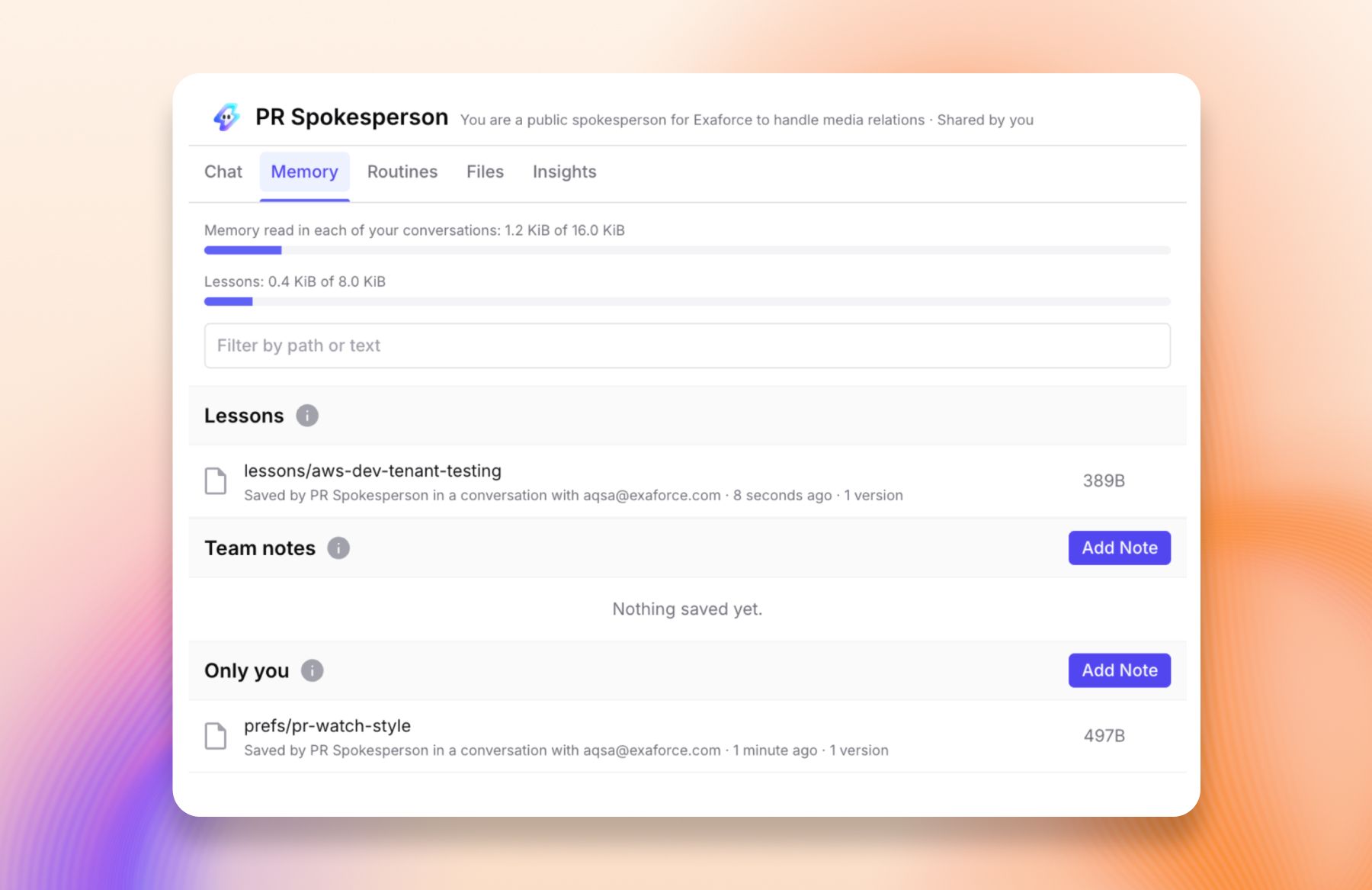
Routines
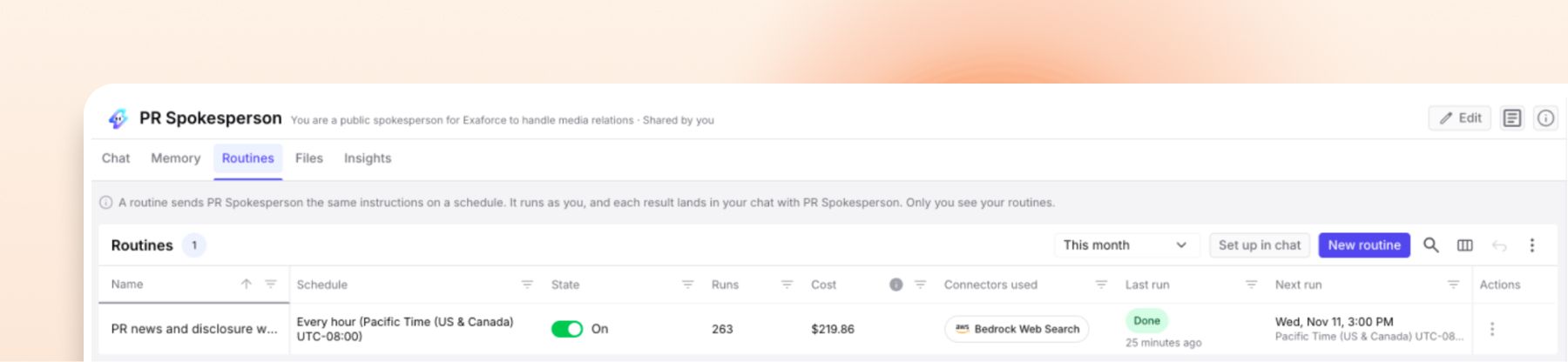
Agents can run automatically on the routines you set. Every agent works from the Exaforce knowledge graph, which connects identities, cloud activity, devices, SaaS apps, and security telemetry. Your agents understand how those pieces relate from their very first task.
Permissions
Agents operate within the permissions boundaries you define and only with your explicit approval. Response actions (e.g. revoking sessions, resetting password, containing a device) are defined by automations in the system; agents can use these actions only if they have the permissions to do so. Any action in the platform (e.g. updating a finding, close a finding) is governed by the user's permissions.
Work the console with you
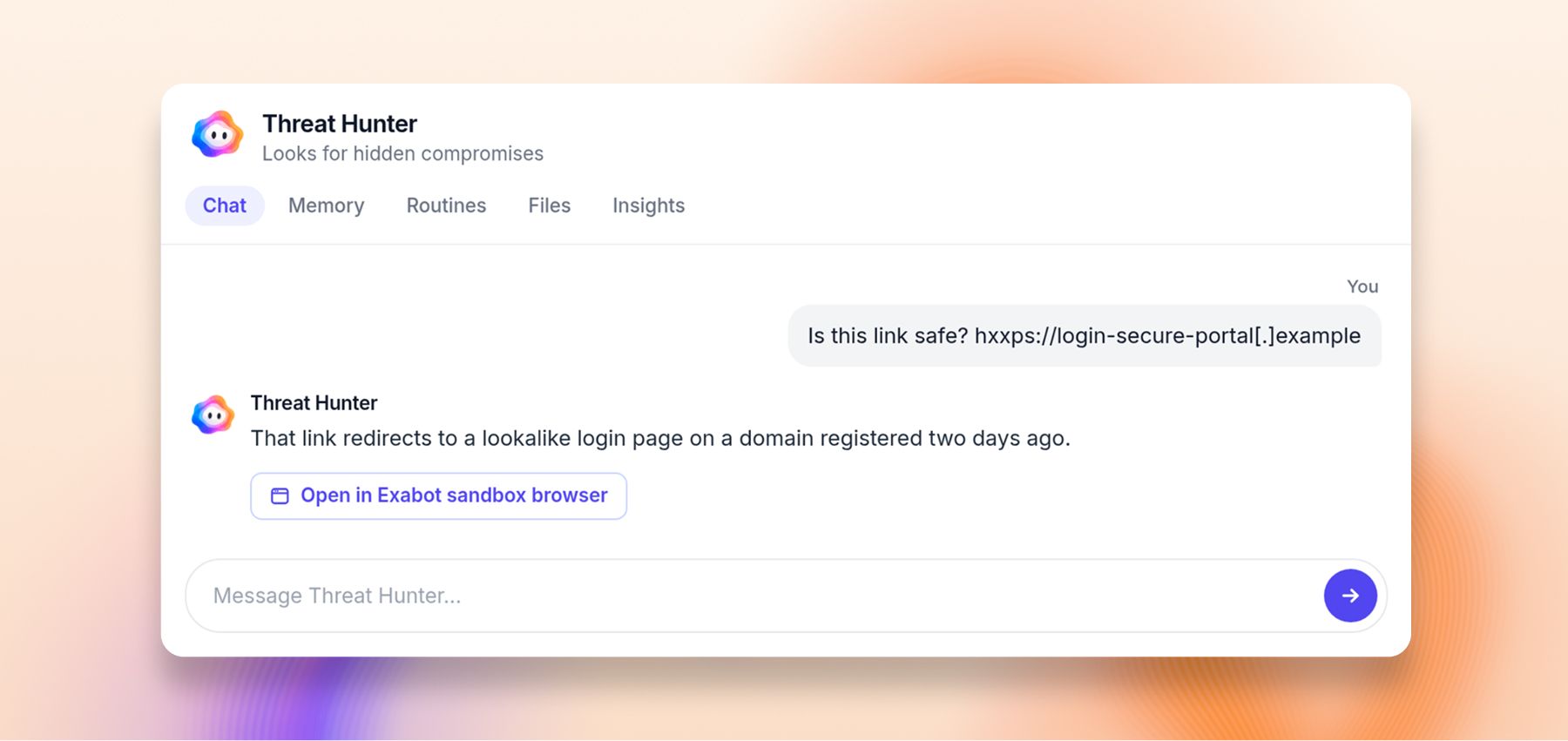
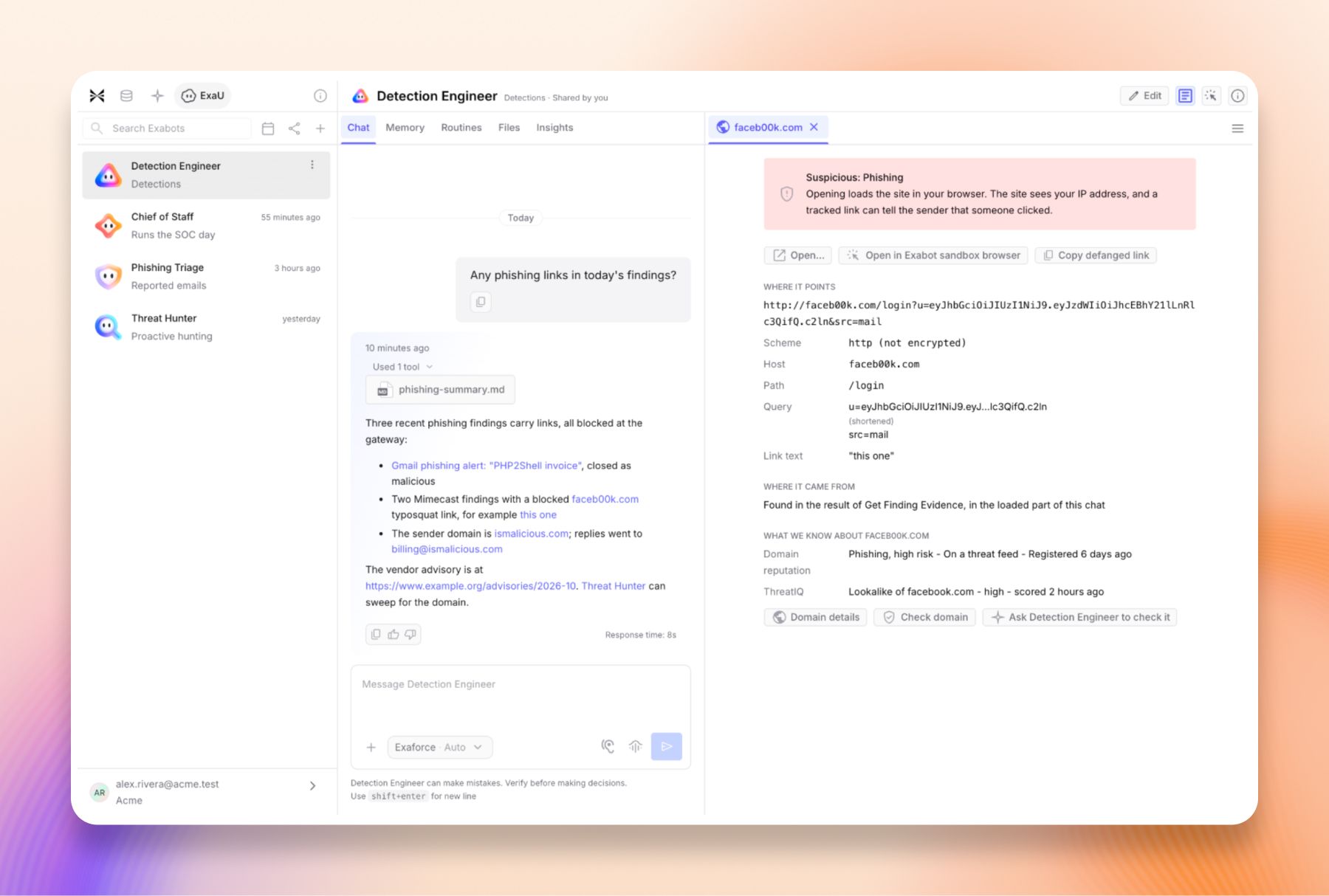
In your own 1:1 chat, an agent can open an Exaforce page, read it, and click, type, and scroll with its own cursor. Anything that would change data waits for your Allow or Deny, and one click in the panel puts you back in charge. Outside links open in a sandbox browser next to the chat (on the web, where the sandbox is deployed), and the agent tells you where a redirect really landed.
Talk to them while you work
ExaU supports voice mode and dictation mode so you can speak to it while on the go. Hang up, keep typing, and it still remembers the call.

Share agents across the security organization
An analyst can share a threat hunting agent with the CISO. The CISO's briefing agent can gather status from every team's agents. One finding can trigger a hunt, an activity audit, and outreach to an employee all at once, and the results roll up into a single assessment. You can also share a read-only copy of any conversation with specific people or with your whole organization, while your live chat stays private.
ExaU - Built by You. Working for You. Always On
We put the U in ExaU on purpose. It is built with you, security practitioner in mind. Customized by you and working for you so you can get time back.
ExaU is included in the Exaforce platform and available now. Get a demo now.