Splunk is the data platform that has been the default SIEM for large security operations centers for more than a decade: Splunk Enterprise Security for detection and investigation, Splunk SOAR for automation, and the same index serving observability. It is now part of Cisco. Teams look for a Splunk alternative for security operations when ingest-based licensing forces them to choose which logs to keep, when the operating effort of tuning detections, maintaining playbooks and correlating alerts by hand outgrows the team, or when they want the investigation completed rather than enabled. This guide covers what Splunk does for the SOC, why teams look beyond it, what to evaluate in a replacement, and five options to test. Exaforce publishes this page and is one of the five; it ingests Splunk data as a source and is used to replace it.
What Splunk does for the SOC
Splunk ingests, indexes and searches machine data from servers, cloud services, applications and security products. Splunk Enterprise Security sits on that index as the SIEM, with correlation searches, risk-based alerting and investigation workflows; Splunk SOAR automates response through playbooks. Licensing is based on ingest volume, with workload-based options. (As published by Splunk, Nov 2026.)
Why teams look beyond Splunk
- Ingest pricing shapes coverage. When the bill tracks daily ingest, growing cloud and SaaS telemetry becomes a reason to collect less, and every source left out is a blind spot the SOC chose.
- Operating effort grows with the estate. Correlation searches need tuning, playbooks break when a vendor API changes, and analysts still correlate most alerts across domains by hand.
- Investigation is still the analyst's job. A SIEM raises the alert; the queue is the people. Teams want the triage and investigation done before the alert reaches a person.
- Identity, cloud and SaaS are the new center. A platform built around indexed logs answers "what happened" through queries; a platform built around a model of identities and resources answers it at ingest.
What to evaluate in a replacement
- Pricing model, because it decides how much data you can afford to analyze.
- Coverage across identity, cloud infrastructure and SaaS, not only the endpoint and network sources the old SIEM was built for.
- Investigation completed: how much triage and investigation the platform finishes itself versus passes back as another queue.
- Retention and search: what stays queryable, for how long, at what cost.
- Migration path: whether you can run the new platform alongside Splunk and move sources in stages. See SIEM migration.
Five Splunk alternatives at a glance
Exaforce
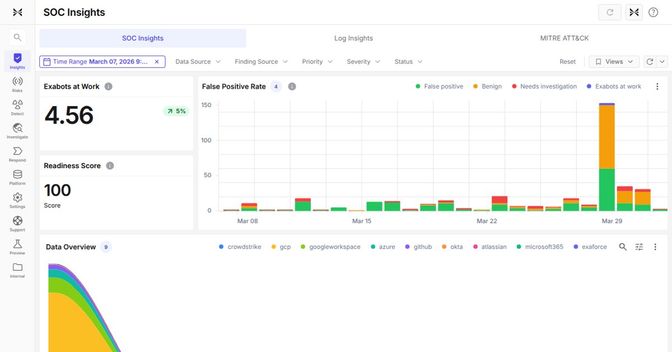
Exaforce is an agentic SOC platform with a data platform of its own. It ingests logs, identity data, configuration and code from 130+ sources, including Splunk itself during a transition, and resolves each event at ingest against a model of identities, resources and their relationships; its own detections run on that model. The Exabots, its AI agents, detect, triage, investigate and respond on the same context, with the reasoning shown on every verdict and the actions you choose gated for approval. With ExaU, teams build their own Exabots for the work specific to them. Customers report 90% fewer false positives and a 95% reduction in mean time to investigate, with an average of under 30 minutes from alert to response. Teams run it themselves or have Exaforce MDR run it. Many SIEM replacements deliver the same alerts into a different console; Exaforce changes what arrives, because the detections run on the model and the Exabots have worked the alert before an analyst sees it. See SIEM replacement with Exaforce and the Splunk integration for running alongside.
Google Security Operations
Google Security Operations is a cloud-native SIEM and SOAR built for very high volumes and long retention, with Google threat intelligence alongside. The fit is a team whose first problem is scale and retention term.
Microsoft Sentinel
Sentinel is Microsoft's cloud-native SIEM and SOAR in the Defender portal, priced per GB with a data lake tier. The fit is a Microsoft-centric estate. See Microsoft Sentinel alternatives.
CrowdStrike Falcon Next-Gen SIEM
Falcon Next-Gen SIEM extends the Falcon endpoint platform into log management and detection with Charlotte AI as the analyst. The fit is a team already standardized on Falcon. See CrowdStrike alternatives.
Elastic Security
Elastic Security is the SIEM built on Elasticsearch, self-managed or in Elastic Cloud, priced on the resources used rather than on ingest. The fit is an engineering-led team that already runs Elasticsearch and wants to own the stack.
Choosing the right option
- Mostly Microsoft: the native SIEM is the simple answer; check the ingest math.
- Ingest cost is the main problem: compare pricing models before features, including resource-based and platform pricing.
- Analyst time is the constraint: check how much investigation each platform completes on its own.
- You want fewer tools, not a different console: a platform with the data, the detections and the investigation together.
A short pilot run alongside Splunk, on your own alerts and data, will tell you more than any feature list. See the SIEM replacement guide for how to run it.
Frequently asked questions
What is the best Splunk alternative for security operations?
It depends on the problem: for ingest cost, a different pricing model; for scale and retention, a cloud-native SIEM; for analyst workload, a platform that completes the investigation. Exaforce is the option on this list that changes all three at once.
What is a cheaper alternative to Splunk?
Anything not priced on ingest can be cheaper at scale: resource-based (Elastic), platform-based (Exaforce), or per GB with a data lake tier (Sentinel). Compare on the data you would collect if the meter were not running.
Can Exaforce replace Splunk?
Yes. Exaforce has its own data platform and detections and is used as the SIEM replacement; teams usually run it alongside Splunk first and move sources in stages. See the SIEM replacement solution page.
What about Splunk SOAR?
Playbooks are the part most teams want to maintain least. See SOAR vs AI SOC for what replaces them and what stays.