Microsoft Sentinel and CrowdStrike Falcon Next-Gen SIEM appear in the same evaluation wherever Microsoft 365 runs alongside the Falcon agent, which is most enterprises. Both are cloud SIEMs with AI built in, and each is shaped by its parent ecosystem: Sentinel by Microsoft 365, Azure and Defender, Falcon by the endpoint. The two factors that usually decide the choice are ingest cost and how much triage is still done by hand. This page compares the two on ecosystem, AI layer, query language, pricing and fit, and says where Exaforce, which publishes it and ingests both vendors' telemetry, fits alongside them.
Microsoft Sentinel in brief
Sentinel is Microsoft's cloud-native SIEM and SOAR, now delivered through the Microsoft Defender portal; Microsoft has said it will no longer be supported in the Azure portal after March 31, 2027. Detections are written in KQL, response runs through playbooks, a data lake tier adds lower-cost long-term retention, and Security Copilot can work on Sentinel data. Pricing is per GB analyzed with commitment tiers. (As published by Microsoft, Nov 2026.)
CrowdStrike in brief
Falcon Next-Gen SIEM extends the Falcon endpoint platform into log management and detection. Charlotte AI, described by CrowdStrike as an agentic security analyst, and Charlotte Agentic SOAR for orchestration sit on the same platform, and queries use the Falcon query language. Licensing is module-based. (As published by CrowdStrike, Nov 2026.)
Microsoft Sentinel vs CrowdStrike side by side
The differences that matter
- Where identity and email live. Sentinel is stronger when identity, email and productivity data already sit in Microsoft, because that context is native. Falcon is strongest when the endpoint is where most investigations start.
- Assistance versus agent. Security Copilot assists an analyst working in the console; Charlotte AI is positioned as an agent that works the alert. Ask both to handle the same alert and show the reasoning.
- Ingest cost. Per-GB pricing makes every new source a budget line; module pricing makes the bill track the modules rather than the data. Model both on what you would collect if cost were not a constraint.
- Manual triage. On both, alerts from third-party sources are investigated by people unless something sits on top. Count how many of last month's alerts needed an analyst and ask each platform what changes.
Where Exaforce fits alongside Microsoft Sentinel and CrowdStrike
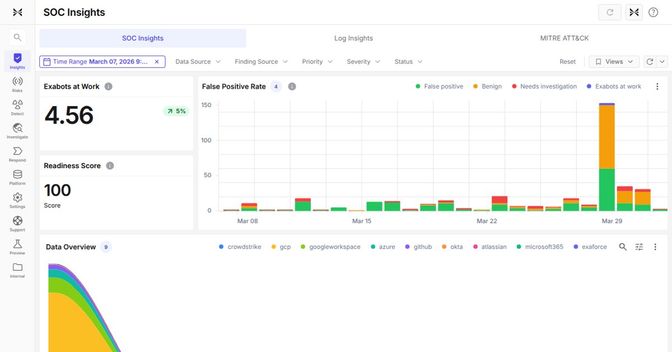
Exaforce is the third option for a team that runs both vendors, or neither on every surface: an agentic SOC platform with a data platform of its own that ingests Sentinel, Defender, Entra ID and Microsoft 365 telemetry and Falcon endpoint telemetry along with identity providers, cloud control planes and SaaS applications, and resolves each event at ingest against a model of identities, resources and their relationships; its own detections run on that model. The Exabots, its AI agents, detect, triage, investigate and respond on the same context, with the reasoning shown on every verdict and the actions you choose gated for approval. With ExaU, teams build their own Exabots for the work specific to them. Customers report 90% fewer false positives and a 95% reduction in mean time to investigate, with an average of under 30 minutes from alert to response. Teams run it themselves or have Exaforce MDR run it. Its data platform tiers storage so retention is not a pricing decision, and a team using both Microsoft and CrowdStrike gets one investigation across both rather than two consoles. It can replace the SIEM or run alongside either platform during a transition. See Microsoft Sentinel alternatives, CrowdStrike alternatives and SIEM augmentation.
Choosing between them
- Identify where your highest-value telemetry lives: Microsoft identity and email, or the endpoint.
- Model the full cost on the data you want to collect, not the data you collect today.
- Pilot both on your own data and count the alerts that still need a person.
- If the answer is "both ecosystems matter equally," evaluate a platform that treats both as sources.
Frequently asked questions
Is Microsoft Sentinel better than CrowdStrike?
For a Microsoft-centric organization, Sentinel has the native identity and email context. For a Falcon-first organization, Next-Gen SIEM has the native endpoint context. Ingest cost and manual triage usually decide it.
Can I use Sentinel and CrowdStrike together?
Yes. Falcon telemetry can be sent to Sentinel, and many enterprises run both. The question is which layer investigates across them.
What is the difference in pricing?
Sentinel is priced per GB analyzed with commitment tiers and a lower-cost data lake tier; CrowdStrike licenses by module. Compare on your own data volumes and the modules you need.
Does Exaforce replace Sentinel or CrowdStrike?
Exaforce can replace the SIEM role and ingests Falcon as an endpoint source; the Falcon agent stays. See the integration pages for Sentinel and CrowdStrike.